Hublot Big Bang
We currently have 4 Hublot Big Bang watches. Every piece is available to order, with prices on request.
4 watches
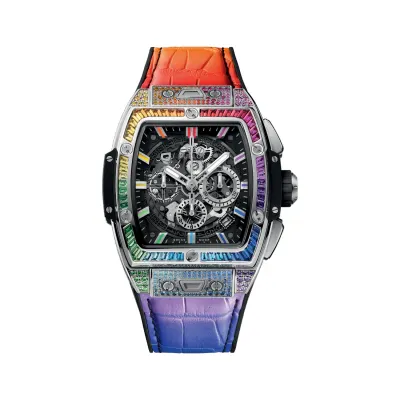
Hublot
Hublot Big Bang 42 mm
Titanium · skeleton dial
Ref. 642.NX.0117.LR.0999 · New
Price on request
Available to order

Hublot
Hublot Big Bang 42 mm
Titanium · rainbow dial
Ref. 441.NX.1117.LR.0999 · New
Price on request
Available to order
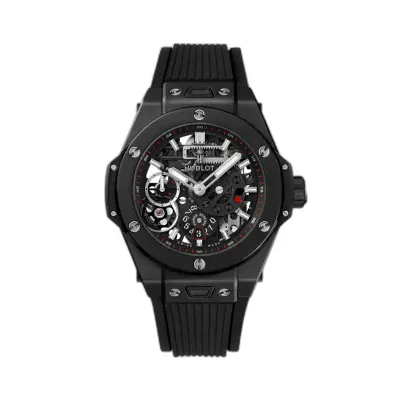
Hublot
Hublot Big Bang 45 mm
Ceramic · black dial
Ref. 414.CI.1123.RX · New
Price on request
Available to order
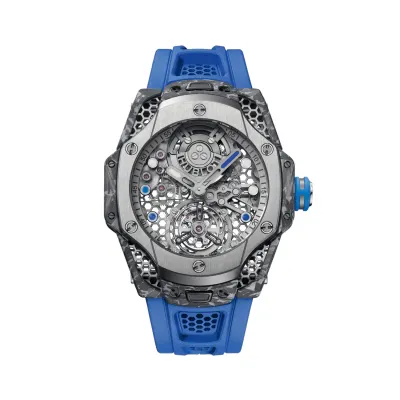
Hublot
Hublot Big Bang 44 mm
Titanium · transparent dial
Ref. 428.NQ.0100.RX.SRA24 · New
Price on request
Available to order
No watches match these filters
Try removing a filter, or ask us for the piece you are looking for.
What is the Hublot Big Bang?
The Big Bang is the chronograph Hublot unveiled at Baselworld 2005, with Jean-Claude Biver at the head of the brand. The original model is reference 301.SB.131.RX: 44.5 mm across, with a layered case that brought together metal, ceramic, rubber and fibreglass. The first versions, in steel or rose gold, had Kevlar side inserts, a ceramic bezel held by six H-shaped screws and a carbon dial. That same year it won a design prize at the Grand Prix d’Horlogerie de Genève. The round porthole shape comes from the first Hublot of 1980.
The variants: All Black, Unico, Integral and Meca-10
The first All Black, entirely in black, followed in 2006. In 2010 Hublot introduced the Unico, an automatic in-house chronograph with a flyback function, a column wheel visible from the dial side, a double clutch and 72 hours of power reserve. It has two counters, rather than the three of the original Big Bang. The Big Bang Unico started out at 45 mm and 15.45 mm thick; in 2018 it came down to 42 mm and 14.5 mm with the HUB1280, a slimmer version of the calibre. Many of these models use the One Click system for changing straps.
The Big Bang Integral followed in 2020, with an integrated bracelet, a 42 mm case and 100 m water resistance. Along the way the Big Bang has tried out many of the house materials: Magic Gold from 2011, sapphire from 2016, coloured ceramics, carbon and texalium, plus collaborations with Ferrari and with Sang Bleu, from the tattoo world. In 2025, for the 20th anniversary, Hublot presented the Big Bang Meca-10 at 42 mm and five limited editions at 43 mm with the HUB1280 calibre and a 22-carat gold rotor.
What to check when choosing a Big Bang
Size depends on the era: 44.5 mm for the 2005 original, 45 mm for the first Unico, 42 mm for the Unico from 2018 and for the Integral, and 43 mm for the anniversary editions. Then look at the calibre, since the Unico is easy to spot by the column wheel visible on the dial, and at the material, which on a Big Bang matters as much as the model.
Each listing shows the reference, the condition, the specifications and whether a certificate is included, and you can ask us for photos of the watch itself. To see the rest of the brand, browse all our Hublot watches and the quieter Hublot Classic Fusion collection. And if the Big Bang you want is not listed, you can request a model.
Questions about Hublot Big Bang
What is the Big Bang Unico?
It is the Big Bang fitted with the Unico, the automatic in-house chronograph Hublot introduced in 2010. It has a flyback function, a column wheel visible from the dial side, a double clutch and 72 hours of power reserve. The first Big Bang Unico measured 45 mm; a 42 mm version followed in 2018 thanks to the HUB1280, a 1.3 mm slimmer version of the calibre.
What does “All Black” mean on a Hublot?
It is the monochrome version of the Big Bang, black from top to bottom. The first one arrived in 2006, a year after the original Big Bang, and the brand has returned to the idea several times since, including one of the 20th anniversary editions released in 2025.
What is the Big Bang Integral?
It is the Big Bang with an integrated bracelet, launched in 2020. It measures 42 mm across and 13.45 mm thick, is water resistant to 100 m and was offered in titanium, King Gold or black ceramic. It runs on the Unico HUB1280 calibre, with a column wheel, a flyback function and around 72 hours of power reserve.