Hublot watches
Our Hublot selection currently includes 7 watches (Big Bang and Classic Fusion). Every piece is available to order, with prices on request. If you are looking for another Hublot model, request it and we will tell you whether we can source it.
7 watches
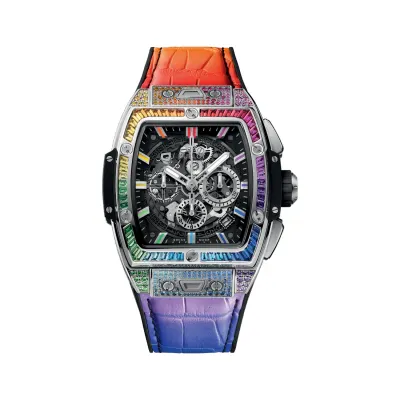
Hublot
Hublot Big Bang 42 mm
Titanium · skeleton dial
Ref. 642.NX.0117.LR.0999 · New
Price on request
Available to order
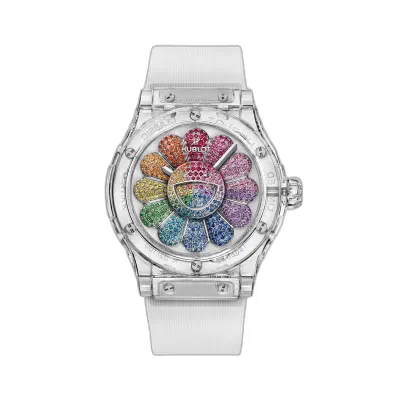 Pre-owned
Hublot
Hublot Classic Fusion 45 mm
Sapphire · rainbow dial
Ref. 507.JX.0800.RT.TAK21 · Pre-owned
Price on request
Available to order
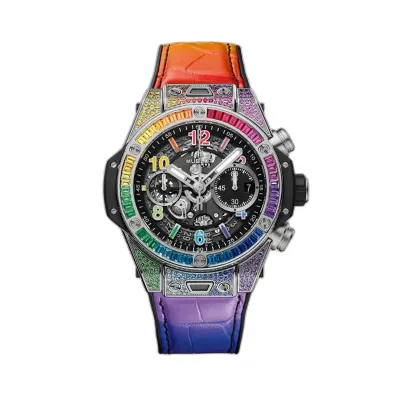
Hublot
Hublot Big Bang 42 mm
Titanium · rainbow dial
Ref. 441.NX.1117.LR.0999 · New
Price on request
Available to order
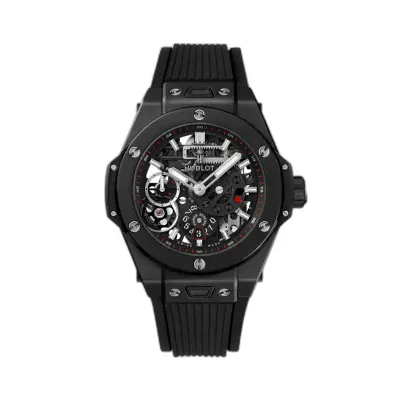
Hublot
Hublot Big Bang 45 mm
Ceramic · black dial
Ref. 414.CI.1123.RX · New
Price on request
Available to order
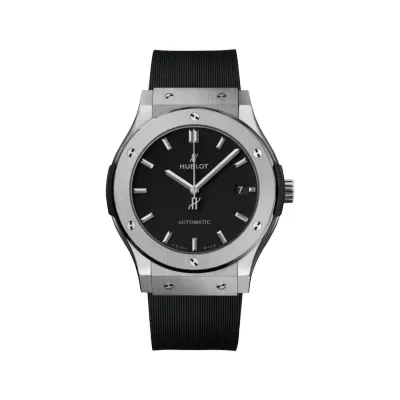
Hublot
Hublot Classic Fusion 45 mm
Titanium and resin · black dial
Ref. 511.NX.1171.RX · New
Price on request
Available to order
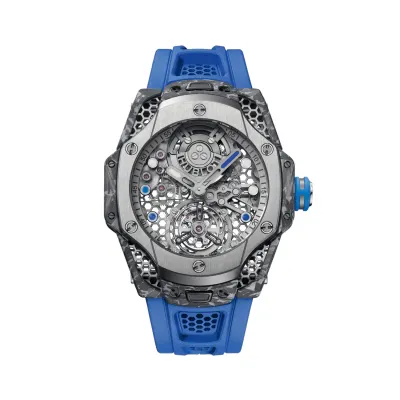
Hublot
Hublot Big Bang 44 mm
Titanium · transparent dial
Ref. 428.NQ.0100.RX.SRA24 · New
Price on request
Available to order
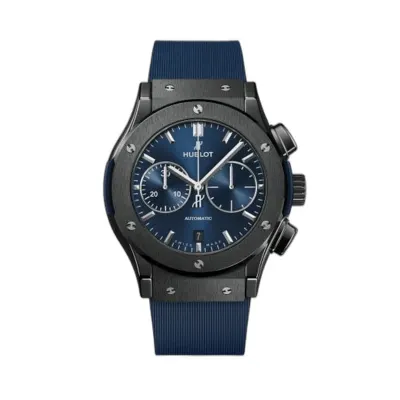
Hublot
Hublot Classic Fusion 45 mm
Titanium, ceramic and resin · blue dial
Ref. 521.CM.7170.RX · New
Price on request
Available to order
No watches match these filters
Try removing a filter, or ask us for the piece you are looking for.
A gold watch on a rubber strap
Hublot was born in 1980, when Carlo Crocco presented a gold watch on a rubber strap, with a quartz movement, at the Basel fair. His company was called MDM, short for “Montre des Montres”, and Hublot, French for “porthole”, was the name of the model: its round bezel, with twelve exposed screws, recalled a ship’s window. In the middle of the quartz crisis, pairing gold with rubber was an unexpected choice for a luxury watch.
The Art of Fusion and the Big Bang
Jean-Claude Biver arrived as chief executive in 2004 and gave that mix a name: the “Art of Fusion”, bringing together materials that rarely meet. At Baselworld 2005 the brand unveiled the Big Bang, a 44.5 mm chronograph combining metal, ceramic, rubber and fibreglass, which won a design prize at the Grand Prix d’Horlogerie de Genève that same year. In 2008 LVMH bought Hublot, and in 2009 the brand built its first manufacture in Nyon.
Since then it has added its own calibres and materials. The Unico, its in-house chronograph, arrived in 2010; Magic Gold, an alloy of gold and ceramic, in 2011; the sapphire-cased Big Bang in 2016; and a red ceramic developed in-house in 2018.
Big Bang, Classic Fusion and the rest of the range
The Hublot Big Bang covers the 2005 chronograph and its offshoots, from the Unico to the Big Bang Integral, which added an integrated bracelet in 2020. The Hublot Classic Fusion keeps the round porthole case of the 1980 model in a quieter register, in sizes from 33 to 45 mm, and in 2026 Hublot brought back the original design in gold with the Classic Fusion Tributo. In 2014 the brand also introduced the Spirit of Big Bang, with a tonneau case. To place Hublot among the other houses, see our guide to luxury watch brands.
What to look at in a Hublot
Because of the Art of Fusion, material matters as much as model at Hublot: the same Big Bang has been made in titanium, King Gold, ceramic, Magic Gold or sapphire. Water resistance varies too, from 50 m on a 45 mm Classic Fusion to 100 m on a Big Bang Integral.
Each listing shows the reference, the condition, the specifications and whether a certificate is included. The image is the reference picture for the model, so you can ask us for photos of the watch itself. If the Hublot you want is not listed, you can request a model.
Questions about Hublot
What does Hublot mean?
It is French for “porthole”. It was the name of the first model Carlo Crocco presented in 1980, whose round bezel with twelve exposed screws recalled a ship’s window. The company was then called MDM, short for “Montre des Montres”, and the name of the watch eventually became the name of the brand.
What is Hublot’s “Art of Fusion”?
It is the idea Hublot uses to sum up its approach: bringing together materials that rarely share a watch. It began with the gold and rubber of the 1980 model, and Jean-Claude Biver gave it a name after joining the brand in 2004. The 2005 Big Bang took it further, with metal, ceramic, rubber and fibreglass in the same case.
What is Magic Gold?
It is an 18-carat gold alloy that Hublot introduced in 2011 and patented, in which gold is combined with boron carbide, an extremely hard ceramic. The brand presented it as the first scratch-resistant 18-carat gold. It is one of its own materials, alongside its coloured ceramics, and it appears in some versions of the Big Bang.
Hublot guides
All articles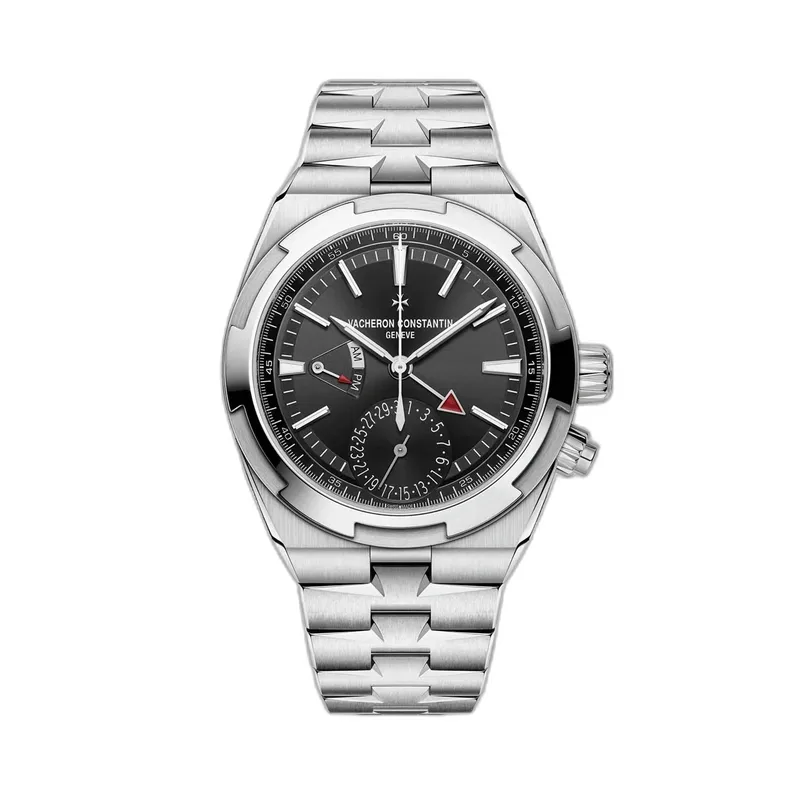
Luxury Watch Brands: A Guide to the Great Houses
Rolex, Patek Philippe, Audemars Piguet, Vacheron Constantin, A. Lange & Söhne, Richard Mille and more: origins, key collections and what sets each apart.