Patek Philippe Calatrava Guide: Models and References
From the 1932 Ref. 96 to today’s Calatrava: what defines the collection, sizes, manual or automatic winding, dial finishes and how to read its references.
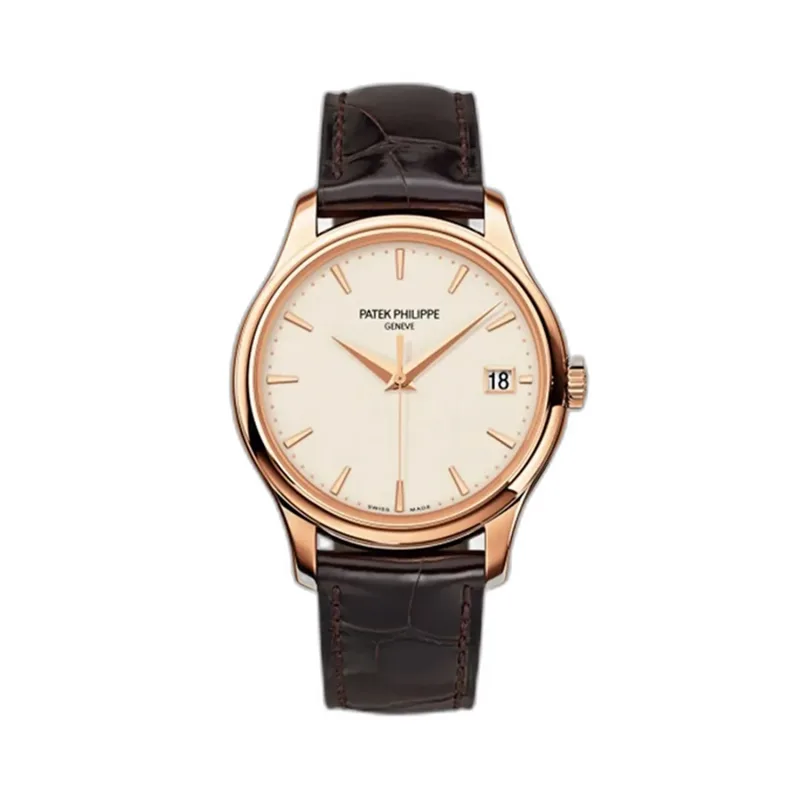
The Calatrava is Patek Philippe’s collection of plain, round watches: a circular case, an uncluttered dial and, almost always, a leather strap. It began in 1932 with the Ref. 96, and today it includes hand-wound and self-winding models (the current ones we checked measure 34.6 to 40 mm), with smooth bezels or the “Clous de Paris” guilloché. What sets each version apart is its size, its winding and the work on the dial, and that is what this guide covers.
What is the Patek Philippe Calatrava?
1932: the Ref. 96 and the idea that function dictates form
In 1932 the brothers Jean and Charles Henri Stern took control of Patek Philippe and, the same year, the brand introduced the Ref. 96. Patek Philippe regards it as the first Calatrava and points out that it was also the firm’s first model with a reference number. It was a 31 mm hand-wound watch with small seconds, and it stayed in production for more than forty years, until 1973.
The brand explains its design through the Bauhaus principle that function determines the form of an object. That is why the Ref. 96 has no ornament: a round case, slightly curved lugs, applied hour markers and dauphine hands. The collection still follows the same approach.
There is a nuance about the name. According to Sotheby’s, “Calatrava” was not used as the watch’s name while the Ref. 96 was in production: collectors apply it retrospectively. Patek Philippe, for its part, dates the collection that now carries the name to 1932.
The Calatrava cross, the brand’s emblem
The name comes from the Calatrava cross, Patek Philippe’s symbol. According to Monochrome, it refers to the knights of Calatrava, who defended the fortress of that name in 1158. The brand officially registered it as a trademark on 27 April 1887 and says it had already appeared on its watches since the 1870s. Since the 1960s it has become more prominent: today it sits on the crown, on the rotor of the automatic calibres and on the fold-over clasp.
Patek Philippe admits that nobody knows for certain why Adrien Philippe chose the emblem. It suggests one possible explanation: the four lilies of the cross recall the fleur-de-lis of the French royal arms, and three lilies adorn the coat of arms of Eure-et-Loir, where Philippe was born.
The collection’s hallmarks: round case, sober dial, smooth or Clous de Paris bezel
Patek Philippe describes the Calatrava as the quintessential round wristwatch. In practice that means a set of traits found across almost the whole collection:
- A round, slim case. The current models we checked measure between 7.37 and 9.33 mm thick.
- An uncluttered dial. Hours and minutes and, depending on the model, small or central seconds and a date at 3 o’clock.
- A leather strap, with a buckle in the same metal as the case.
- 30 m water resistance on every current product page we consulted.
- A smooth or Clous de Paris bezel. Clous de Paris is a guilloché made of tiny diamond-polished pyramids. Patek Philippe records it on a Calatrava as early as 1934, on the Ref. 96D (D for décor), and the Ref. 3919 of 1985, with that bezel, was made for around twenty years.
The Clous de Paris line has a genealogy of its own. The 33.5 mm Ref. 3919 was followed in 2006 by the 36 mm Ref. 5119, both with the hand-wound calibre 215 PS. According to Patek Philippe, from 2018 the motif was absent from the regular collection, apart from some rare handcrafts editions, until it returned in 2021 with the 6119.
Calatrava sizes and current models
This table brings together the current Calatravas whose product pages we have checked on patek.com. It is not the full collection: the brand also offers an eight-day Calatrava, the 5328G, introduced in 2025, and versions with further complications.
| Reference | Size | Thickness | Metal | Winding | Calibre | Key feature |
|---|---|---|---|---|---|---|
| 7200/50G-001 | 34.6 mm | 7.37 mm | White gold | Automatic | 240 | Breguet numerals, introduced 2026 |
| 6196P-001 | 38 mm | 9.33 mm | Platinum | Manual | 30-255 PS | Successor to the 5196, introduced 2025 |
| 6119R-001 / 6119G-001 | 39 mm | 8.08 mm | Rose gold / white gold | Manual | 30-255 PS | Clous de Paris bezel, introduced 2021 |
| 5226G-001 | 40 mm | 8.53 mm | White gold | Automatic | 26-330 S C | Clous de Paris caseband, introduced 2022 |
| 6007G-010 | 40 mm | 9.17 mm | White gold | Automatic | 26-330 S C | “Carbon” motif dial, introduced 2023 |
Sizes run from the 31 mm of the Ref. 96 to 40 mm among the current models we checked. The growth shows clearly in the Clous de Paris line: 33.5 mm for the 3919, 36 mm for the 5119 and 39 mm for the 6119. Patek Philippe says the 6119 is larger to reflect today’s preferences without losing the slender profile of the case.
Manual or automatic Calatrava
A Calatrava can be hand-wound, like the Ref. 96, or self-winding, like the Ref. 2526 of 1953, Patek Philippe’s first automatic wristwatch according to the brand. Both kinds sit side by side in the collection. If you want to understand how each one works, what power reserve means and how they differ from a quartz watch, read our guide to automatic, manual and quartz watches.
Hand-wound Calatravas (6196P and 6119)
The 6119 and the 6196P use calibre 30-255 PS, which Patek Philippe introduced in 2021 with the 6119. Its details, according to the brand’s press release:
- 31 mm across and 2.55 mm high. Much wider than the 215 PS (21.9 mm) used in earlier hand-wound Calatravas, at the same height.
- Two barrels in parallel. They are not linked in series to stretch the power reserve; they add their torque together. That allowed the brand to fit a balance with twice the moment of inertia.
- 65 hours of power reserve, nearly three days.
- Stop seconds. Pulling the crown stops the balance, so the time can be set to the second.
- Six bridges, one for each wheel or function, with Geneva striping and chamfered, polished edges, visible through the sapphire case back.
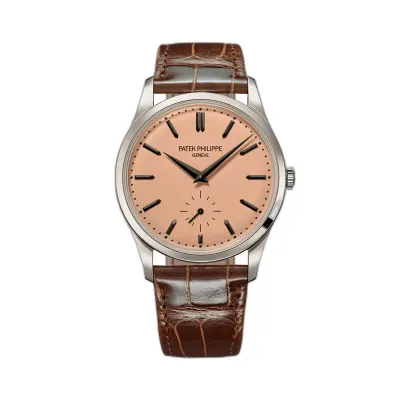
The 6119, at 39 mm, brings back the Clous de Paris bezel and replaces the Roman numerals of the 3919 and 5119 with applied faceted “obus” markers, like those of the Ref. 96. The rose gold version (6119R-001) has a silvery grained dial, and the white gold one (6119G-001) a charcoal grey dial with a vertical satin finish.
The 6196P-001, 38 mm in platinum, succeeds the 5196, the hand-wound Calatrava introduced in 2004 with a case and dial inspired by the Ref. 96. It has a rose-gilt opaline dial, charcoal grey markers and hands, and a diamond set in the case at 6 o’clock. Monochrome notes that the main improvement over the 5196 lies in the calibre: a longer power reserve and stop seconds.
Automatic Calatravas (5227 and others)
The automatic Calatravas mentioned in this guide use one of two calibres:
- 26-330 S C. A central 21-carat gold rotor, a date window and central seconds, 4 Hz and between 35 and 45 hours of power reserve. It powers the 5226G and the 6007G, and also the 5227 according to its patek.com pages, now marked as discontinued.
- 240. An ultra-thin calibre 2.53 mm high, with an off-centre 22-carat gold micro-rotor, smaller than a central rotor. It beats at 3 Hz and has a minimum power reserve of 48 hours. You will find it in the 7200/50G, and also in the now-discontinued 4997/200 and 5088/100P. Patek Philippe notes that when it was released in 1977 it was the thinnest self-winding movement of its time.
Dials and decoration: lacquer, guilloché and hand engraving
In a watch so simple in shape, the dial carries much of the craft. According to Monochrome, the family of the Stern brothers, who took control of the company in 1932, owned a dial maker that already supplied Patek Philippe, Cadrans Stern Frères. These are the techniques found on the Calatravas mentioned in this guide:
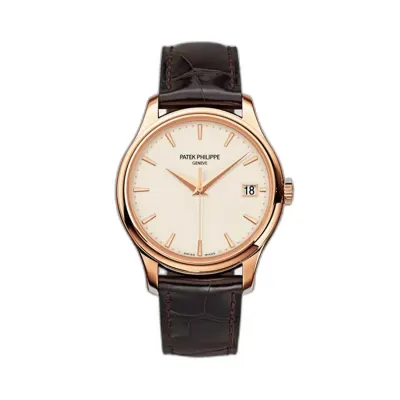
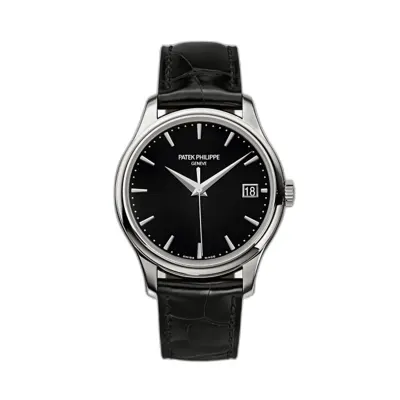
- Lacquer. The 5227R-001 has an ivory lacquered dial and the 5227G-010 a black lacquered one. On the 4997/200G, the dial plate is first embossed with a concentric wave motif and then coated with dozens of layers of translucent midnight blue lacquer, which gives a sense of depth; the 4997/200R has an embossed dial lacquered in purple.
- Clous de Paris guilloché. On the bezel of the 6119 and on the caseband of the 5226G.
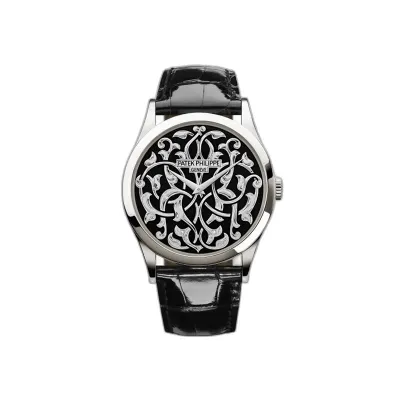
- Hand engraving and enamel. The 5088/100P-001 has an 18-carat gold dial hand-engraved with scrolls and arabesques and enamelled in black, and the case flanks are engraved and enamelled too (champlevé enamel).
- Rare handcrafts. The 5077/100G belongs to the brand’s Rare Handcrafts line. On patek.com, the 5077/100G-080 has a champlevé and paillonné enamel dial, a 38 mm white gold case with diamonds on the bezel and lugs, and the self-winding calibre 240.
The 5227’s hinged dust cover
The 5227 was unveiled at Baselworld 2013 and revisits a classic Calatrava idea: the officer’s-style case, with a cover over the back. Beneath that cover is a sapphire case back that shows the movement. The twist, according to the brand’s press release, is that the hinge sits inside the cover, so it cannot be seen while the watch is worn: it appears only when the cover is opened, for instance to read an engraved dedication.
Other details from the 2013 press release:
- A 39 mm case with a concave bezel and curved lugs with flutes that run down from the case flank, polished by hand.
- 9.24 mm thick measured to the dust cover, despite the double back.
- A cream lacquered dial, applied trapezoidal gold markers, faceted dauphine hands and a date at 3 o’clock in a gold frame.
- Calibre 324 S C at launch, with 38 to 48 hours of power reserve. The current product pages on patek.com list the 26-330 S C.
- Three golds in 2013: yellow, white and rose.
Patek Philippe now marks the 5227R-001 and the 5227G-010 as discontinued on its website.
The Patek Philippe Seal
Mechanical Calatravas carry the Patek Philippe Seal, created in 2009 by Philippe and Thierry Stern. According to the brand:
- It applies to the whole watch, not just the movement: case, dial, hands and every other external component.
- Accuracy. The rate is checked at every stage, from the uncased movement to the finished watch, and the brand’s current website sets a maximum deviation of −1/+2 seconds every 24 hours. In 2021 the 6119 press release quoted −3/+2 seconds for calibre 30-255 PS.
- Inspections. Finished movements undergo tests lasting up to thirty days.
- Mandatory finishing. The upper side of every bridge decorated, with polished chamfers; an oscillating weight in precious metal and decorated; natural gemstones, never glued.
The Seal’s symbol, a double P, is inspired by the initials engraved on the rotor of the brand’s first automatic calibre, the 12-600 AT. Before creating its own Seal, the brand used the Geneva Seal: it is the hallmark listed, for example, in the technical data of the 2007 Aquanaut press release.
How to read a Calatrava reference number
The 4997/200R-001 reads like this:
- Four digits (4997). Identify the model.
- Slash and digits (/200). Mark a variant of the model, with no single rule among the Calatravas we checked: the 4997/200 has a gem-set bezel, the 5088/100P a hand-engraved dial and the 7200/50G Breguet numerals.
- Letter (R). The metal: R for rose gold, G for white gold and P for platinum.
- Three digits after the hyphen (-001). Distinguish versions of the same reference, for example by dial colour, as with the Nautilus 5711/1A-014 (olive green) and 5711/1A-018 (Tiffany blue).
Calibre names can be read too. In the 30-255 PS, according to the brand, the 255 reflects the movement’s 2.55 mm height, and the letters summarise functions: on the product pages, PS goes with small seconds and S C with central seconds and a date. These are observations on the published pages, not a complete official key. We explain the system with more examples in how to read watch reference numbers.
Calatrava references in our catalogue
These are the Calatrava references currently in our catalogue, with the details from their patek.com pages.
| Reference | Size | Metal | Winding and calibre | Dial | On patek.com |
|---|---|---|---|---|---|
| 4997/200R-001 | 35 mm | Rose gold, bezel with 76 diamonds | Automatic, 240 | Purple lacquer with wave motif | Discontinued |
| 4997/200G-001 | 35 mm | White gold, bezel with 76 diamonds | Automatic, 240 | Midnight blue lacquer with wave motif | Discontinued |
| 5088/100P-001 | 38 mm | Platinum | Automatic, 240 | Hand-engraved, black enamel | Discontinued |
| 6196P-001 | 38 mm | Platinum | Manual, 30-255 PS | Rose-gilt opaline | Current |
| 5227R-001 | 39 mm | Rose gold | Automatic, 26-330 S C | Ivory lacquer | Discontinued |
| 5227G-010 | 39 mm | White gold | Automatic, 26-330 S C | Black lacquer | Discontinued |
There are also two Calatrava 5077/100G watches from the rare handcrafts line. We have not found their full references on patek.com, so we will confirm the details of each piece before you buy.
All of them are in our Patek Philippe Calatrava collection, with price on request and available to order. If you would like a closer look at a piece, we can send you photos; and if the reference you want is not there, you can request a specific model. The brand’s other collections are on our Patek Philippe watches page.
Calatrava vs Nautilus and Aquanaut
The three collections answer different needs rather than forming a ladder from good to better:
| Calatrava | Nautilus | Aquanaut | |
|---|---|---|---|
| Origin | 1932, Ref. 96 | 1976, Ref. 3700/1A | 1997 |
| Case | Round | Rounded octagonal bezel with side “hinges” | Rounded octagonal case and bezel |
| Dial | Plain, lacquered, guilloché or engraved | Horizontal embossing | Embossed checkerboard |
| Fastening | Leather strap | Metal bracelet on many references | Composite strap |
| Metals on the pages cited | Gold and platinum | Steel, gold and platinum | Steel and gold |
The Nautilus is the steel sports watch Patek Philippe launched in 1976; we cover it in our Patek Philippe Nautilus guide. The Aquanaut, from 1997, takes that case as its starting point and pairs it with a composite strap; see our Patek Philippe Aquanaut guide. The Calatrava is the most classical of the three and the one Patek Philippe links to the Bauhaus principle that form follows function.
Frequently asked questions
Where does the name Calatrava come from?
From the Calatrava cross, Patek Philippe’s emblem, which refers to the Order of Calatrava, whose knights defended the fortress of that name in 1158. The brand registered it on 27 April 1887 and uses it on crowns, rotors and clasps. The collection of round watches that now carries the name begins, according to the brand, with the Ref. 96 of 1932.
What is the Patek Philippe Seal?
Patek Philippe’s own quality standard, created in 2009 by Philippe and Thierry Stern. It applies to all the brand’s mechanical watches and covers the whole watch, not just the movement. According to the brand’s current website it sets a maximum rate deviation of −1/+2 seconds a day, with checks at every stage of production and finishing rules for bridges, rotors and gem-setting.
Should I choose a manual or an automatic Calatrava?
It depends on how you wear it. A hand-wound model, such as the 6119 or the 6196P, needs winding by hand every few days (its 65-hour reserve lasts nearly three), and in return shows a calibre with no rotor. An automatic winds itself as you move your wrist; in the current collection it comes with a date and central seconds (5226G, 6007G) or with the ultra-thin micro-rotor calibre 240 (7200/50G).
What is the difference between the 5227 and the 6119?
Both measure 39 mm, but they follow different ideas: the 5227, now discontinued, is automatic, with a date and a hinged cover over its sapphire back; the 6119 is hand-wound, with small seconds and the Clous de Paris guilloché bezel.
| 5227 | 6119 | |
|---|---|---|
| Introduced | 2013 | 2021 |
| Size | 39 mm | 39 mm |
| Winding | Automatic | Manual |
| Dial | Lacquered, date at 3 o’clock | Small seconds at 6 o’clock |
| Bezel | Smooth, concave | Clous de Paris |
| Case back | Sapphire under a cover with a hidden hinge | Sapphire |
What is Clous de Paris?
A guilloché pattern made of tiny diamond-polished pyramids, often called “hobnail” in English. On the Calatrava it has appeared on the bezel since the Ref. 96D of 1934, and it defines the line of the 3919, the 5119 and today’s 6119. The 5226G carries it on the side of the case rather than on the bezel.
What sizes does the Calatrava come in?
Among the current models we checked, from 34.6 mm (7200/50G) to 40 mm (5226G and 6007G), with 38 mm (6196P) and 39 mm (6119) in between. Our catalogue also includes discontinued models at 35 mm (4997/200), 38 mm (5088/100P) and 39 mm (5227). The original Ref. 96 measured 31 mm.
Sources
- Patek Philippe, Calatrava collection (opens in a new window)
- Patek Philippe, “The Calatrava Cross” (opens in a new window)
- Patek Philippe, “The Patek Philippe Seal” (opens in a new window)
- Patek Philippe, manufacture movements (opens in a new window)
- Patek Philippe, calibre 30-255 (opens in a new window)
- Patek Philippe, “The Finest Timepieces in the World” (calibre 240) (opens in a new window)
- Patek Philippe, Aquanaut tenth anniversary press release (July 2007, PDF) (opens in a new window)
- Patek Philippe, Calatrava “Clous de Paris” 6119 press release (April 2021, PDF) (opens in a new window)
- Patek Philippe, Calatrava 5227 press release (April 2013, PDF) (opens in a new window)
- Patek Philippe, 6119G-001 product page (opens in a new window)
- Patek Philippe, 6119R-001 product page (opens in a new window)
- Patek Philippe, 6196P-001 product page (opens in a new window)
- Patek Philippe, 5227R-001 product page (opens in a new window)
- Patek Philippe, 5227G-010 product page (opens in a new window)
- Patek Philippe, 4997/200R-001 product page (opens in a new window)
- Patek Philippe, 4997/200G-001 product page (opens in a new window)
- Patek Philippe, 5088/100P-001 product page (opens in a new window)
- Patek Philippe, 5226G-001 product page (opens in a new window)
- Patek Philippe, 6007G-010 product page (opens in a new window)
- Patek Philippe, 7200/50G-001 product page (opens in a new window)
- Patek Philippe, 5077/100G-080 product page (Rare Handcrafts) (opens in a new window)
- Monochrome, “History of the Patek Philippe Calatrava, Part 1 – Reference 96” (opens in a new window)
- Monochrome, Calatrava 6196P, the hand-wound successor to the 5196 (opens in a new window)
- Sotheby’s, “The Complete Collector’s Guide to the Patek Philippe Calatrava” (opens in a new window)