Automatic, Manual or Quartz Watch: How Each One Works
What an automatic watch is and how it differs from a manual-wind or quartz watch: how each movement works, power reserve, accuracy and COSC certification.
Manual-wind and automatic watches are both mechanical: each stores energy in a spring and keeps time with a balance wheel that swings back and forth a few times a second. The difference lies in how that spring is wound: on a manual watch you turn the crown, while on an automatic a rotor driven by the movement of your wrist does the job. A quartz watch works differently: its energy comes from a battery, and the beat is set by a quartz crystal vibrating thousands of times a second (32,768 in Patek Philippe’s E23-250 calibre).
Automatic vs manual-wind vs quartz at a glance
| Manual winding | Automatic | Quartz | |
|---|---|---|---|
| Energy source | Mainspring, wound by turning the crown | Mainspring, wound by a rotor as the wrist moves (and by the crown) | Battery |
| What keeps time | Balance and balance spring, usually between 2.5 and 5 Hz | Balance and balance spring, usually between 2.5 and 5 Hz | Quartz crystal, at 32,768 Hz in Patek Philippe’s E23-250 |
| Reference accuracy | A COSC chronometer must stay within −4 and +6 seconds a day | The same COSC standard; some brands demand more (see below) | COSC also certifies quartz, with its own requirements |
| What you need to do | Wind it before the power reserve runs out | Wear it, or wind it if it has stopped | Replace the battery when it runs down |
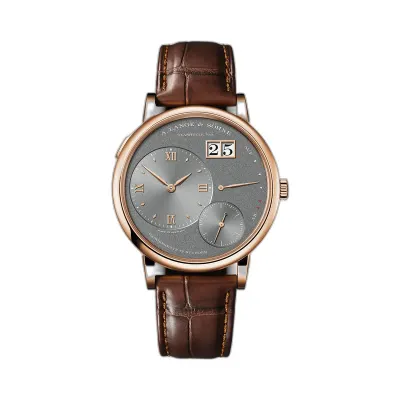
| Examples in our catalogue | Patek Philippe Calatrava 6196P, A. Lange & Söhne Grand Lange 1 | Rolex Oyster Perpetual, Patek Philippe Calatrava 4997/200, Audemars Piguet Royal Oak 26735ST | Patek Philippe Aquanaut Luce 5267/200A and 5269/200R |
What is a watch movement, or calibre?
The movement, or calibre, is the set of parts that displays the time and any other information on a watch. Horopedia, an online watchmaking encyclopaedia, divides today’s movements into two broad families: mechanical and electronic. A mechanical movement can be broken down into four functions.
Barrel and mainspring: the energy
The barrel is the power source. Inside it sits the mainspring, a long strip of steel coiled around an arbor. Winding tightens the spring; as it relaxes, it releases that energy little by little.
Between the barrel and the regulating organ is the gear train, which carries the energy onward and divides the motion so that each hand moves at the right speed. According to Horopedia, the fourth wheel turns once a minute and the centre wheel once an hour.
Balance and balance spring: the regulating organ
If the mainspring were released all at once, the watch would run down in seconds. The regulating organ prevents that: a balance, a wheel weighted at its rim, attached to a very fine balance spring. Together they oscillate back and forth at a steady rate, like a pocket-sized pendulum, and each swing lets the gear train advance one step.
Some brands now use silicon balance springs, a material Monochrome describes as antimagnetic. Rolex fits one, the Syloxi, to its calibre 2232, and Tudor uses them in its manufacture calibres.
Escapement and frequency
The escapement is the link between the gear train and the balance. It locks the train while the balance swings and releases it at regular intervals, giving the balance a small push each time so that it keeps going. In the Swiss lever escapement, the main parts are the escape wheel, the lever and the double roller.
Frequency is the number of oscillations per second. According to Horopedia, the regulating organs of mechanical watches generally oscillate between 2.5 and 5 Hz, and the higher the frequency, the more precise the watch. Brands sometimes give it in semi-oscillations per hour: 21,600 equals 3 Hz and 28,800 equals 4 Hz.
Manual-wind watches
Patek Philippe defines them simply: the movement is powered by turning the crown by hand, after which the mainspring slowly unwinds and drives the gears. There is no rotor, so if you do not wind it, the watch stops when the power reserve runs out.
How and when to wind a manual watch
Turn the crown in its first, resting position. On watches with a screw-down crown, unscrew it first. How often depends on each calibre’s power reserve:
- Patek Philippe 30-255 PS (Calatrava 6119 and 6196P): at least 65 hours, nearly three days.
- A. Lange & Söhne L095.1 (Grand Lange 1, 137.033): 72 hours.
Some hand-wound watches show on the dial how much power is left. The Grand Lange 1, for example, does so with a power reserve indicator.
Why some houses still make them
Patek Philippe says hand-wound movements are highly valued by enthusiasts of traditional watchmaking. There are technical and aesthetic reasons:
- Slimness. Without a rotor, the calibre can be thinner. Patek Philippe’s 30-255 PS is 2.55 mm high, and the 6119 case that houses it is 8.08 mm.
- A view of the movement. Without a rotor, a sapphire case back shows every bridge. On the 30-255 PS there are six, one for each wheel or function, decorated with Geneva striping and polished edges.
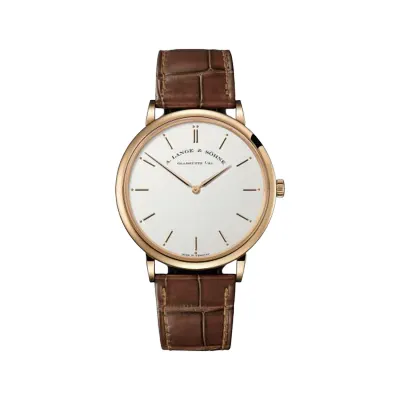
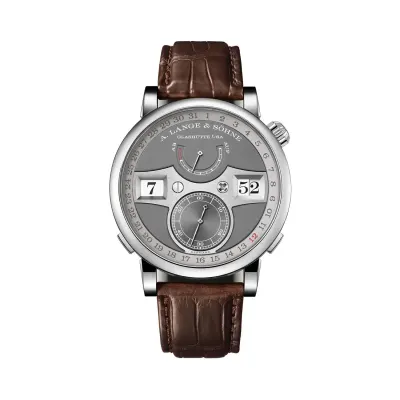
Our catalogue includes both examples: the platinum Patek Philippe 6196P in our Patek Philippe Calatrava collection (the collection itself is covered in our Patek Philippe Calatrava guide), and the Grand Lange 1 among our A. Lange & Söhne watches. A single family can include both manual and automatic models, so it pays to check the product page for each reference.
What is an automatic watch?
How does an automatic watch work?
An automatic watch is a mechanical watch that winds itself. According to Patek Philippe, the mainspring is wound by a rotor powered by the motion of the wrist. The rotor is a weight that turns above the movement and, as it does so, passes energy to the barrel through a set of gears. Patek Philippe makes its rotors in 21- or 22-carat gold, because the high density of the precious metal makes better use of the wearer’s movement.
A rotor can wind in one direction of rotation or in both. Patek Philippe’s press releases describe unidirectional winding rotors, while Tudor’s calibres have a bidirectional rotor, according to Monochrome. Both systems work; they are design choices made by each brand.
Many automatics can also be wound by hand through the crown, which is useful once the watch has stopped; Patek Philippe’s technical data sheets, for example, list it among the crown’s functions.
A short history: from the first mechanisms to Rolex’s Perpetual rotor
Who invented the automatic watch is a disputed question. This is what Monochrome and Worldtempus record:
- 1777–1778. In 1777 Horace-Bénédict de Saussure referred to a “Monsieur Perlet” as the inventor of watches that wind themselves, in a vague description. In 1778 the Liège watchmaker Hubert Sarton presented a mechanism with a central rotor to the Academy of Sciences in Paris, the best documented of the period. Worldtempus credits the rotating weight to Sarton or to Abraham-Louis Perrelet, without being able to choose between them.
- Late 18th century. Abraham-Louis Breguet made his “perpétuelles”, with a weight that swings through an arc rather than turning.
- 1923. John Harwood filed a Swiss patent for an automatic wristwatch with a pivoting weight and spring buffers; it went on sale in 1926.
- 1931. Rolex introduced calibre 620 NA Rolex Perpetual, with a central rotor that turns through 360 degrees and could also be wound by hand.
- 1942. Felsa’s Bidynator calibre was the first with a free central rotor winding in both directions.
- 1953. The Patek Philippe Ref. 2526 was the brand’s first automatic wristwatch, according to Patek Philippe.
Micro-rotor
Instead of a rotor that covers the whole movement, some calibres have a small rotor set into the movement itself, level with the bridges. That allows a thinner calibre. According to Monochrome, Büren patented the first micro-rotor movements in 1954.
An example from our catalogue is Patek Philippe’s calibre 240, used in the Calatrava 4997/200 and the 5088/100P. It is 2.53 mm high, with an off-centre 22-carat gold micro-rotor and at least 48 hours of power reserve. Patek Philippe notes that when it was released in 1977 it was the thinnest self-winding movement of its time.
What happens if you do not wear it?
If an automatic is not worn, the rotor does not turn, and the watch keeps running until the power reserve is used up. Then it stops. To restart it, wind it with the crown, or simply wear it, and set the time and, if it has one, the date.
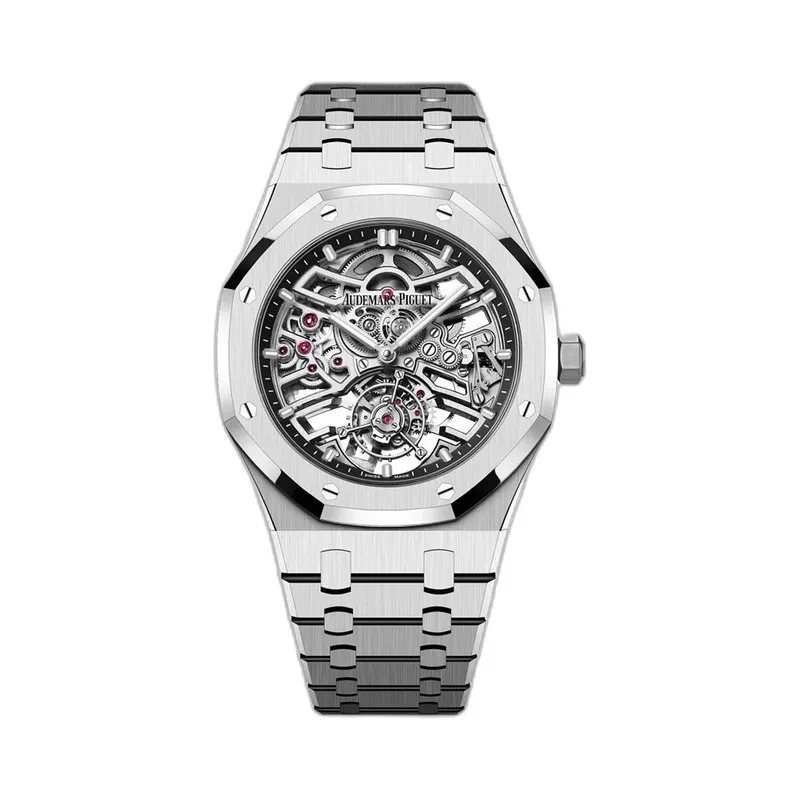
The watch pictured, the Audemars Piguet Royal Oak 26735ST, is an automatic that shows its entire mechanism: an openworked dial and calibre 2972 with a flying tourbillon, beating at 3 Hz with 65 hours of power reserve, according to Monochrome.
What is a quartz watch?
How it works: quartz crystal, circuit and motor
A quartz watch has no mainspring and no balance. A battery powers an electronic circuit that makes a small quartz crystal vibrate at a very stable frequency. In Patek Philippe’s calibre E23-250 that frequency is 32,768 Hz. The circuit counts the vibrations and, each time it completes a cycle, sends a pulse to a tiny stepping motor that moves the hands.
The Seiko Museum sums up the three components that made the first quartz wristwatch possible: a small, low-consumption tuning-fork quartz oscillator; a stepping motor that moves the hand second by second; and an ultra-low-power CMOS integrated circuit. That is why, on most quartz watches, the seconds hand jumps once a second.
The silver oxide 1.55 V battery in Patek Philippe’s calibre E23-250 S C lasts about three years, according to the brand.
1969: the first quartz wristwatch
On 25 December 1969 Seiko introduced the Quartz Astron 35SQ, the world’s first quartz wristwatch according to the Seiko Museum. The Japanese company then chose to disclose a large share of its patents, and other manufacturers adopted its system. In the years that followed, quartz spread rapidly through ever smaller, thinner and more accurate calibres.
Quartz in fine watchmaking
Quartz is not confined to simple watches. Patek Philippe says it was among the first watchmakers to explore electronic timekeeping, in 1948, and that it finishes its quartz calibres with the same care as its mechanical ones. Some examples:
- Aquanaut Luce 5267/200A, in steel, with a bezel set with 48 diamonds and calibre E23-250 S C. It is in our Patek Philippe Aquanaut collection, alongside the 5269/200R.
- Aquanaut Luce 5269/200R, in rose gold, with a dual time zone quartz calibre, the E23-250 S FUS 24H. It is no longer listed on the brand’s website.
- Nautilus 7010, 32 mm, also with the E23-250 S C.
Power reserve: what it is and what it depends on
Power reserve is how long a mechanical watch runs with its mainspring fully wound, without any further winding. It depends mainly on the barrel, or barrels, that store the energy. Patek Philippe explains that two barrels connected in series extend the reserve, whereas two in parallel, as in its calibre 30-255 PS, add their torque together.
| Calibre | Watch | Type | Power reserve |
|---|---|---|---|
| Patek Philippe 26-330 S C | Aquanaut 5167, Calatrava 5227 | Automatic | 35 to 45 h |
| Patek Philippe 240 | Calatrava 4997/200 | Automatic, micro-rotor | Minimum 48 h |
| Rolex 2232 | 28, 31 and 34 mm Oyster Perpetual | Automatic | 55 h |
| Patek Philippe 30-255 PS | Calatrava 6119 and 6196P | Manual | Minimum 65 h |
| Audemars Piguet 2972 | Royal Oak 26735ST | Automatic with tourbillon | 65 h |
| Rolex 3230 | 36 and 41 mm Oyster Perpetual | Automatic | 70 h |
| Tudor MT5602-U | 41 mm Black Bay | Automatic | 70 h |
| A. Lange & Söhne L095.1 | Grand Lange 1 | Manual | 72 h |
Patek Philippe gives its reserves as a range (minimum and maximum), while other brands quote an approximate figure. To compare, the most reliable number is the one on each reference’s product page. On the Rolex watches in the table, which you can see in our Rolex Oyster Perpetual collection, the difference between 55 and 70 hours depends on size.
Accuracy and certification
What does COSC mean? Chronometers and ISO 3159
A chronometer is a high-precision watch certified by a neutral official body. In Switzerland that body is COSC (Contrôle Officiel Suisse des Chronomètres), a non-profit association founded in 1973 with laboratories in Biel/Bienne, Le Locle and Saint-Imier. Its tests for mechanical movements follow the ISO 3159 standard:
- Duration: 15 days.
- Positions: five.
- Temperatures: three (8, 23 and 38 °C).
- Average daily rate: between −4 and +6 seconds.
Each chronometer carries a number engraved on the movement and a certificate number. COSC also certifies quartz movements, with internal requirements inspired by the same standard. Its “Excellence Chronometer” certification tests the cased watch for at least four further days: it requires −2 to +4 seconds a day after simulated wear in six positions, resistance to a 200 gauss magnetic field and running for the full power reserve stated by the brand.
Brand certifications
Beyond COSC there are stricter tests on the finished watch, run by a brand or by another body:
- Rolex Superlative Chronometer. Since late 2015, Rolex has required a deviation of −2/+2 seconds a day with the watch cased, plus tests of water resistance, self-winding and power reserve; the movements pass through COSC first. In 2026 Rolex added three criteria (magnetic resistance, reliability and sustainability) applied throughout design and manufacture; according to the specialist press, no figures have been published for them.
- Patek Philippe Seal. Created in 2009, it applies to the whole watch. The brand’s current website sets a maximum deviation of −1/+2 seconds every 24 hours.
- Master Chronometer (METAS). Awarded by the Swiss Federal Institute of Metrology on the finished watch, which must be “Swiss made” and contain an ISO 3159 chronometer movement. It requires 0 to +5 seconds a day and resistance to magnetic fields of 15,000 gauss, plus tests of water resistance and power reserve. Tudor is among the brands that use it.
What is a manufacture movement?
A “manufacture” calibre is one the brand designs and makes itself. Patek Philippe, for instance, describes itself as an independent, vertically integrated maker that develops and produces its own calibres, with around fifty base calibre variants in its current collection. Tudor calls its MT calibres manufacture movements.
The term covers different degrees of collaboration. Tudor’s MT5813 chronograph calibre, for example, came out of a collaboration with Breitling, based on its B01. And the first Black Bay of 2012 used an ETA 2824, from an outside supplier. Whether a calibre is “manufacture” tells you who designs and makes it; how much it gains or loses is what certification tells you.
How to tell which movement a watch has
- The technical sheet. Brands state it on their product pages, with terms such as “self-winding” or “automatic”, “manual winding” or “manually wound”, and “quartz”.
- The seconds hand. On most quartz watches it jumps once a second; on a mechanical watch it moves in steps so short that it appears to glide.
- The case back. If it is sapphire, an automatic shows its rotor and a hand-wound watch its uncluttered bridges. Some quartz watches have a solid back, such as the Aquanaut Luce 5267/200A.
- The reference and calibre. A calibre’s name often hints at its functions. We explain more in how to read watch reference numbers.
On the product pages of our watch catalogue, the calibre appears among the specifications where we have it. These are reference details for the model: before you buy, we will confirm the specifications of the individual piece.
Frequently asked questions
Automatic vs quartz: which is better?
It depends on how you use the watch. An automatic is mechanical, winds itself as you wear it and stops if it goes unworn for longer than its power reserve. A quartz watch runs on a battery, keeps going whether or not you wear it, and its oscillator works at a far higher frequency. Fine watchmaking has room for both: Patek Philippe makes quartz Aquanaut and Nautilus models.
How long does an automatic watch run when fully wound?
As long as its power reserve, which varies by calibre. Some examples from the brands’ product pages: 35 to 45 hours for the Patek Philippe 26-330 S C, 55 hours for the Rolex 2232, 65 hours for the Audemars Piguet 2972 and 70 hours for the Rolex 3230 and the Tudor MT5602-U. While you wear it, the rotor keeps topping up the spring.
How do you wind an automatic watch?
By wearing it: the rotor winds the mainspring as your wrist moves. If it has stopped, you can wind it by turning the crown in its resting position; on watches with a screw-down crown, unscrew it first. Once it is running, set the time and date and screw the crown back down.
Do I need a watch winder?
It is not essential. A watch winder keeps an unworn automatic running by moving it so the rotor carries on winding, and it can be convenient for calendar watches that take time to set. The alternative is to let the watch stop and, when you next wear it, wind it with the crown and set the time and date.
What is a chronometer watch?
A watch whose accuracy has been certified by a neutral official body. In Switzerland that is COSC: it tests the movement for 15 days, in five positions and at three temperatures, and requires an average rate of −4 to +6 seconds a day. Some brands add their own tests on the finished watch, such as the Rolex Superlative Chronometer.
Are a chronograph and a chronometer the same thing?
No. A chronograph is a watch with a function for timing intervals, with pushers to start, stop and reset it. A chronometer is a watch whose accuracy has been certified by an official body such as COSC. A chronograph can also be a chronometer if it passes that certification. We explain the chronograph and other functions in our watch complications glossary.
Are there luxury quartz watches?
Yes. Patek Philippe makes its own quartz calibres, such as the E23-250 S C in the Aquanaut Luce 5267/200A and the Nautilus 7010, and says it has explored electronic timekeeping since 1948. COSC also certifies quartz movements as chronometers, under its own requirements. And Patek Philippe says it finishes its quartz calibres with the same care as its mechanical ones.
Sources
- Horopedia, “How a mechanical movement works” (opens in a new window)
- Horopedia, “Watch movement and its components” (opens in a new window)
- Patek Philippe, manufacture movements (self-winding, manual and quartz) (opens in a new window)
- Patek Philippe, “The Finest Timepieces in the World” (calibre 240 and quartz E23-250) (opens in a new window)
- Patek Philippe, “The Patek Philippe Seal” (opens in a new window)
- Patek Philippe, Calatrava 6119 and calibre 30-255 PS press release (April 2021, PDF) (opens in a new window)
- Patek Philippe, “Aquanaut and Aquanaut Luce” press release (May 2021, PDF) (opens in a new window)
- Patek Philippe, 6196P-001 product page (opens in a new window)
- Patek Philippe, 4997/200R-001 product page (opens in a new window)
- Patek Philippe, 5267/200A-001 product page (opens in a new window)
- Patek Philippe, quartz movements (opens in a new window)
- Fratello, Grand Lange 1 in pink and white gold with grey dials (137.033 and 137.038) (opens in a new window)
- Monochrome, “An Extensive Look at the Entire Tudor Black Bay Lineage from 2012 to 2024” (opens in a new window)
- Monochrome, the all-black 41 mm Tudor Black Bay 7941A1A0NU (2024) (opens in a new window)
- Watches by SJX, Tudor Black Bay Chrono 79350 (2017) (opens in a new window)
- Monochrome, a technical history of the automatic watch (opens in a new window)
- Worldtempus, “Is Perrelet the inventor of the automatic watch?” (opens in a new window)
- The Seiko Museum Ginza, “The Quartz Innovation” (opens in a new window)
- COSC, frequently asked questions (opens in a new window)
- COSC, “Excellence Chronometer Certified” (opens in a new window)
- METAS, Master Chronometer watch certification (opens in a new window)
- Time+Tide, “What is the Rolex Superlative Chronometer Standard and why does it matter?” (opens in a new window)
- WebChronos, on the new Rolex Superlative Chronometer criteria (2026) (opens in a new window)
- Watches by SJX, Rolex Oyster Perpetual 2020 (calibres 3230 and 2232) (opens in a new window)
- Monochrome, Audemars Piguet Royal Oak Selfwinding Flying Tourbillon Openworked 26735ST (opens in a new window)