How to Read Rolex, Patek and AP Reference Numbers
What the digits and letters in Rolex, Patek Philippe and Audemars Piguet reference numbers mean: model, material, bezel and dial, with examples.
A watch’s reference number is the code that identifies its model and configuration: family, case material, type of bezel and, often, dial and bracelet. Each brand writes it in its own way. At Rolex it is six digits, sometimes followed by letters, and a suffix, at Patek Philippe four digits with a material letter, and at Audemars Piguet several blocks separated by full stops. Here we decode them one by one, with real examples.
Reference number vs serial number, and where the calibre fits
These three pieces of information are often confused, and they answer different questions.
- The reference number tells you which watch it is. Every example of the same model in the same configuration shares it.
- The serial number tells you which individual watch it is. It is unique to each one.
- The calibre is the name of the movement. The current GMT-Master II, for example, uses calibre 3285. We explain the different types of movement in our guide to automatic, manual and quartz watches.
On a Rolex, the reference is engraved on the case between the lugs at the 12 o’clock side, where the bracelet covers it. The serial number used to be engraved between the lugs at the 6 o’clock side. In the mid-2000s the brand began engraving it on the rehaut as well, the inner ring around the dial, and since 2008 it has gradually moved to engraving it there only.
Audemars Piguet also distinguishes between the movement number, the case number and the model reference, which according to the brand itself is only rarely engraved on the watch.
Rolex reference numbers explained
Rolex does not explain on its product pages how its reference numbers are built. What follows is the usual reading among enthusiasts, and we include only the parts we have been able to check against those pages.
Six digits: family, bezel and material
Current references have six digits. The first ones identify the family and the generation:
- 1265, Cosmograph Daytona (126500LN).
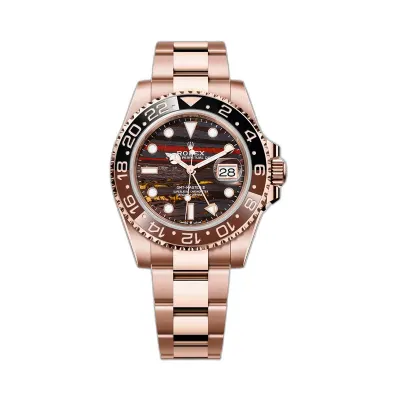
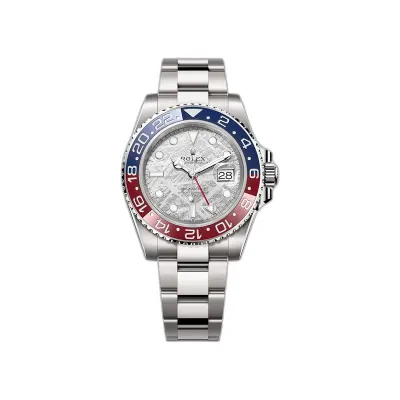
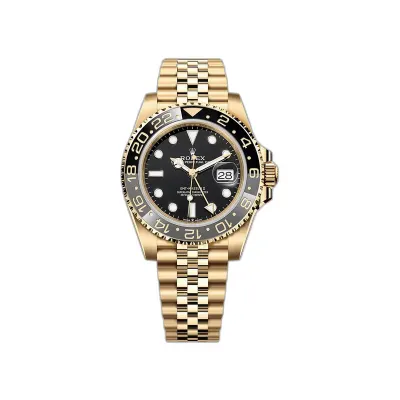
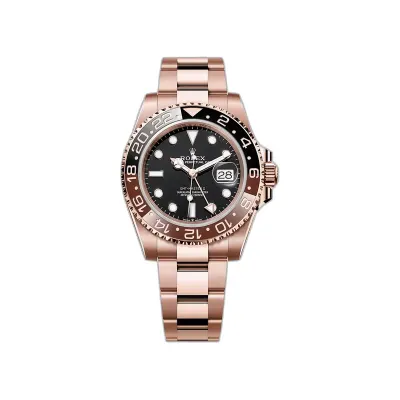
- 1267, GMT-Master II (126710BLNR).
- 1262, Datejust 36 (126200) and 1263, Datejust 41 (126300).
- 1282, Day-Date 36 (128238) and 2282, Day-Date 40 (228238).
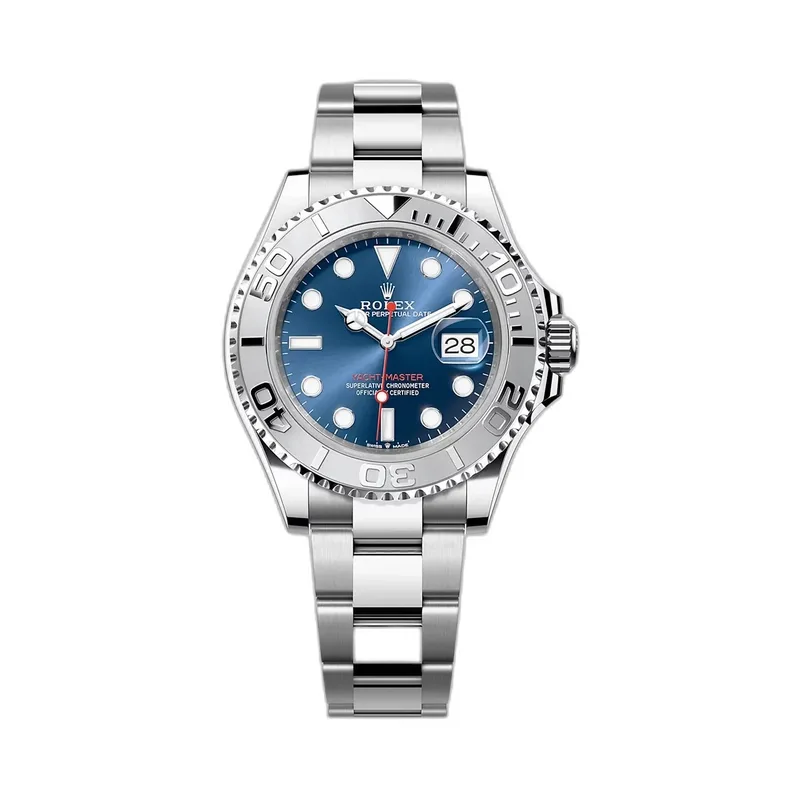
The system is not perfect. The opening digits 1266, for example, are shared by the Submariner (126610LN) and the Yacht-Master 40 (126622).
The second-to-last digit is associated with the type of bezel. On the Datejust this is easy to check: the 126300 has a smooth bezel and the 126334 a fluted one. On the sports models that digit does not follow the same logic, so it is better not to stretch the rule.
The last digit and the material
This is the most dependable part of the code. These correspondences can be checked reference by reference:
| Last digit | Material | Example |
|---|---|---|
| 0 | Steel | 126500LN, 126300 |
| 1 | Steel and Everose gold | 126711CHNR |
| 2 | Steel and platinum | 126622 |
| 3 | Steel and yellow gold | 126503 |
| 4 | Steel and white gold | 126334 |
| 5 | Everose gold | 126505, 126715CHNR |
| 6 | Platinum | 126506 |
| 8 | Yellow gold | 126508, 228238 |
| 9 | White gold | 126509, 128239 |
The digit 7 appears today on the titanium Yacht-Master 42, the 226627. Everose is Rolex’s name for its pink gold.
The letters: bezel and gem-setting (LN, LV, LB, BLRO, BLNR, CHNR, VTNR, GRNR, RBR, TBR)
The letters after the digits are read as French abbreviations and describe the bezel:
- LN, lunette noire: black bezel. LV, lunette verte: green. LB, lunette bleue: blue. All three appear on the Submariner, as our Rolex Submariner guide explains.
- BLRO, bleu and rouge: blue and red. BLNR, bleu and noir: blue and black.
- CHNR, chocolat and noir: brown and black. VTNR, vert and noir: green and black. GRNR, gris and noir: grey and black.
Other letters signal gem-setting. RBR appears on references with a diamond-set bezel, such as the 126284RBR, a Datejust 36, and TBR on diamond-set pieces such as the 128398TBR, a Day-Date 36 in yellow gold. The gem-set bezels of the Day-Date are covered in our Rolex Day-Date President guide.
Bezel colours also have their collector nicknames, which we cover in our article on Rolex nicknames.
The four-digit suffix: dial and bracelet
After the hyphen come four digits that separate configurations within the same reference. Sometimes the dial changes: the 126500LN-0001 is the white dial and the 126500LN-0002 the black one. Sometimes it is the bracelet: the 126710BLNR-0002 comes on a Jubilee and the 126710BLNR-0003 on an Oyster.
There is no known rule for working out the dial from those digits: you have to look them up on the brand’s product page.
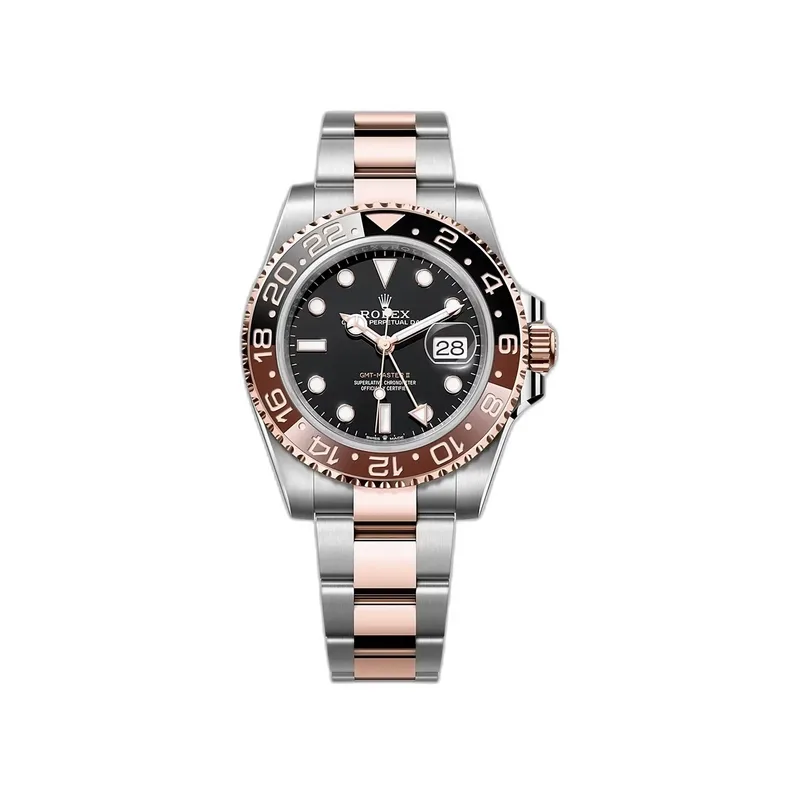
Example: 126711CHNR-0002
- 1267: current-generation GMT-Master II.
- Last digit, 1: steel and Everose gold.
- CHNR: brown and black bezel insert.
- -0002: the configuration Rolex lists with a black dial and an Oyster bracelet.
The result is a 40 mm GMT-Master II, like those in our Rolex GMT-Master II collection. How to read a second time zone with it is explained in our Rolex GMT-Master II guide.
Patek Philippe reference numbers
Patek Philippe does not explain its numbering on its product pages either, but the format is regular and you can check it there.
Four digits, material and dial variant
A reference such as 5811/1G-001 has up to four parts:
- Four digits for the model: 5811.
- A slash and a number, not always present: /1.
- A letter for the case material: G.
- Three digits after the hyphen for the version: 001.
The final three digits separate versions of the same watch, usually by the dial. The Aquanaut 5168G-001 has a blue dial and strap, and the 5168G-010 a khaki green one.
The brand gives no explanation for the number after the slash. In the references we have checked, /1 coincides with watches on a metal bracelet (5811/1G, 5990/1A, 5712/1R), and those on a strap have no slash (5168G, 5270P, 5227J). The 5227J is a Calatrava, the collection covered in our Patek Philippe Calatrava guide.
The letters: A, J, G, R, P
The letter gives the case metal and matches the initial of its French name (white gold is or gris):
| Letter | Material | Example checked |
|---|---|---|
| A (acier) | Steel | 5990/1A-011 |
| J (jaune) | Yellow gold | 5227J-001 |
| G (gris) | White gold | 5811/1G-001 |
| R (rose) | Rose gold | 5712/1R-001 |
| P (platine) | Platinum | 5270P-014 |
Example: 5990/1A-011
- 5990: the model, a Nautilus with a flyback chronograph and a second time zone.
- /1: on this reference, a steel bracelet.
- A: steel.
- -011: the version with a blue-grey dial.
You can see more references from the family in our Patek Philippe Nautilus collection.
Audemars Piguet reference numbers
Audemars Piguet is the most explicit of the three: it explains its numbering on its heritage website, AP Chronicles.
The blocks of a reference, according to the numbering the brand publishes
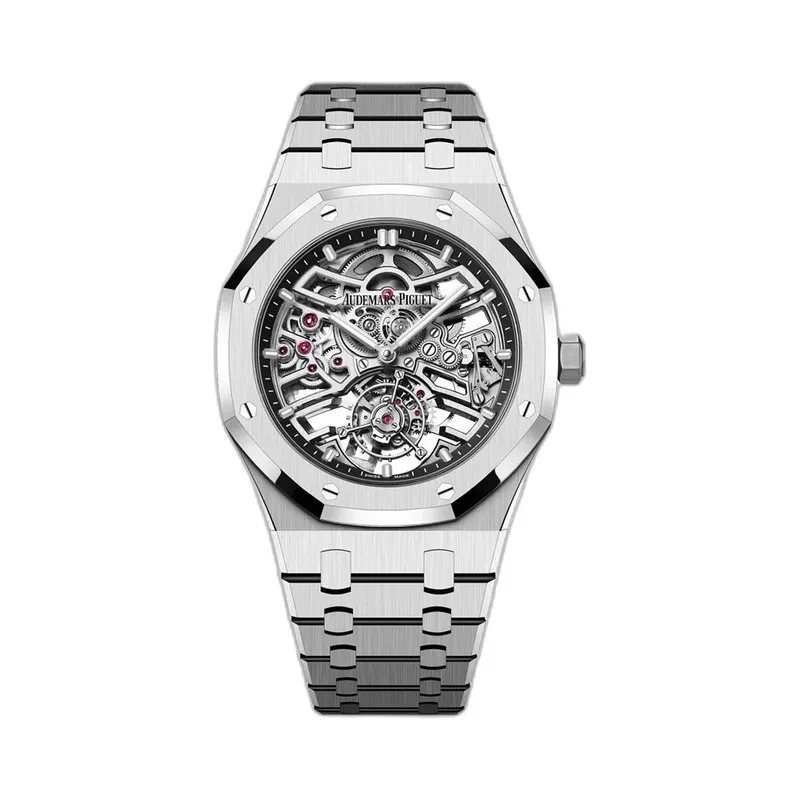
The brand has assigned model numbers since 1951. At first they had four digits. Material codes were added in the 1970s, and in the mid-1980s references moved to five digits: the 5402 of the first Royal Oak became the 25402. Since the early 2000s, codes for gem-setting, clasp, bracelet and dial have been added.
A full reference is now read in blocks, from left to right:
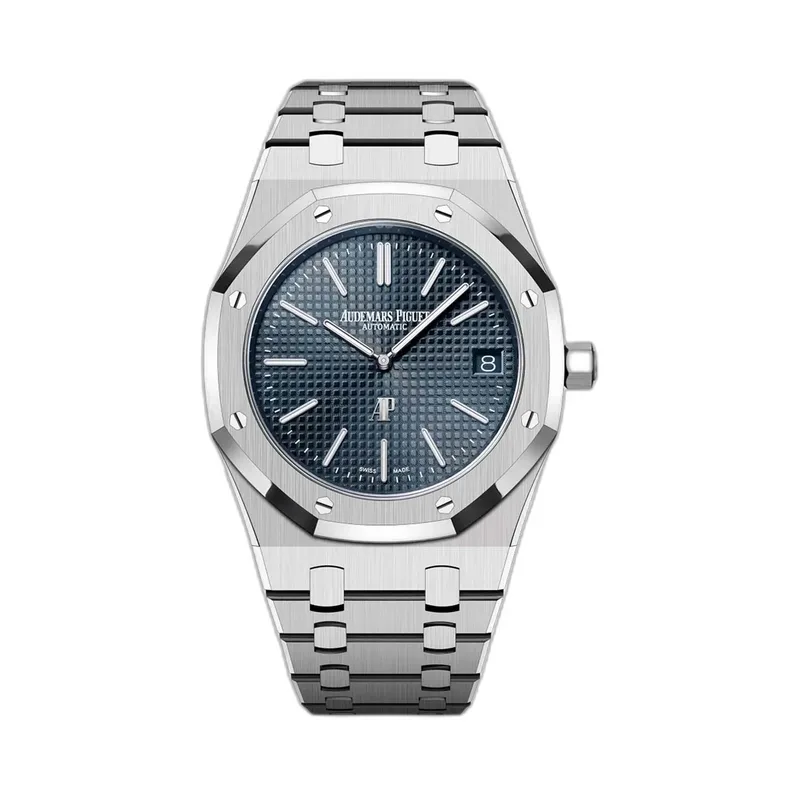
- Model number, of four or five digits.
- Case material, in two letters.
- Two letters for the finish, which in the brand’s examples appear as OO for standard decoration.
- Bracelet or strap: a code and two letters for its material. If the watch is on a leather strap, the block begins with a letter, A or D, which indicates the type of buckle.
- Dial, in digits.
Material codes
| Code | Material |
|---|---|
| ST | Steel |
| BA | Yellow gold |
| BC | White gold |
| OR | Pink gold |
| PT | Platinum |
| TI | Titanium |
| CE | Black ceramic |
The brand also has codes of its own for cases that combine two materials, such as SA for steel and yellow gold.
Example: 15510ST.OO.1320ST.09
- 15510: the model, a 41 mm selfwinding Royal Oak.
- ST: steel case.
- OO: standard finish.
- 1320ST: bracelet, also in steel.
- 09: the dial, which in this version is a khaki Grande Tapisserie.
Another dial on the same watch is identified by that last block. There are more examples in our Audemars Piguet Royal Oak collection.
Richard Mille: the name is the reference
Richard Mille works differently: the watch is identified by its name, made up of the letters RM and a number, such as RM 65-01. On the brand’s product page that name stands alone, next to the name of its calibre, the RMAC4, with no material or dial code like those used by Rolex, Patek Philippe or Audemars Piguet. We explain it in our Richard Mille guide.
Where to find the reference on our watch pages
Every watch in our catalogue has its own page, and the reference appears there next to the condition and the specifications. Those specifications are reference data for the model: before you buy, we confirm the details of the specific watch, and if you would like to see it, we send you photos.
Frequently asked questions
Are the reference number and the serial number the same thing?
No. The reference identifies the model and its configuration, and all identical watches share it. The serial number identifies one single watch. Neither of them proves on its own that a watch is genuine, because both can be copied. We explain what else is worth checking in our guide on what to check in a new or pre-owned watch.
Are two watches with the same reference identical?
They left the factory in the same configuration, but each has its own serial number, its own year and its own history. On a worn watch, the condition of the case and bracelet, the paperwork that comes with it and any work carried out on it will all differ. That is why the reference is the starting point of a purchase, not the end.
Sources
- Audemars Piguet, AP Chronicles: Audemars Piguet watch numbering (opens in a new window)
- Audemars Piguet, AP Chronicles: Royal Oak numbering (opens in a new window)
- Audemars Piguet, Royal Oak Selfwinding 15510ST.OO.1320ST.09 (opens in a new window)
- Patek Philippe, Nautilus 5990/1A-011 (opens in a new window)
- Patek Philippe, Nautilus 5811/1G-001 (opens in a new window)
- Patek Philippe, Nautilus 5712/1R-001 (opens in a new window)
- Patek Philippe, Grand Complications 5270P-014 (opens in a new window)
- Patek Philippe, Calatrava 5227J-001 (opens in a new window)
- Patek Philippe, Aquanaut 5168G-001 (opens in a new window)
- Patek Philippe, Aquanaut 5168G-010 (opens in a new window)
- Rolex, GMT-Master II 126711CHNR-0002 (opens in a new window)
- Rolex, Cosmograph Daytona: all models (opens in a new window)
- Rolex, Datejust 41 126300-0013 (opens in a new window)
- Rolex, Datejust 41 126334-0021 (opens in a new window)
- Rolex, Datejust 36 126284RBR-0011 (opens in a new window)
- Rolex, Day-Date 36 128398TBR-0004 (opens in a new window)
- Rolex, Yacht-Master: all models (opens in a new window)
- Richard Mille, RM 65-01 (opens in a new window)
- Monochrome, The Rolex GMT-Master II 126710GRNR (opens in a new window)
- Monochrome, Kermit 16610LV vs. Starbucks 126610LV (opens in a new window)
- Monochrome, The ABCs of Time: Fighting Counterfeiting (opens in a new window)
- Fratello, Rolex Serial Numbers and Clasp Codes (opens in a new window)
- Phillips, Rolex Cosmograph Daytona 116520 (catalogue note on the rehaut engraving) (opens in a new window)
- Phillips, Rolex GMT-Master (catalogue note on reference and serial positions) (opens in a new window)