Rolex Submariner Guide: References, Sizes and Materials
A guide to the Rolex Submariner: Date or no-date, 40 vs 41 mm, steel, Rolesor or gold, Cerachrom bezels and the reference behind each colour.
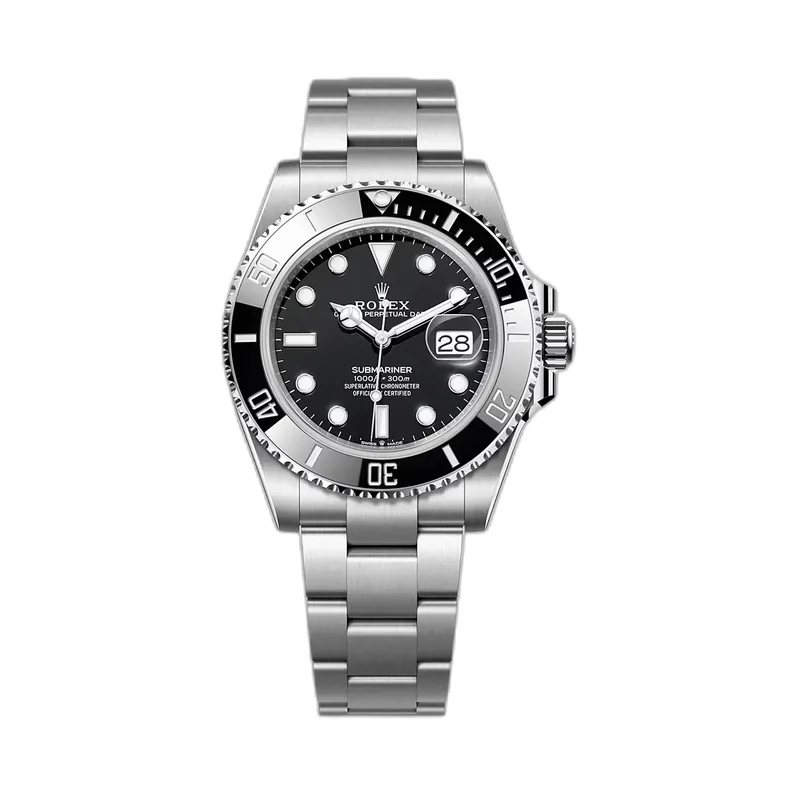
The Rolex Submariner is Rolex’s dive watch: an Oyster case waterproof to 300 metres, a unidirectional rotatable bezel graduated over 60 minutes and a Triplock crown. It comes in two versions. The plain Submariner has no date and is made only in steel; the Submariner Date adds a magnified date window and is offered in steel, in steel and gold, and in gold. Since 2020 the case has measured 41 mm and the movements have been calibres 3230 and 3235.
This guide explains how to tell the generations apart, what each letter in the reference means, which bezel and dial combinations go with each material, and how the Submariner differs from Rolex’s other sports watches.
What is the Rolex Submariner?
A dive watch has two jobs: keep water out at the intended depth, and tell the diver how long they have been underwater. The Submariner does the first with a reinforced Oyster case, with a screw-down case back and crown, and the second with a rotating bezel that works as a simple timer. Everything else – the high-contrast dial, the large hands, the adjustable bracelet – serves those two functions.
The early years: reference 6204 and 100 metres
Rolex regards 1953 as the year the Submariner was born, because that is when the first production watches were completed. The public launch came in 1954, at the Basel fair. The first reference was the 6204, the first to carry the word “Submariner” on the dial, although not every example has it. Rolex presented it as the first wristwatch waterproof to 100 metres.
The rating soon grew: according to Monochrome and Fratello, reference 6200, from the mid-1950s, was already good for 200 metres. A version with a date arrived in the second half of the 1960s, as reference 1680. The 300-metre rating came in 1979 with the 16800, a Submariner Date that also introduced the sapphire crystal.
Oyster case, Triplock crown and unidirectional bezel
The Oyster case is the basis of every Rolex, but the Submariner takes it furthest. The case back is screwed down onto the middle case and the crown screws down against the case. On the Submariner that crown is the Triplock, which Rolex describes as a triple waterproofness system, and it is protected by a crown guard that is part of the middle case itself.
The bezel turns in one direction only, anticlockwise, and is graduated over 60 minutes. Before the dive, the diver lines up the bezel’s triangle with the minute hand and, during the dive, reads elapsed time off the bezel. Turning in one direction only is a safety feature: if the bezel is knocked, it can only move in the direction that makes the diver think more time has passed, never less.
The final element is the Oyster bracelet with its Oysterlock clasp and Glidelock system, which extends the bracelet without tools so the watch can be worn over a diving suit. According to Monochrome, Glidelock made its debut in 2008 on the gold versions.
Submariner vs Submariner Date
The difference is more than a date window. The no-date Submariner, today reference 124060, has a symmetrical dial with no magnifier on the crystal and runs on calibre 3230: hours, minutes and seconds. It is made only in steel, with a black bezel and black dial.
The Submariner Date shows the date at 3 o’clock beneath a Cyclops lens that magnifies it, and uses calibre 3235. It is the one with the full range of materials and colours: steel with a black or green bezel, steel and yellow gold, yellow gold and, until 2026, white gold.
| Submariner (no date) | Submariner Date | |
|---|---|---|
| Current reference | 124060 | 126610LN, 126610LV, 126613LN, 126613LB, 126618LN, 126618LB |
| Calibre | 3230 | 3235 |
| Date | No | Yes, at 3 o’clock, with Cyclops lens |
| Materials | Steel | Steel, steel and yellow gold, yellow gold |
| Bezels | Black | Black, green or blue depending on material |
| Diameter | 41 mm | 41 mm |
| Water resistance | 300 m | 300 m |
Choosing between them is mostly a matter of use and taste. If you want the date on show or a gold watch, the Date is the only option. If you prefer a clean dial and the most restrained line in the family, the 124060 is the direct descendant of the 1953 idea.
The generations you will see most
Rolex Submariner 40 vs 41 mm: what changed in 2020
In September 2020 Rolex renewed the whole collection. The case went from 40 to 41 mm, the first time the Submariner had used that size after decades at 40 mm. The extra millimetre does not make it look bulkier: the lugs and crown guards were slimmed, so the watch looks more streamlined than the previous generation. The bracelet is slightly wider at the lugs and tapers towards the clasp, and the hands are longer.
The real change is the movement. Calibres 3230 and 3235 replaced the 3130 and 3135. Both beat at 4 Hz, use the Chronergy escapement and have a power reserve of around 70 hours. Water resistance stayed at 300 metres.
The renewal also brought colour changes. The steel Submariner Date with a green bezel, the 126610LV, switched from a green dial to a black one. The white gold version, the 126619LB, kept its blue bezel but with a black dial.
The previous Cerachrom generation (114060 and 1166xx)
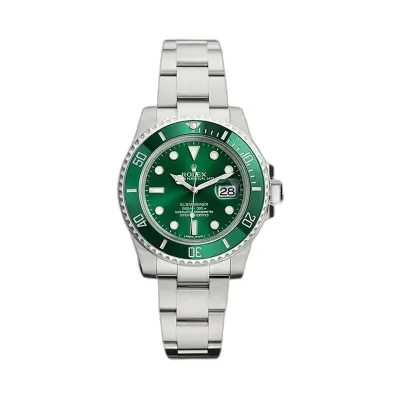
The ceramic bezel insert reached the Submariner at the end of the 2000s. According to Monochrome, it arrived in 2008 on three gold references, the 116618LN, 116618LB and 116619LB, which also introduced a sturdier case with thicker lugs and a dial with larger hour markers. The steel and yellow gold 116613LN and 116613LB followed in 2009, and the steel versions in 2010: the black 116610LN and the 116610LV, with a green bezel and green dial. The no-date version took on the same look in 2012 with the 114060.
This generation measures 40 mm and uses calibre 3135 for the date versions and 3130 for the no-date. Next to the current watch, it is easy to spot by the lugs, which look thicker from the front, and by the diameter.
Five-digit references with aluminium inserts
Before ceramic, the bezel insert was anodised aluminium, lighter in appearance and easier to scratch, and liable to lose some intensity of colour over the years. These are the five-digit references:
- 16800, from 1979, the first Submariner Date with a sapphire crystal and 300 metres.
- 16610, from 1988, the steel Submariner Date that stayed in the catalogue until ceramic arrived. It uses calibre 3135.
- 14060 and 14060M, the no-date versions. The 14060, from 1988, used calibre 3000; the 14060M took the 3130 around the turn of the century.
- 16610LV, from 2003, with a green aluminium bezel and black dial, launched for the model’s 50th anniversary.
All of them are 40 mm and differ from the six-digit references in their aluminium bezel and slimmer lugs.
Materials: Oystersteel, yellow Rolesor, yellow gold and white gold
The current Submariner comes in four material versions:
- Oystersteel. Rolex’s name for its steel, from the 904L family. Used for the 124060 and the Submariner Date 126610LN and 126610LV.
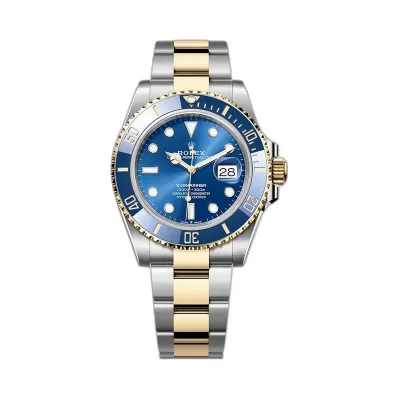
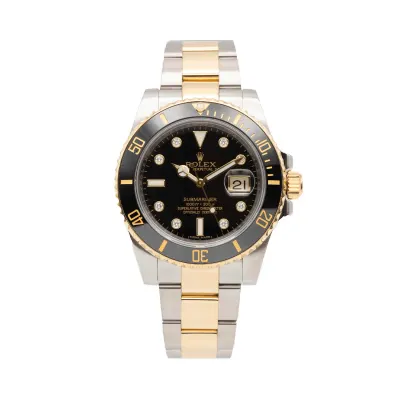
- Yellow Rolesor. Rolesor is Rolex’s name for the combination of steel and 18 ct gold in the same watch. References 126613LN and 126613LB.
- 18 ct yellow gold. Case and bracelet entirely in gold. References 126618LN and 126618LB.
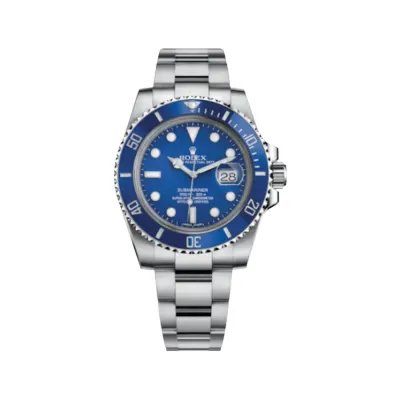
- 18 ct white gold. The 126619LB, with a blue bezel and black dial, left the Rolex catalogue in 2026, according to the specialist press. Its predecessor, the 116619LB, had a blue bezel and blue dial.
The last digit of the number gives the material: 0 for steel, 3 for steel and yellow gold, 8 for yellow gold and 9 for white gold. It is the same logic as the rest of the Oyster collection, and we explain it step by step in our guide on how to read watch reference numbers.
Bezels and dials by colour
The table brings together the most common six-digit references and the 16610LV, which is still seen often. The right-hand column shows whether the reference has left the Rolex catalogue.
| Reference | Material | Bezel | Dial | Status |
|---|---|---|---|---|
| 124060 | Steel | Black Cerachrom | Black, no date | Current |
| 126610LN | Steel | Black Cerachrom | Black | Current |
| 126610LV | Steel | Green Cerachrom | Black | Current |
| 126613LN | Steel and yellow gold | Black Cerachrom | Black | Current |
| 126613LB | Steel and yellow gold | Blue Cerachrom | Blue | Current |
| 126618LN | Yellow gold | Black Cerachrom | Black | Current |
| 126618LB | Yellow gold | Blue Cerachrom | Blue | Current |
| 126619LB | White gold | Blue Cerachrom | Black | Discontinued in 2026 |
| 116610LN | Steel | Black Cerachrom | Black | 2010–2020 |
| 116610LV | Steel | Green Cerachrom | Green | 2010–2020 |
| 116613LB | Steel and yellow gold | Blue Cerachrom | Blue | Previous generation |
| 116619LB | White gold | Blue Cerachrom | Blue | 2008–2020 |
| 16610LV | Steel | Green aluminium | Black | 2003–2010 |
The green Submariner
There have been three green versions. The 16610LV of 2003 was the first to pair a green bezel with a black dial; the 116610LV of 2010 made both bezel and dial green, with a sunray finish; and the 126610LV of 2020 went back to a black dial with the green ceramic bezel. Collectors call them Kermit, Hulk and Starbucks respectively, although none of these is a Rolex name. We go into more detail in our article on Rolex nicknames.
The blue Submariner
In the current range, blue is offered only with gold. In steel and yellow gold, the 126613LB and its predecessor, the 116613LB, have a blue bezel and blue dial and are known as the Bluesy. In yellow gold there is the 126618LB. In white gold, the 116619LB had a blue dial and the 126619LB a black one; the first was nicknamed Smurf and the second Cookie Monster.
Water resistance: what 300 metres means
Rolex states the Submariner’s water resistance as “waterproof to 300 metres (1,000 feet)”, and its user guide specifies that this applies with the crown fully screwed down. It is the pressure the case withstands with the crown, the sapphire crystal and the case back in place. It is not a recommended diving depth for anyone: it describes the margin of the case, not the limits of the person wearing it.
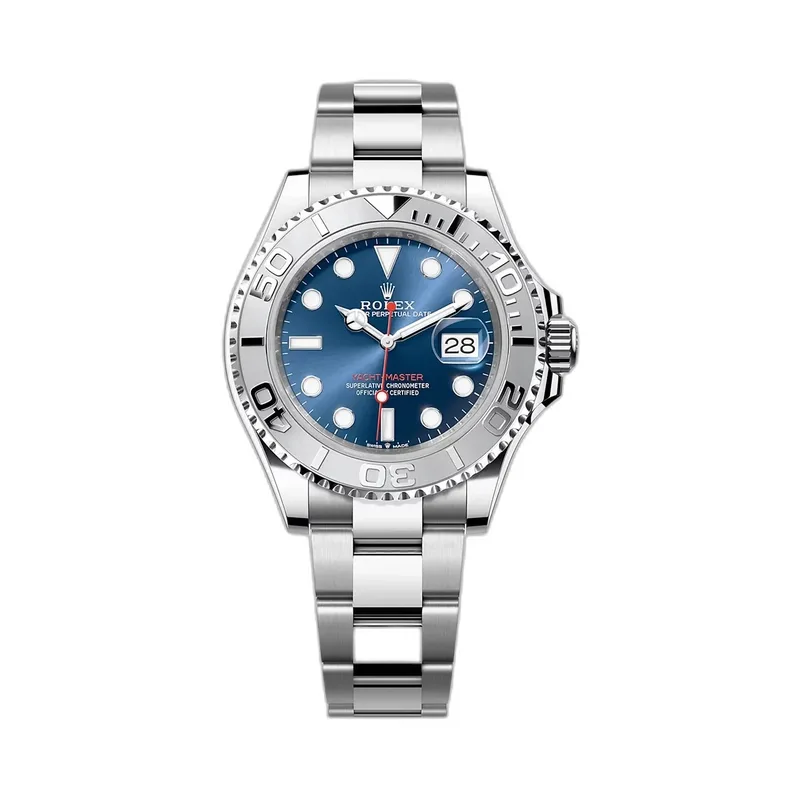
To put the figure in context within the collection: the GMT-Master II and the Yacht-Master are waterproof to 100 metres; the Submariner to 300; and the brand has models built for greater depths, such as the Sea-Dweller, which adds a helium escape valve designed for saturation diving.
There is one practical point Rolex repeats in its user guides: the crown must be screwed back down against the case after every use and should never be unscrewed underwater. Water resistance depends on that crown and on the seals, which are checked at every service.
The movement: calibres 3230 and 3235
Both current calibres are self-winding, made in-house, and share almost all of their architecture. The 3230 shows hours, minutes and seconds; the 3235 adds an instantaneous date change. Both run at 28,800 vibrations per hour (4 Hz), have a power reserve of around 70 hours and use the Chronergy escapement together with a blue Parachrom hairspring.
Rolex certifies these watches as Superlative Chronometers: on top of the official COSC certification of the movement, the brand carries out its own final checks on the finished watch.
The earlier 3130 and 3135 had less power reserve, and the difference shows in daily use: a fully wound 3235 will keep running through a whole weekend off the wrist. If you want to understand how a self-winding movement works and what chronometer certification means, our guide on automatic, manual or quartz watches explains it.
How to read a Submariner reference: LN, LV, LB
A reference such as 126610LN-0001 breaks down like this:
- 1266 identifies the current-generation Submariner Date. The previous one began with 1166 and the last five-digit one with 166. The no-date version uses 1240 (current) and 1140 (previous).
- The last digit of the number gives the material: 0 steel, 3 steel and yellow gold, 8 yellow gold, 9 white gold.
- The letters describe the bezel and are read in French: LN, lunette noire, black bezel; LV, lunette verte, green bezel; LB, lunette bleue, blue bezel. Rolex does not explain them on its product pages, but the reading always matches the bezel colour.
- -0001 identifies the dial configuration within the reference.
The no-date reference has no letters: 124060. Rolex does not currently offer that watch with any other bezel colour, so there is nothing to distinguish.
Submariner vs GMT-Master II vs Yacht-Master
All three are Rolex sports watches with an Oyster case and a rotating bezel, and they are often mixed up in searches. They differ in what the bezel does and in water resistance.
| Submariner Date | GMT-Master II | Yacht-Master | |
|---|---|---|---|
| Designed for | Diving | Travel, two time zones | Sailing |
| Bezel | Unidirectional, 60 minutes | Bidirectional, 24 hours, two colours | Bidirectional, 60 minutes, raised numerals |
| Water resistance | 300 m | 100 m | 100 m |
| Diameter | 41 mm | 40 mm | 37, 40 or 42 mm |
| Bracelet | Oyster | Oyster or Jubilee | Oyster or Oysterflex |
The GMT-Master II adds a 24-hour hand for reading a second time zone, and it is the one for frequent travellers; we cover it in our GMT-Master II guide. The Yacht-Master is the dressiest of the three, almost always in precious metal or on an Oysterflex strap. Anyone who needs more depth than the Submariner offers has the Sea-Dweller in the same family, which you can find among the Rolex watches in our catalogue.
Outside Rolex, the most common comparison is with Tudor, its sister brand, whose Black Bay draws on Tudor’s own dive watches of the 1950s. We look at it in our Tudor Black Bay guide, and the watches are in the Tudor Black Bay collection.
The Submariners in our collection
Our Rolex Submariner collection currently includes watches from the two latest generations: the 41 mm 126610LN and 126613LB, and the 40 mm 116610LV and 116619LB. All are priced on request and available to order, and we can send you photos of any piece. If you are looking for a specific reference that is not listed, such as a no-date Submariner or a yellow gold version, you can request a model.
Frequently asked questions
Submariner or Submariner Date?
It depends on what you want to see on the dial. The no-date Submariner (124060) comes only in steel, has a symmetrical dial and uses calibre 3230. The Submariner Date adds a magnified date at 3 o’clock, uses calibre 3235 and is the only choice if you want gold, steel and gold, or a green or blue bezel. Both measure 41 mm and are waterproof to 300 metres.
What is the difference between the 116610LN and the 126610LN?
The 126610LN, from 2020, measures 41 mm against the 40 mm of the 116610LN, has slimmer lugs and crown guards, and uses calibre 3235, with around 70 hours of power reserve, instead of the 3135. Both are steel, with a black Cerachrom bezel, a black dial and 300 metres of water resistance.
What do LN, LV and LB mean?
They are French abbreviations for the bezel colour: LN, lunette noire (black); LV, lunette verte (green); and LB, lunette bleue (blue). Rolex does not explain them on its product pages, but the pattern holds across every Submariner reference. The dial colour does not always match: the 126610LV has a green bezel and a black dial.
How water resistant is the Rolex Submariner?
The current Submariner is waterproof to 300 metres (1,000 feet), according to Rolex. It achieves this with the Oyster case, screw-down case back, sapphire crystal and screwed-down Triplock crown. The first reference, the 6204, was rated to 100 metres; 300 metres came in 1979 with reference 16800, a date model.
What is the Rolex Submariner “Hulk”?
It is the nickname for reference 116610LV, a 40 mm steel Submariner Date with a green ceramic bezel and a green sunray dial, made between 2010 and 2020. It is not a Rolex name. Its successor, the 126610LV, keeps the green bezel but has a black dial, which is why it goes by a different nickname.
Which calibre does the current Submariner use?
Since 2020, calibre 3230 in the no-date Submariner and 3235 in the Submariner Date. Both are self-winding, beat at 4 Hz, offer around 70 hours of power reserve and use the Chronergy escapement. Rolex certifies them as Superlative Chronometers with its own checks on the finished watch. The previous generation used calibres 3130 and 3135.
Sources
- Rolex, Submariner and Submariner Date user guide (2020) (opens in a new window)
- Rolex, GMT-Master II user guide (screw-down crown) (opens in a new window)
- Monochrome, Rolex Submariner History, Part 1 – The Early References (opens in a new window)
- Monochrome, History of the Rolex Submariner, Part 4: Modern References (opens in a new window)
- Fratello, The History of the Rolex Submariner (opens in a new window)
- SJX, Rolex Introduces the Submariner 41 mm (opens in a new window)
- Gear Patrol, Rolex Quietly Discontinued Some of Its Top Watches (opens in a new window)
- WatchTime, Rolex-Abgänge 2026 (opens in a new window)