Rolex GMT-Master II: How It Works and the Main Versions
How to read two or three time zones with the Rolex GMT-Master II, from 1955 to today: calibre 3285, two-colour bezels, Oyster or Jubilee and materials.
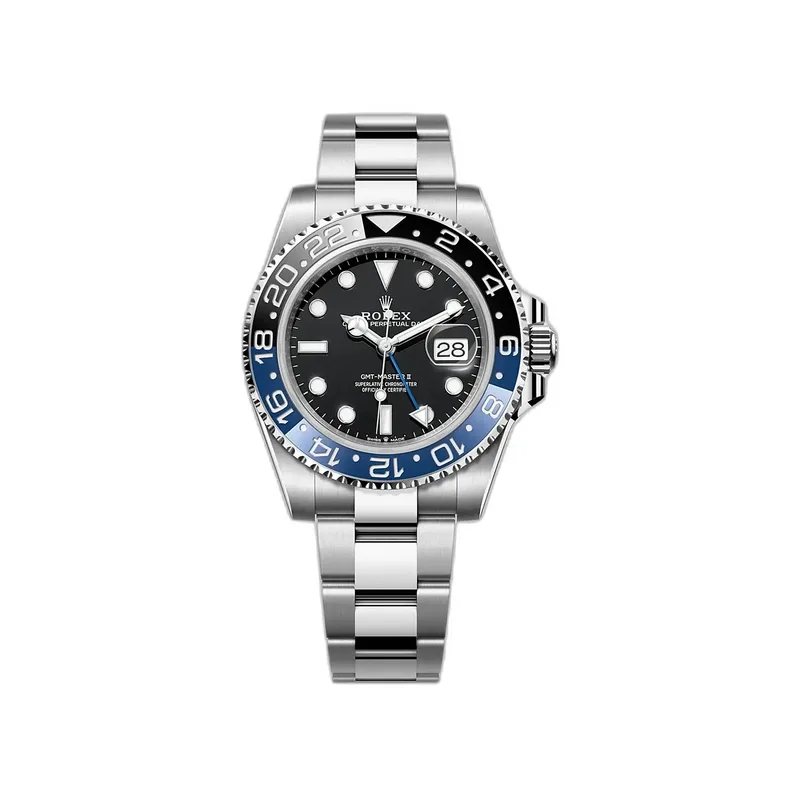
The Rolex GMT-Master II shows the time in two time zones at once. Local time is read with the usual hands; reference time with a 24-hour hand that points to the 24-hour graduated bezel. Turn the bezel and that hand shows a third time zone instead, although it then stops showing the reference time. The current model measures 40 mm, uses calibre 3285 and is made in steel, steel and gold, and gold, with two-colour ceramic bezels.
This guide explains how to use it step by step, where it comes from, what the letters in each reference mean and how the materials, bracelets and dials differ.
What is the GMT-Master II?
GMT stands for Greenwich Mean Time, the time at the Greenwich meridian, which for decades was the international time reference. A GMT watch, in general, is any watch that shows a second time zone with an additional hand. The GMT-Master II is Rolex’s version, and what sets it apart is how it is adjusted: the hand you move when you change country is the local hour hand, not the 24-hour hand.
1955: the GMT-Master, a watch for pilots
The GMT-Master was introduced in 1955. According to Sotheby’s and Fratello, it grew out of a request from Pan American World Airways, which wanted a watch for its pilots that could show two time zones, at a time when commercial aviation was beginning to cross several in a single day. The first reference was the 6542, with a two-colour rotating bezel in red and blue to distinguish daytime from night-time hours.
The family evolved for decades without changing the idea. Reference 1675 was made between 1959 and 1980; the 16750 added a quick-set date, and the 16700 was the last of the original GMT-Master line.
GMT-Master vs GMT-Master II: the independent hour hand
On the original GMT-Master, the hour hand and the 24-hour hand moved together: to read another zone, you turned the bezel. In the early 1980s Rolex introduced a movement that let the hour hand be set on its own, without touching the minute hand or the 24-hour hand, and with it the watch was renamed GMT-Master II. The first reference was the 16760, with calibre 3085, a sapphire crystal and a thicker case than the GMT-Master of the time.
The two names coexisted for years. Then came the 16710, made with various colours of aluminium bezel and given calibre 3186 in 2007, and the six-digit references with ceramic bezels that are covered below.
How does a GMT watch work? Reading the GMT-Master II
Everything that follows comes from the GMT-Master II user guide published by Rolex.
The 24-hour hand and the 24-hour bezel
The watch has four central hands. Three are the usual ones: hours, minutes and seconds, which give local time. The fourth, with a triangular tip, makes one revolution every 24 hours and is read against the bezel scale when the bezel is in the neutral position, with its triangle opposite the 12 o’clock marker. That hand shows the reference time, home time for example.
The two colours of the bezel are not decorative: they separate the twelve daytime hours from the twelve night-time ones. Rolex puts it this way in the guide: the 24-hour hand lets the wearer tell daytime hours from night-time hours. If it is 3 o’clock in the reference zone, the hand shows at a glance whether that is 3 in the morning or 3 in the afternoon.
A third time zone by turning the bezel
The bezel turns both ways. To read the time in a third place, start from the neutral position and work out the difference from the reference time. If the destination lies east, turn the bezel anticlockwise by as many notches as there are hours of difference; if west, turn it clockwise. The guide’s example: to show Tokyo time with Geneva as the reference, eight hours ahead, turn the bezel eight notches anticlockwise.
From then on, the 24-hour hand read against the bezel shows Tokyo time, with the minutes given by the central minute hand. What Rolex points out is that the reference time is then no longer displayed: you need to return the bezel to neutral to see it.
How to set it when you change time zone (according to Rolex)
Once unscrewed, the crown has three positions. Full setting is done in two steps, in this order:
- Reference time, with the crown in position 3 (second notch). The seconds hand stops. With the bezel in neutral, set the 24-hour hand and the minute hand. This also moves the hour hand, which is why it comes first.
- Date and local time, with the crown in position 2 (first notch). Turning the crown either way moves the hour hand forwards or backwards in one-hour jumps. The date changes when that hand passes midnight, in either direction.
When travelling, only the second step is needed. Pull the crown to position 2 and move the hour hand to the time at your destination; the watch keeps running, the minutes and the 24-hour hand stay where they are, and the date follows local time. The guide’s example: reference time in Geneva at 10.10, local time in New York at 4.10. Rolex stresses that the crown should be screwed back down after every use and never unscrewed underwater.
The specialist press calls this system, in which the local hour hand is the one that moves, a “flyer” or traveller’s GMT. It is the practical difference between the GMT-Master II and the original GMT-Master.
Two-colour Cerachrom bezels
Cerachrom is Rolex’s name for its ceramic bezel inserts. The first Rolex with a Cerachrom insert was itself a GMT-Master II, the yellow gold 116718LN of 2005, with a single-colour black bezel.
Making a ceramic insert in two colours as a single piece was harder. Rolex achieved it in 2013, on the steel GMT-Master II with a blue and black bezel, the 116710BLNR. The red and blue of the original model followed in 2014 on a white gold version, and later came brown and black (2018), green and black (2022) and grey and black (2023).
Bezel letters: BLRO, BLNR, CHNR, VTNR, GRNR
The letters at the end of the reference describe the bezel colours in French. Rolex does not explain them, but the pattern always holds. Each combination also has a collectors’ nickname, which is not a Rolex name:
| Letters | Colours | References | Nickname |
|---|---|---|---|
| BLRO | Bleu, rouge: blue and red | 126710BLRO, 126719BLRO (discontinued in 2026) | Pepsi |
| BLNR | Bleu, noir: blue and black | 116710BLNR, 126710BLNR | Batman |
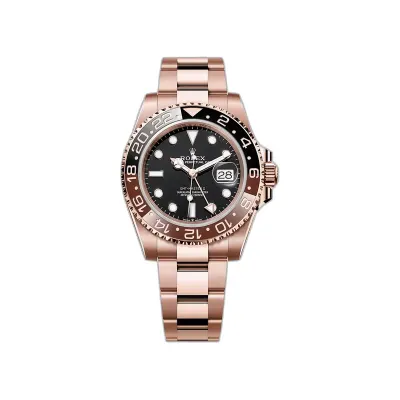
| CHNR | Chocolat, noir: brown and black | 126711CHNR, 126715CHNR | Root Beer |
| VTNR | Vert, noir: green and black | 126720VTNR, 126729VTNR | Sprite |
| GRNR | Gris, noir: grey and black | 126710GRNR, 126713GRNR, 126718GRNR | Bruce Wayne (the steel one) |
The story behind each nickname, and why some are not universally agreed, is in our article on Rolex nicknames.
Oyster or Jubilee bracelet
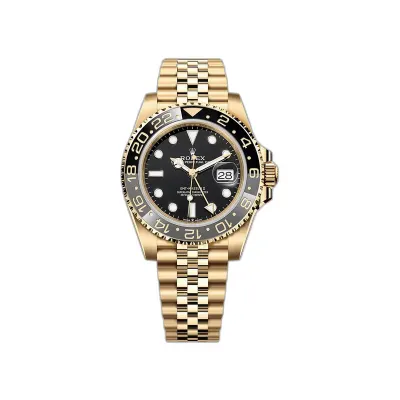
The GMT-Master II comes on two bracelets. The Oyster has three-piece links, broad and flat; it is the sportier of the two, and gold versions such as the 126715CHNR or the 126729VTNR wear it in the same metal as the case. The Jubilee, with five smaller pieces per link, is more supple and catches more light. Rolex offers it on several steel versions and also on the 2023 grey and black models: the 126713GRNR in steel and yellow gold, and the 126718GRNR in yellow gold.
Both have the Oysterlock safety clasp and the Easylink extension, which lengthens the bracelet by around 5 mm without tools, handy when your wrist swells in the heat. In steel, the blue and black bezel comes on either: 126710BLNR-0002 on Jubilee and 126710BLNR-0003 on Oyster. The same goes for grey and black (126710GRNR-0003 on Jubilee and -0004 on Oyster) and for the left-handed green and black, the 126720VTNR.
The choice comes down to style and comfort. The Oyster is more restrained and sporty; the Jubilee, with more pieces per link, follows the wrist more closely, has more sparkle and gives the watch a more classic air.
Materials: Oystersteel, Rolesor, Everose, yellow gold and white gold
The last digit of the number gives the material, and the GMT-Master II uses nearly all of Rolex’s:
- 0, Oystersteel. Rolex’s steel: 126710BLNR, 126710GRNR and, until 2026, 126710BLRO.
- 1, Everose Rolesor. Steel and Everose, Rolex’s pink gold: 126711CHNR, from 2018.
- 3, yellow Rolesor. Steel and yellow gold: 126713GRNR, from 2023.
- 5, Everose gold. 126715CHNR, from 2018.
- 8, yellow gold. 126718GRNR, from 2023, and before it the 116718LN of 2005.
- 9, white gold. 126719BLRO, discontinued in 2026, and 126729VTNR, from 2025.
The fifth digit tells you something too: in 12672x, the 2 marks the left-handed version with the crown on the left. The 126720VTNR is steel and the 126729VTNR white gold. To see how this reading system works on other models and brands, read our guide on how to read watch reference numbers.
Dials: black, meteorite and stone
Most GMT-Master IIs have a black dial, with Chromalight markers that, according to Rolex, give off a blue glow in the dark. The exceptions are in the gold versions:
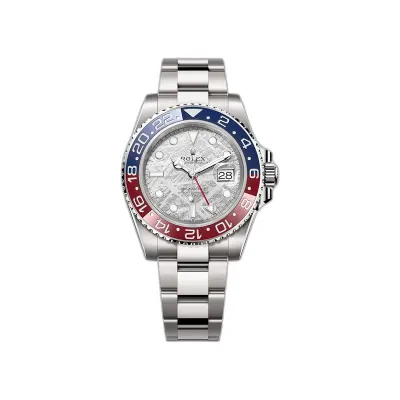
- Meteorite. The white gold 126719BLRO was offered with a blue or a meteorite dial. Both left the catalogue in 2026, along with the other blue and red bezels.
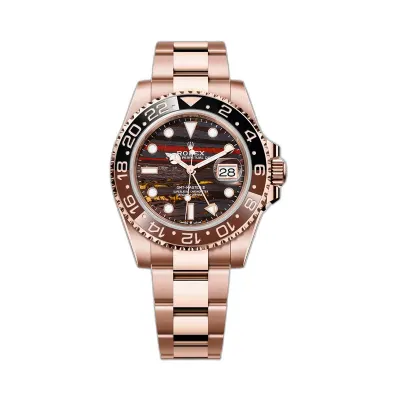
- Stone. In 2025 the Everose gold 126715CHNR gained a second dial, in tiger iron, a natural stone made up of tiger’s eye, red jasper and haematite. According to SJX, it was a new dial material for Rolex.
- Ceramic. Also in 2025 came the white gold 126729VTNR, with the crown on the left and a green ceramic dial in the same colour and texture as the green half of the bezel. SJX describes it as Rolex’s first ceramic dial.
Crown on the left: the 126720VTNR
In 2022 Rolex introduced a steel GMT-Master II with a green and black bezel and, above all, with the crown and date on the left-hand side of the case: the crown at 9 o’clock and the date window at 9 as well. The model’s user guide now includes instructions for this version.
The idea is that of so-called destro watches: worn on the right wrist, it sits like a conventional watch on the left, with the crown pointing towards the hand and within reach of the free hand. It works exactly like the rest of the GMT-Master II range, with the same calibre 3285. In 2025 it was joined by the white gold 126729VTNR, with the green ceramic dial.
The movement: calibre 3285
Calibre 3285 arrived in 2018 with the steel 126710BLRO and the two Everose gold versions, and is now used across the GMT-Master II range. It is an in-house self-winding movement beating at 4 Hz, with a power reserve of around 70 hours and the Chronergy escapement. Rolex certifies the watch as a Superlative Chronometer, with its own checks on top of COSC certification.
The previous 1167xx generation used calibre 3186, with the same independent hour hand but less power reserve.
| 1167xx generation | 1267xx generation | |
|---|---|---|
| Calibre | 3186 | 3285 |
| Power reserve | Shorter | Around 70 hours |
| Bezel | One- or two-colour Cerachrom | Two-colour Cerachrom |
| Bracelets | Oyster | Oyster or Jubilee depending on version |
| Left-handed crown | No | Yes, on 12672x |
How a self-winding movement works and what chronometer certification means are explained in our guide on automatic, manual or quartz watches.
References in our catalogue
These are the GMT-Master II references currently in our Rolex GMT-Master II collection. Stock changes, so treat the list as a guide.
| Reference | Material | Bezel | Bracelet | Dial |
|---|---|---|---|---|
| 126710BLNR-0003 | Steel | Blue and black | Oyster | Black |
| 126710GRNR-0003 | Steel | Grey and black | Jubilee | Black |
| 126710BLRO-0001 | Steel | Blue and red | Jubilee | Black |
| 126720VTNR-0001 | Steel, crown on the left | Green and black | Oyster | Black |
| 126711CHNR-0002 | Steel and Everose gold | Brown and black | Oyster | Black |
| 126715CHNR-0001 | Everose gold | Brown and black | Oyster | Black |
| 126715CHNR-0002 | Everose gold | Brown and black | Oyster | Tiger iron |
| 126718GRNR-0001 | Yellow gold | Grey and black | Jubilee | Black |
| 126719BLRO-0002 | White gold | Blue and red | Oyster | Meteorite |
| 116710BLNR-0002 | Steel, calibre 3186 | Blue and black | Oyster | Black |
All are priced on request and available to order, and we can send you photos of any piece. If you are after another combination, such as the 126729VTNR or another Jubilee version, you can request a specific model.
Submariner vs GMT-Master II, and the Sky-Dweller
The GMT-Master II and the Submariner share an Oyster case, a rotating bezel and a date, and look very alike at first glance. The differences:
| GMT-Master II | Submariner Date | |
|---|---|---|
| What the bezel does | Reads a second or third time zone | Times a dive |
| Bezel rotation | Both directions | One direction |
| Scale | 24 hours | 60 minutes |
| Water resistance | 100 m | 300 m |
| Diameter | 40 mm | 41 mm |
| Bracelet | Oyster or Jubilee | Oyster |
If you dive regularly, the Submariner is the watch designed for it, as we explain in our Rolex Submariner guide; the watches are in the Rolex Submariner collection. If you travel and want to know the time at home without doing sums, the GMT-Master II is the most direct tool.
The Sky-Dweller goes a step further: it shows the second time zone in 24-hour format and adds an annual calendar that indicates the month in twelve apertures around the dial, all set via the rotatable Ring Command bezel. It is in the Rolex Sky-Dweller collection. To compare the GMT-Master II with other second-time-zone and world time watches, our watch complications glossary sets out the differences.
Frequently asked questions
What does GMT stand for?
Greenwich Mean Time, the mean time at the Greenwich meridian, which for decades served as the international time reference. In watchmaking, a GMT watch is one that shows a second time zone with an extra hand, usually a 24-hour one. Rolex has used the term in the name of the GMT-Master line since the original model of 1955.
What is the difference between the GMT-Master and the GMT-Master II?
On the original GMT-Master, the hour hand and the 24-hour hand were linked, and reading another zone meant turning the bezel. The GMT-Master II, from the early 1980s, lets you move the hour hand in one-hour jumps without touching the minutes or the 24-hour hand. That means you can change time zone when travelling without stopping the watch.
How many time zones can you read at once?
Two, according to Rolex: local time with the central hands and reference time with the 24-hour hand against the bezel in its neutral position. Turning the bezel lets the same hand show a third zone, but the user guide notes that the reference time is then no longer displayed. Return the bezel to its starting position and it reappears.
Why is there a GMT-Master II with the crown on the left?
It is a version designed to be worn on the right wrist. With the crown and date at 9 o’clock, on that wrist the watch handles just like a conventional one on the left. Rolex introduced it in steel in 2022, the 126720VTNR with a green and black bezel, and in white gold in 2025, the 126729VTNR.
What is the difference between the 116710BLNR and the 126710BLNR?
Both are steel, measure 40 mm and have a blue and black Cerachrom bezel. The 116710BLNR, from 2013, uses calibre 3186 and was only made on an Oyster bracelet. The 126710BLNR, from 2019, uses calibre 3285, with around 70 hours of power reserve, and comes on a Jubilee (-0002) or Oyster (-0003) bracelet.
Oyster or Jubilee?
They work the same and share the Oysterlock clasp with Easylink extension. The Oyster, with three broad pieces per link, is sportier and more restrained; the Jubilee, with five small pieces, is more supple and dressier. In steel, Rolex offers the blue and black, grey and black and green and black versions on both. In gold it depends on the reference: the 126715CHNR and 126729VTNR come on an Oyster, the 126718GRNR on a Jubilee.
Sources
- Rolex, GMT-Master II user guide (opens in a new window)
- Sotheby's, Exploring the History of the Rolex GMT (opens in a new window)
- Fratello, Rolex GMT-Master History And Overview Of All Major References (opens in a new window)
- Monochrome, History of the Rolex Submariner, Part 4: Modern References (first Cerachrom bezel, GMT-Master II 116718LN) (opens in a new window)
- SJX, Hands-On with the Rolex GMT-Master II in Both Everose and Rolesor (2018) (opens in a new window)
- SJX, Rolex Introduces the GMT-Master II “Left Handed” Ref. 126720VTNR (opens in a new window)
- Monochrome, GMT-Master II 126713GRNR and 126718GRNR (2023) (opens in a new window)
- Monochrome, The Rolex GMT-Master II Bruce Wayne 126710GRNR (opens in a new window)
- SJX, Hands On: Rolex GMT-Master II 126729VTNR “Green Ceramic” & 126715CHNR “Tiger Iron” (opens in a new window)
- Monochrome, Rolex Sky-Dweller review (opens in a new window)
- Gear Patrol, Rolex Quietly Discontinued Some of Its Top Watches (opens in a new window)
- WatchTime, Rolex-Abgänge 2026 (opens in a new window)