Watch Complications Explained: A Glossary with Examples
Chronograph, GMT, annual and perpetual calendar, moon phase, minute repeater and tourbillon: what each complication does, with examples from our catalogue.
A complication is any function of a watch beyond telling the hours, minutes and seconds. That is the Fondation Haute Horlogerie’s definition, and it covers everything from a simple date to a minute repeater. The most common are calendars, the chronograph and a second time zone; among those that demand the most parts are the perpetual calendar, chiming mechanisms and the tourbillon.
This glossary explains what each complication does, how to recognise it on the dial and which watch in our catalogue shows it. They are grouped by what they do, not ranked by difficulty or prestige.
What is a watch complication?
The Fondation Haute Horlogerie (FHH) sorts complications into several families: practical ones, such as calendars or a second time zone; striking watches, which tell the time with sound; astronomical ones, such as the moon phase; those that measure short periods, such as the chronograph; those that display time in an unusual way or improve the watch’s regulation; and grand complications, which bring several of the above together.
Every complication adds parts, energy demand and adjustments to the movement. That is why watches often combine two or three that complement one another – calendar and moon phase, chronograph and world time – and why brands develop specific calibres for each combination. In Patek Philippe’s references, for example, the letters in the calibre name sum up its functions: QA is quantième annuel, annual calendar; Q, perpetual calendar; LU, moon phases; CH, chronograph; HU, world time.
Calendars
Date, day of the week and big date
The date is the most widespread complication: a disc numbered 1 to 31 that moves on once a day and shows through an aperture. It is a simple calendar and does not know how many days each month has, so, as the FHH points out, it needs correcting five times a year, at the end of every month shorter than 31 days. A well-known example is the Rolex Datejust, and the Day-Date adds the day of the week spelt out in full.
A big date solves a legibility problem: instead of one disc with 31 small numbers, it uses two discs, one for tens and one for units, read together in a much larger double aperture. A. Lange & Söhne calls it the Lange outsize date and fits it, for instance, to the manually wound Grand Lange 1 (137.033), which is in our catalogue.
Some simple calendars show more. Patek Philippe’s Calatrava Weekly Calendar 5212A indicates the number of the week, with a hand, as well as the day and date.
Annual calendar vs perpetual calendar: the annual calendar
An annual calendar shows the day, date and month, and knows which months have 30 days and which have 31. It only gets February wrong, so it needs a single correction a year, at the end of that month. Patek Philippe invented and patented the mechanism in 1996 with reference 5035, and now uses it across much of its collection.
On the dial you recognise it by the three indications – day, date and month – with no leap-year indicator. Examples from our catalogue:
- Patek Philippe 5205G-013, in white gold, 40 mm, with day, date and month in apertures, moon phases and a 24-hour indication. Patek notes on its product page that it needs only one correction a year, at the end of February.
- Patek Philippe 5396G-017, 38.5 mm, with the same combination of annual calendar, moon phases and 24-hour display.
- Patek Philippe Aquanaut 5261R-001, in rose gold, with annual calendar and moon phases in a sporty case.
- Rolex Sky-Dweller, with an annual calendar Rolex calls Saros: the month is shown in twelve apertures around the dial, with the current month highlighted in colour.
The Patek Philippe annual calendars in our catalogue are in the Patek Philippe Complications collection.
The perpetual calendar
A perpetual calendar tracks the Gregorian calendar mechanically, with all its quirks: months of 30 and 31 days, a 28-day February and a 29-day one in leap years. The FHH explains that it needs no adjustment until 2100, which will not be a leap year despite being divisible by four; that year it will need correcting by one day at the end of February.
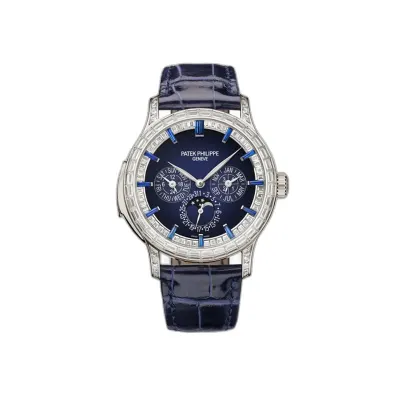
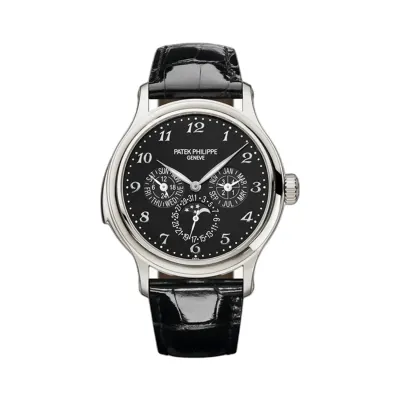
On the dial it can usually be told apart by the leap-year cycle indicator, which an annual calendar lacks, alongside the day, date and month. It is very often paired with a moon phase. Examples:
- Patek Philippe 5327G-001, in white gold, 39 mm, with day, date, month, leap year and 24-hour indication by hands, plus moon phases.
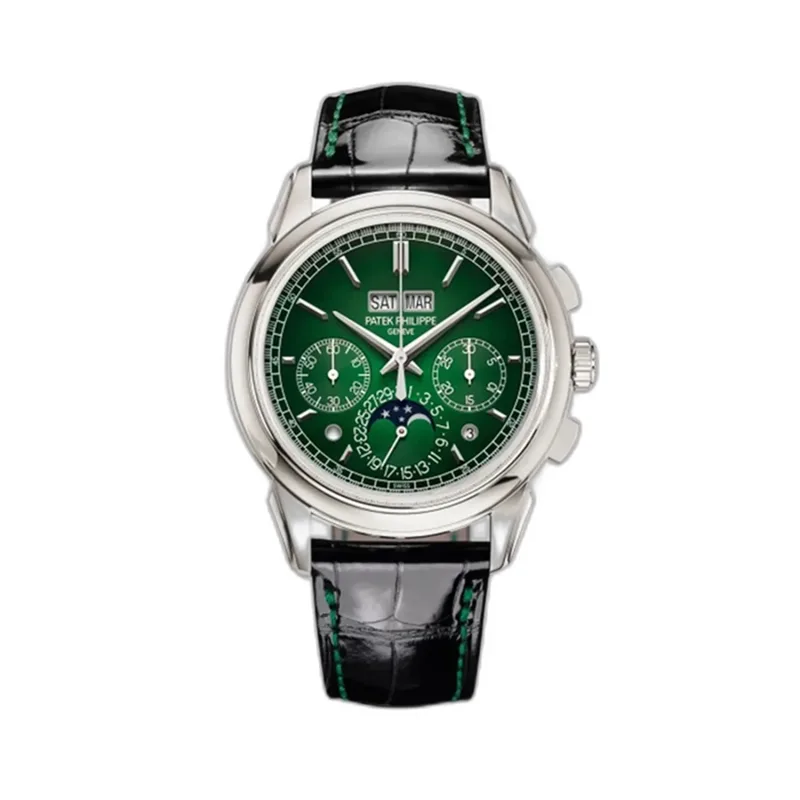
- Patek Philippe 5270P-014, in platinum, 41 mm, combining a chronograph and perpetual calendar, with a green lacquered dial.
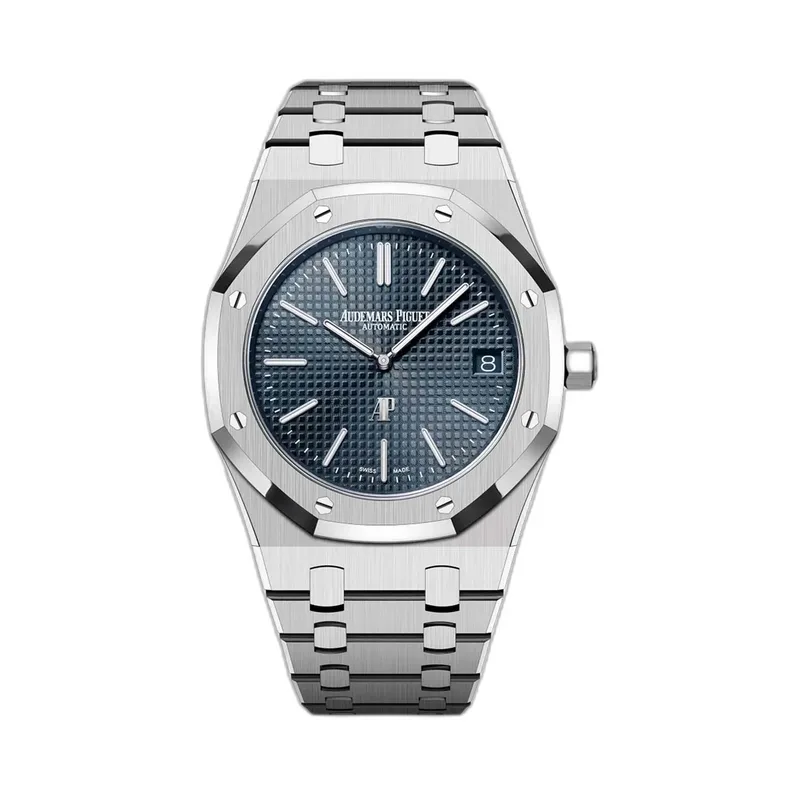
- Audemars Piguet Royal Oak Selfwinding Perpetual Calendar 26684ST, in steel, 38 mm, with calibre 7136. Audemars Piguet highlights that all its indications are set using the crown alone, without the recessed correctors in the case side used by many perpetual calendars. It is in our Audemars Piguet Royal Oak collection.
Patek Philippe’s perpetual calendars are in our Patek Philippe Grand Complications collection.
Moon phase
Patek Philippe defines it as the complication that depicts the evolution of the moon as seen from the earth. Typically it is a painted disc with two moons turning beneath a crescent-shaped aperture, so that the moon appears, waxes, becomes full and disappears over the cycle. It is often combined with an annual or perpetual calendar, as on Patek Philippe’s 5205G and 5327G. The FHH counts it among the astronomical complications.
Measuring time
What is a chronograph?
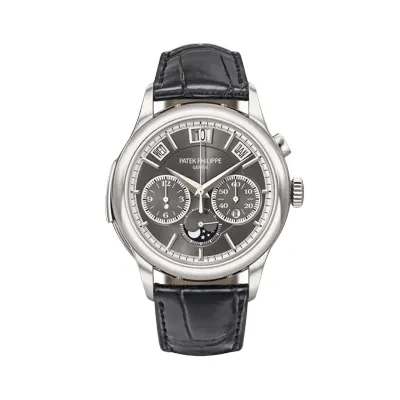
The FHH defines it as a watch that measures short periods of time by means of additional hands. It is usually operated with two pushers: one starts and stops the central chronograph seconds hand, the other returns it to zero. The small counters on the dial add up the elapsed minutes and, sometimes, hours.
Examples from our catalogue:
- Rolex Cosmograph Daytona, with 30-minute and 12-hour counters; the watches are in our Rolex Daytona collection.
- Patek Philippe 5172G-001, in white gold, 41 mm, a manually wound chronograph with a 30-minute counter.
What is a flyback chronograph?
A flyback chronograph lets you restart timing with a single press: the FHH describes it as the mechanism that resets and restarts the chronograph at once, without stopping it first. A standard chronograph needs three presses – stop, reset, start; a flyback needs one. It is useful for timing consecutive intervals, such as the legs of a flight or a race.
Examples: the Patek Philippe 5905/1A-001, in steel, 42 mm, which Patek presents as a flyback chronograph with annual calendar, and the 5930P-001, which combines flyback and world time.
Split-seconds (rattrapante)
A split-seconds chronograph, or rattrapante, has two superimposed central seconds hands. According to the FHH, one of them can be stopped and then restarted to catch up with the other; Patek Philippe describes it as an additional seconds hand superimposed on the chronograph hand. It is used to time an intermediate interval, or two events that start together and finish at different moments, without stopping the main measurement. That is why it has one more control than a standard chronograph, to stop and release the second hand.
Examples:
- Patek Philippe 5370R-001, in rose gold, 41 mm, a manually wound split-seconds chronograph.
- Patek Philippe 5204G, which combines a split-seconds chronograph and perpetual calendar.
- Richard Mille RM 65-01, which the brand presents as an automatic split-seconds chronograph, with calibre RMAC4; it is in our Richard Mille RM 65-01 collection.
Tachymeter scale
Not a mechanism but a printed or engraved scale, usually on the bezel, used with the chronograph to work out an average speed. You start the chronograph at the beginning of a known distance, a kilometre for example, and stop it at the end: the hand points to the speed in units per hour on the scale. The Rolex Daytona has carried it on the bezel since its first reference, the 6239, and on current models the scale reads up to 400 units per hour.
Regatta countdown
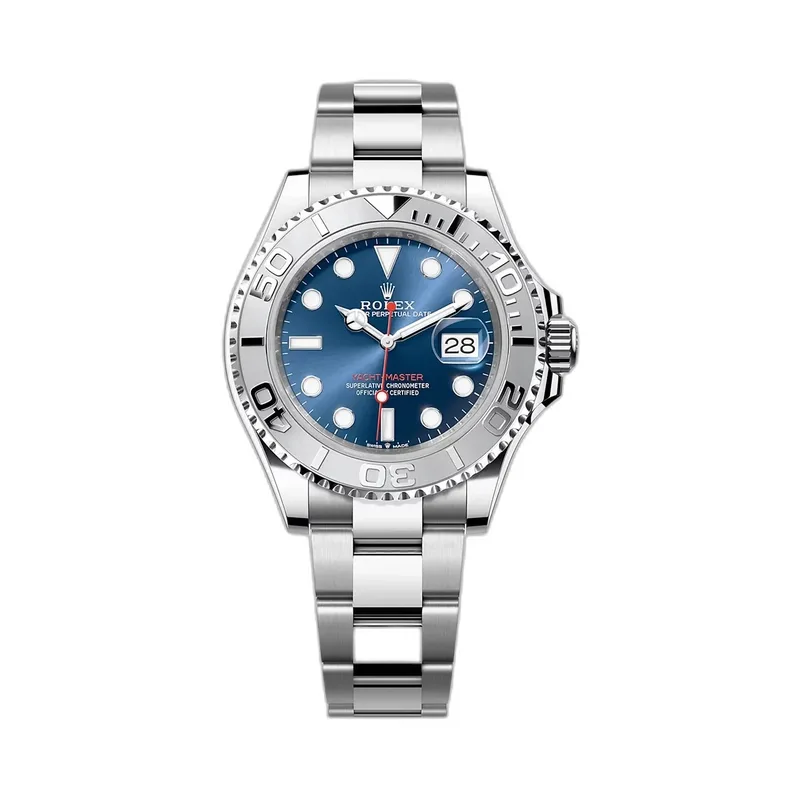
A chronograph designed for the start of a sailing race, in which boats must cross the line under way just as a sequence of signals ends. The clearest example is the Rolex Yacht-Master II: its countdown can be programmed for up to 10 minutes, is stored in a mechanical memory and can be resynchronised on the fly with a pusher if the watch and the signals do not match. On the 2026 version, the countdown hands run anticlockwise. We explain it in our Rolex Yacht-Master guide.
Other time zones
What is a GMT watch?
A GMT watch shows a second time zone with an additional hand, in the FHH’s definition. Most often that hand turns once every 24 hours, so you can tell day from night in the other zone. There are two main approaches:
- A 24-hour hand against a 24-hour bezel or scale. This is the Rolex GMT-Master II system: the 24-hour hand shows the reference time and, when travelling, the local hour hand is moved in jumps without stopping the watch. Turning the bezel lets you read a third time zone. We explain it in our GMT-Master II guide, and the watches are in the Rolex GMT-Master II collection.
- Two hour hands. This is Patek Philippe’s Travel Time system. On the Aquanaut Travel Time 5164G-001, the skeletonised hand shows home time and the solid one local time, which is set with two pushers on the left-hand side of the case. Two apertures show whether it is day or night in each zone.
GMT vs world time
A world time watch shows the time in all 24 time zones at once. In the classic version, Patek Philippe’s, the dial has a disc with 24 city names and a 24-hour ring that turns with it. The hour and minute hands show the time in the city at 12 o’clock, and the rest of the world is read on the ring opposite each city. When you travel, a pusher at 10 o’clock advances the city disc and the 24-hour ring, and moves the hour hand, in one-hour steps.
Examples in our catalogue, all from Patek Philippe: the 5930P-001, in platinum, with world time and a flyback chronograph; the 5935A-001, in steel, 41 mm, with the same combination; and the 7129J-001, in yellow gold, 36 mm, with the self-winding calibre 240 HU.
Displaying the time differently
Jumping hours and digital displays
Instead of hands, a jumping hour shows the hours, and sometimes the minutes, as numerals in apertures that change instantly. The clearest example in our catalogue is A. Lange & Söhne’s Zeitwerk. It shows hours and minutes with jumping numerals on three discs which, every 60 seconds, advance in a fraction of a second. Moving the discs at once takes a burst of energy, which Lange supplies with a patented constant-force escapement that delivers the impulse for the display once a minute. The Zeitwerk Date 148.038, in white gold, 44.2 mm, adds a date ring around the dial and runs on the manually wound calibre L043.8.
A variation is the retrograde display, in which a hand sweeps an arc and then flies back to the start. Jacob & Co’s Bugatti Tourbillon combines off-centre jumping retrograde hours and retrograde minutes with a flying tourbillon.
Chiming watches
Minute repeater
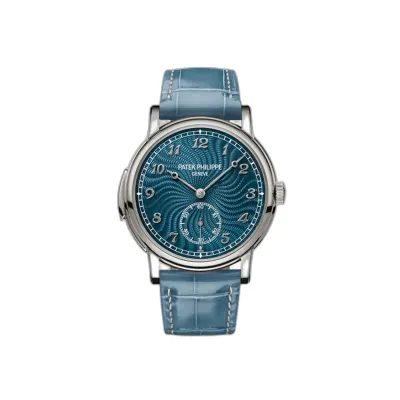
A minute repeater tells the time with sound when the wearer asks it to. The FHH describes it as a mechanism that chimes the time with two hammers striking two gongs; according to Patek Philippe’s glossary, it strikes the hours, quarters and minutes, exclusively on request. It is usually activated with a slide on the side of the case, which also winds the striking mechanism.
Examples:
- Patek Philippe 5178G-012, in white gold, 40 mm, a minute repeater chiming on two “cathedral” gongs, longer than standard ones.
- Patek Philippe 5374G-001, which combines a minute repeater with a perpetual calendar.
- Audemars Piguet Royal Oak Minute Repeater Supersonnerie 26591TI, in titanium, 42 mm, with the manually wound calibre 2953.
Grande and petite sonnerie
The difference from a repeater is that a sonnerie chimes by itself, in passing, like a church clock. Patek Philippe’s glossary defines it this way: a grande sonnerie automatically strikes the full hours and, as each quarter passes, the hours and quarters; a petite sonnerie strikes the full hours and, as each quarter passes, the quarters only.
Regulation and construction
What is a tourbillon? Tourbillon and flying tourbillon
A tourbillon is a rotating cage housing two key components of a mechanical watch: the balance and the escapement. By turning continuously, often once a minute, it averages out the rate errors that gravity causes when the watch is in a vertical position. The FHH notes that Abraham-Louis Breguet registered the patent in 1801 and that the aim was to offset the effect of gravity on the balance and balance spring.
In a classic tourbillon, the cage is held from above, by a bridge, and from below. A flying tourbillon does away with the upper bridge: the cage is supported only from below and is visible in full, as if floating. It is credited to Alfred Helwig, a teacher at the Glashütte watchmaking school, in the 1920s.
Examples:
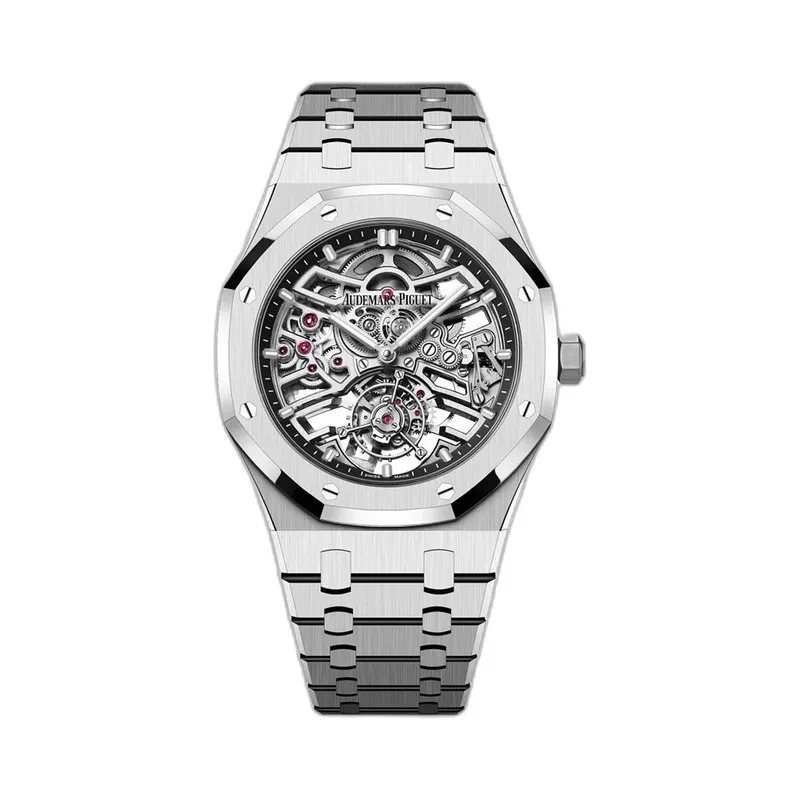
- Audemars Piguet Royal Oak Selfwinding Flying Tourbillon Openworked 26735ST, in steel, with the self-winding calibre 2972 and an openworked movement.
- Jacob & Co Bugatti Tourbillon, with a flying tourbillon that turns once every 30 seconds and an automaton shaped like a V16 engine, powered by the manually wound calibre JCAM55.
Skeleton or openworked
A skeleton, or openworked, watch has a hollowed-out movement: all material that is not strictly needed is removed from the plates and bridges so the mechanism can be seen from front and back. Patek Philippe defines it as a movement that is openworked and engraved by hand, because the finishing of the exposed edges is part of the craft.
The Audemars Piguet Royal Oak Double Balance Wheel Openworked 15412 is a good example: an openworked self-winding movement, calibre 3132, with two balance wheels and two hairsprings working together. The 26735ST tourbillon above is openworked too.
Power reserve indicator
It shows how long the watch will keep running before it needs winding. Patek Philippe abbreviates it as IRM in its calibre names. It is especially useful on manually wound watches, which stop if you forget to wind them: A. Lange & Söhne’s Grand Lange 1 has one, and Jacob & Co’s Bugatti Tourbillon has a double power reserve indicator. What power reserve is, and how it differs between automatic and manual watches, is explained in our guide on automatic, manual or quartz watches.
What counts as a grand complication?
Tradition, as the FHH puts it, dictates that a grand complication includes at the very least a chronograph, a minute repeater and a perpetual calendar. All three functions draw energy and compete for space in the same movement, hence the difficulty.
An example in our catalogue is the Audemars Piguet Royal Oak Offshore Grande Complication 26582, in black ceramic on the CE version. Its self-winding calibre 2885 combines a minute repeater, a perpetual calendar and a split-seconds chronograph.
The term should not be confused with a collection name. Patek Philippe calls the line that gathers its most complex watches Grand Complications, and it includes pieces with only one of those functions, such as the 5327G perpetual calendar.
Summary table
| Complication | What it does | Example from our catalogue |
|---|---|---|
| Date and big date | Shows the day of the month | Grand Lange 1 137.033 |
| Annual calendar | Day, date and month; one correction a year | Patek Philippe 5205G-013, Rolex Sky-Dweller |
| Perpetual calendar | Full calendar with leap years until 2100 | Patek Philippe 5327G-001, AP 26684ST |
| Moon phase | Shows the phase of the moon | Patek Philippe 5396G-017 |
| Chronograph | Times short intervals | Rolex Daytona, Patek Philippe 5172G-001 |
| Flyback | Restarts the chronograph with one press | Patek Philippe 5905/1A-001 |
| Split-seconds | Times intermediate intervals | Patek Philippe 5370R-001, Richard Mille RM 65-01 |
| Regatta countdown | Times the start of a race | Rolex Yacht-Master II |
| GMT | Reads a second time zone | Rolex GMT-Master II, Patek Philippe 5164G-001 |
| World time | Reads all 24 time zones at once | Patek Philippe 5930P-001, 7129J-001 |
| Jumping hours | Shows the time in numerals | A. Lange & Söhne Zeitwerk Date 148.038 |
| Minute repeater | Chimes the time on request | Patek Philippe 5178G-012, AP 26591TI |
| Tourbillon | Offsets the effect of gravity | AP 26735ST, Jacob & Co Bugatti Tourbillon |
| Skeleton | Shows the movement | AP Royal Oak 15412 |
| Power reserve | Shows how much winding is left | Grand Lange 1 137.033 |
| Grand complication | Chronograph, repeater and perpetual together | AP Royal Oak Offshore 26582 |
Every watch in our catalogue is priced on request and available to order, and we can send you photos of any of them. If you are looking for a particular complication in a reference that is not listed, you can request a model.
Frequently asked questions
What is the difference between an annual and a perpetual calendar?
Both show the day, date and month and know the 30- and 31-day months. The difference is February: an annual calendar does not know whether it has 28 or 29 days and needs correcting once a year, at the end of that month. A perpetual calendar does, because it follows the leap-year cycle, and needs no adjustment until 2100.
What does a tourbillon do?
It offsets the effect of gravity on the balance and hairspring, which makes a watch run fast or slow depending on its position. A tourbillon mounts the balance and escapement in a cage that turns continuously, often once a minute, and so averages out those errors. Abraham-Louis Breguet patented it in 1801.
What is the difference between GMT and world time?
A GMT watch shows two time zones: local time and a reference zone, usually with a 24-hour hand. A world time watch shows all 24 time zones at once, with a city disc and a 24-hour ring around the dial. A GMT is for keeping track of home time; a world time watch tells you the time anywhere.
Are a chronograph and a chronometer the same thing?
No. A chronograph is a complication that measures intervals of time with pushers and extra hands. A chronometer is a watch whose precision has been tested and certified; in Switzerland that is done by the COSC, which tests mechanical movements to the ISO 3159 standard. A watch can be both, like the Rolex Daytona, a chronograph with chronometer certification.
What is a flyback?
A chronograph that restarts with a single press: push the reset button while it is running and the hand flies back to zero and starts again without stopping. On a standard chronograph you have to stop it, reset it and start it again. It is used to time consecutive intervals without losing a moment.
What is a minute repeater?
A chiming complication that sounds the exact time when you operate a slide on the side of the case. Two hammers strike two gongs and chime, in this order, the hours, the quarters and the minutes that have passed. Unlike a grande or petite sonnerie, it does not chime by itself: only when the wearer asks.
What counts as a grand complication?
A watch that combines at least a chronograph, a minute repeater and a perpetual calendar, according to the tradition recorded by the Fondation Haute Horlogerie. A fourth, such as a tourbillon, is sometimes added. The term should not be confused with Grand Complications, the name Patek Philippe uses for its collection of most complex watches.
Sources
- Fondation Haute Horlogerie, Watch complications (opens in a new window)
- Fondation Haute Horlogerie, The unstoppable tourbillon (opens in a new window)
- SJX, In-Depth: Alfred Helwig’s Flying Tourbillon in Wrist- and Pocket Watches (opens in a new window)
- Patek Philippe, glossary (opens in a new window)
- Patek Philippe, calendar watches (opens in a new window)
- Phillips, Patek Philippe ref. 5035, the first annual calendar (1996) (opens in a new window)
- Patek Philippe, 5205G-013 Annual Calendar (opens in a new window)
- Patek Philippe, 5327G-001 Perpetual Calendar (opens in a new window)
- Patek Philippe, 5270P-014 Chronograph with Perpetual Calendar (opens in a new window)
- Patek Philippe, 5905/1A-001 Flyback Chronograph with Annual Calendar (opens in a new window)
- Patek Philippe, 5370R-001 Split-Seconds Chronograph (opens in a new window)
- Patek Philippe, Aquanaut Travel Time 5164G-001 (opens in a new window)
- Patek Philippe, Chronograph with World Time ref. 5930 press release (2016, PDF) (opens in a new window)
- Patek Philippe, 5178G-012 Minute Repeater (opens in a new window)
- Patek Philippe, 5212A-001 Calatrava Weekly Calendar (opens in a new window)
- Audemars Piguet, Royal Oak Selfwinding Perpetual Calendar 26684ST (opens in a new window)
- SJX, Audemars Piguet Scales Down the Royal Oak Perpetual Calendar (38 mm) (opens in a new window)
- Audemars Piguet, Royal Oak Selfwinding Flying Tourbillon Openworked 26735ST (opens in a new window)
- SJX, Audemars Piguet Royal Oak Frosted Gold Double Balance Wheel Openworked (opens in a new window)
- Monochrome, Audemars Piguet Royal Oak Minute Repeater Supersonnerie 26591TI (opens in a new window)
- Audemars Piguet, Royal Oak Offshore Grande Complication 26582CE (opens in a new window)
- WorldTempus, Audemars Piguet Royal Oak Offshore Grande Complication (opens in a new window)
- Richard Mille, RM 65-01 Automatic Split-Seconds Chronograph (opens in a new window)
- Jacob & Co, Bugatti Tourbillon (opens in a new window)
- A. Lange & Söhne, Zeitwerk Date (press) (opens in a new window)
- A. Lange & Söhne, Grand Lange 1 (press) (opens in a new window)
- Monochrome, 2026 Rolex Yacht-Master II 126680 and 126688 (opens in a new window)
- Rolex, GMT-Master II user guide (opens in a new window)
- Monochrome, Rolex Sky-Dweller review (opens in a new window)
- COSC, frequently asked questions (opens in a new window)