Rolex Yacht-Master and Yacht-Master II: Model Guide
The Yacht-Master in 37, 40 and 42 mm, in Everose gold, titanium or on an Oysterflex strap, and the Yacht-Master II regatta countdown: how they differ.
The Rolex Yacht-Master is a three-hand watch with a date and a bidirectional rotatable bezel graduated over 60 minutes with raised numerals. It is waterproof to 100 metres and made in 37, 40 and 42 mm, in gold, Rolesor, Rolesium or titanium. The Yacht-Master II is a different watch: a 44 mm regatta chronograph with a countdown that can be programmed for up to 10 minutes, which Rolex renewed in 2026 with calibre 4162. They share a name and a nautical calling, but not a function.
This guide covers the sizes, materials, bezel and strap of the Yacht-Master, and how the Yacht-Master II countdown works in both its generations.
What is the Rolex Yacht-Master?
The Yacht-Master is Rolex’s watch for recreational sailing. It is not a dive watch, even if it looks like one at first glance: it is waterproof to 100 metres, the same as a GMT-Master II, and its bezel turns both ways. What gives it character is the pairing of a sporty Oyster case with materials that Rolex usually keeps for its dress watches.
1992: an Oyster for sailing
Rolex introduced the Yacht-Master in 1992 as reference 16628, in 18 ct yellow gold, 40 mm, with a white dial, calibre 3135 and a Triplock crown. From the start it was a gold watch with a sporting spirit, and Rolex gave it 100 metres of water resistance, less than a Submariner.
In 1994 two smaller sizes arrived, also in gold: 35 mm (reference 68628) and 29 mm (69628), with calibre 2135. At the 1999 Basel fair Rolex presented the steel and platinum version, the 16622, and christened the combination Rolesium; its 35 and 29 mm versions, 168622 and 169622, followed. Steel and gold versions, which Rolex calls Rolesor, completed the range.
The bidirectional bezel with raised numerals
The bezel is what identifies a Yacht-Master. It is graduated over 60 minutes and turns in both directions, so it can be used to time an interval or to mark a reference point, such as the time you need to be back in harbour. The numerals and graduations are raised.
The bezel varies by version. On the bracelet models – Rolesor, Rolesium and the early gold ones – it is solid metal, gold or platinum, with no insert, and the numerals are worked into the metal itself. On the Oysterflex versions and the titanium one, it carries a black Cerachrom ceramic insert with raised numerals.
Yacht-Master sizes: 37, 40 and 42 mm (and the earlier 29 and 35 mm)
| Size | Example references | Materials | Calibre |
|---|---|---|---|
| 29 mm | 69628, 169622, 69623 | Yellow gold, Rolesium, steel and yellow gold | 2135 on the 1994 models |
| 35 mm | 68628, 168622 | Yellow gold, Rolesium | 2135 on the 1994 models |
| 37 mm | 268655, 268621 | Everose gold, Everose Rolesor | 2236 |
| 40 mm | 126621, 126622, 126655 | Everose Rolesor, Rolesium, Everose gold | 3235 |
| 42 mm | 226659, 226658, 226627 | White gold, yellow gold, RLX titanium | 3235 |
How to choose a size
Size is not a question of whether a watch is “for men” or “for women”, but of your wrist and how you want to wear it. The 29 and 35 mm sizes are no longer made, but they are still seen often. The 37 mm is the most discreet of the current range and sits best on slimmer wrists. The 40 mm is the model’s historic size and the one with the widest choice of materials. The 42 mm, the newest, is the sportiest: it arrived in 2019 and is the size Rolex has used to try out new materials, such as titanium.
Materials
Rolesium: steel and platinum
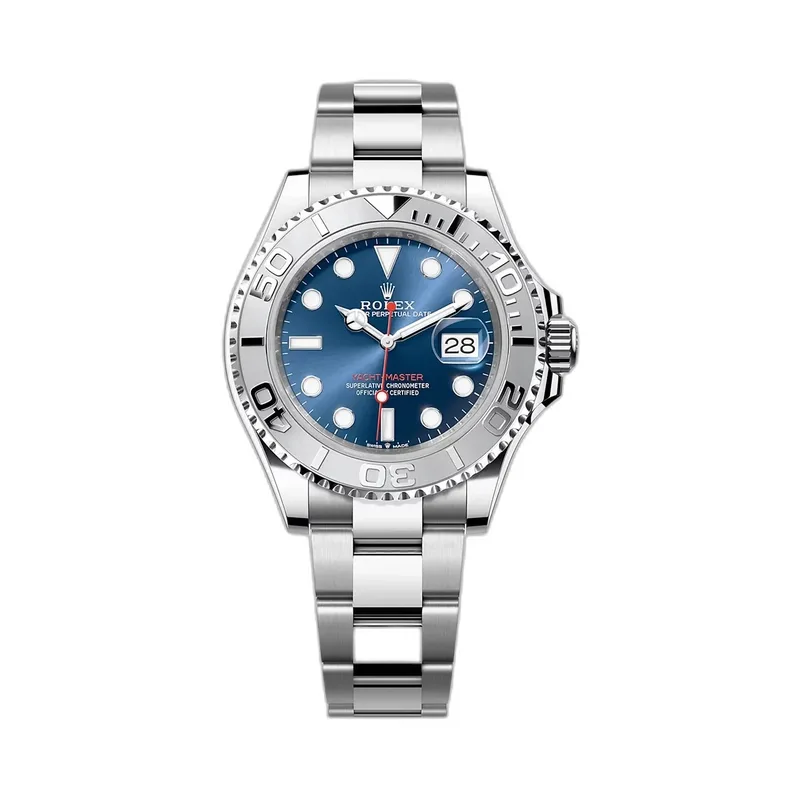
Rolesium is Rolex’s name for the combination of its Oystersteel with platinum. On the Yacht-Master, the bezel is solid platinum while the case and bracelet are steel. It made its debut in 1999 with the 16622, and in the 40 mm generation with calibre 3235 it is the 126622. The name reappeared in 2026 on another Rolex, the Daytona 126502.
Everose gold and Everose Rolesor
Everose is Rolex’s 18 ct pink gold alloy. The Yacht-Master uses it in two ways:
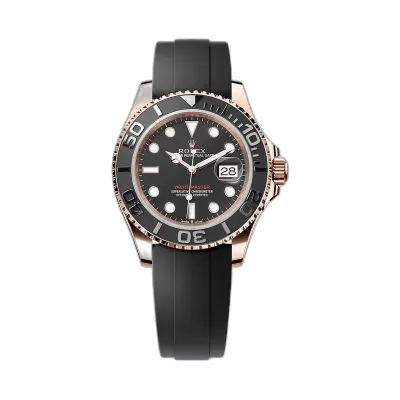
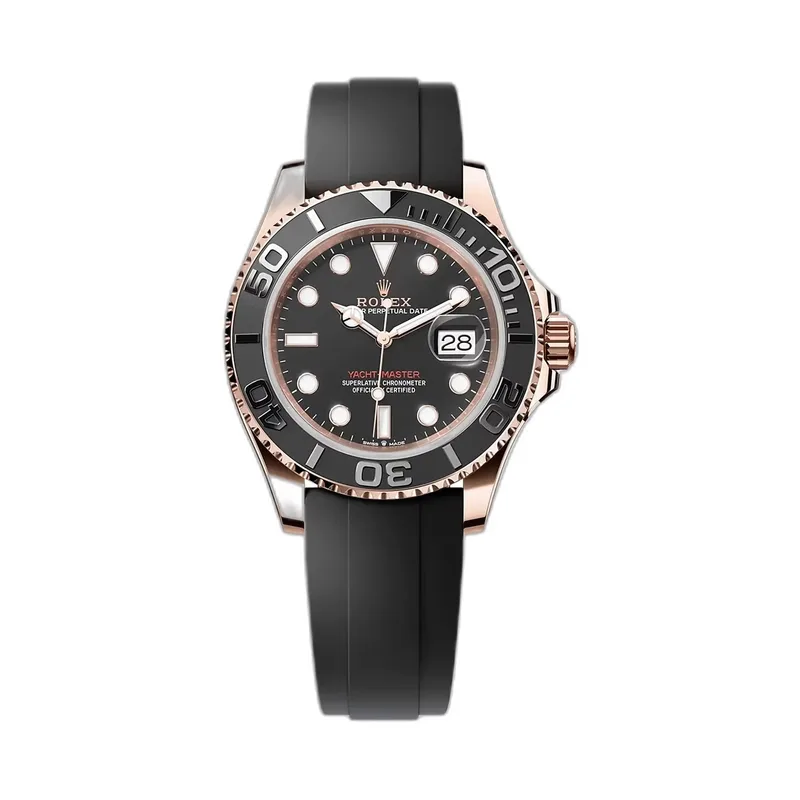
- Solid Everose gold. In 2015 Rolex introduced the Everose gold Yacht-Master on an Oysterflex bracelet, which was also the debut of that strap at the brand: the 40 mm 116655, with calibre 3135, and the 37 mm 268655, with calibre 2236, both with a matt black ceramic bezel and polished raised numerals. Today’s 40 mm version is the 126655, with calibre 3235.
- Everose Rolesor, steel and Everose gold. These are the 40 mm 126621 and the 37 mm 268621, always on an Oyster bracelet with an Everose gold bezel and raised numerals.
In 2026, according to WatchTime, the Yacht-Master’s diamond and pavé dials and some Everose versions left the catalogue; the article does not list the references.
Yellow gold and white gold
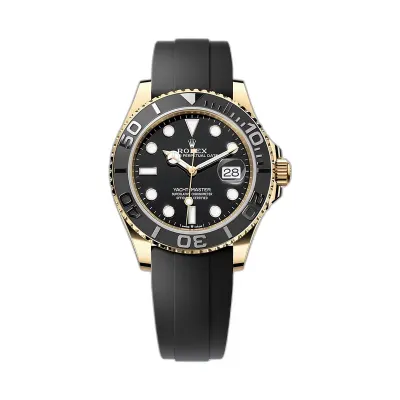
Yellow gold is the material the model was born in, in 1992. In the 42 mm size it returned in 2022 with the 226658, on an Oysterflex bracelet with a matt black ceramic bezel. White gold came with the first 42 mm version, the 226659 of 2019, also on Oysterflex.
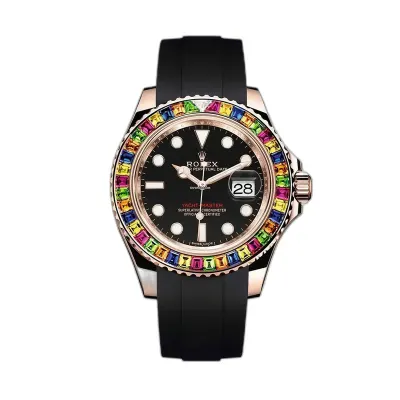
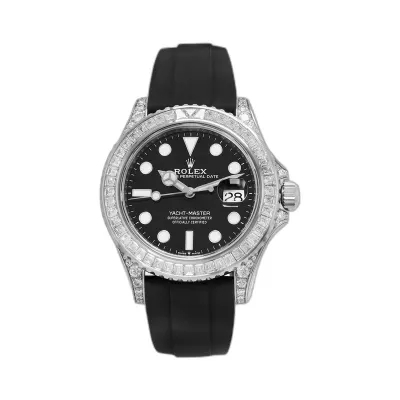
There are also gem-set versions, which you can recognise by their suffixes. The 116695SATS, introduced in 2017, is a 40 mm Everose gold watch with a bezel set with coloured sapphires and tsavorites, on an Oysterflex strap. The 226679TBR is a 42 mm white gold watch with baguette diamonds on the bezel and lugs, a black dial and an Oysterflex strap.
Rolex Yacht-Master titanium
In 2023 Rolex introduced the Yacht-Master 42 in titanium, the 226627. The brand calls its alloy RLX titanium, a grade 5 titanium, and according to SJX it is the second all-titanium Rolex in series production, after the Deepsea Challenge. It has a black ceramic bezel with raised numerals, a matt black dial and a titanium bracelet with the Easylink extension.
What is the Oysterflex strap? Oyster bracelet or Oysterflex
The Oysterflex looks like a rubber strap, but Rolex treats it as a bracelet. Inside is a flexible titanium and nickel alloy blade coated in black elastomer, and the brand developed and patented it as a sporty alternative to metal bracelets. It made its debut in 2015 on the Yacht-Master and later moved to other models, such as the Daytona.
In the recent range, the Oysterflex goes with the solid gold Yacht-Masters: Everose in 37 and 40 mm, and yellow and white gold in 42 mm. The three-link Oyster bracelet is used on the Rolesor and Rolesium versions. The titanium version has a bracelet in the same metal.
The choice is mostly about use and style. The Oysterflex is the sportier option; the Oyster bracelet, more classic, lengthens with the Easylink extension, which adds around 5 mm without tools.
Yacht-Master II: the regatta chronograph
The Yacht-Master II shares its name with the Yacht-Master but differs in everything else: a 44 mm case, a chronograph movement and a function built for one specific moment in competitive sailing, the start of a race.
How the programmable countdown works
In a regatta, boats do not start from a standstill: they sail behind the line during a start sequence of 5 to 10 minutes, marked by signals, and the aim is to cross it at speed just as the sequence ends. That calls for a countdown that can be set to the length of the sequence and synchronised with the signals.
The Yacht-Master II handles both. The countdown can be programmed for up to 10 minutes and the watch stores it in a mechanical memory: when you reset it, it returns to the programmed duration without being set again. And if the race committee’s signal does not match the watch, a pusher lets you resynchronise on the fly: it resets the seconds hand and moves the countdown minute hand to the nearest minute.
The rotating bezel that controlled the watch
On the first generation, the countdown was programmed with the bezel. Rolex called it Ring Command: turning the bezel 90 degrees gave access to the duration setting, which was adjusted with the crown, and turning it back locked and memorised it. The bezel was not decoration but part of the mechanism, and Rolex later used the same principle on the Sky-Dweller.
On the 2026 generation the bezel plays no part. The countdown is programmed with the lower pusher, at 4 o’clock, and started with the upper one. The bezel is now a conventional bidirectional one, with a blue Cerachrom insert and a 60-minute scale.
Yacht-Master vs Yacht-Master II: from the 2007 version to 2026
| First generation (2007) | 2026 generation | |
|---|---|---|
| References | 116688, 116689, 116681, 116680 | 126680, 126688 |
| Materials | Yellow gold; white gold with platinum bezel; Everose Rolesor; steel | Steel; yellow gold |
| Calibre | 4161 | 4162 |
| Programming | Ring Command bezel and crown | Pushers |
| Countdown hands | Clockwise | Anticlockwise |
| Diameter | 44 mm | 44 mm (13.9 mm thick) |
| Water resistance | 100 m | 100 m |
The first generation was introduced in 2007 and came to be made in yellow gold, in white gold with a platinum bezel, in Everose Rolesor and in steel. In 2017 Rolex revised the dial of the steel 116680: a triangular marker at 12, a rectangular one at 6, an hour hand with a large luminescent disc and a cut-out minute hand so as not to obscure the countdown scale. Calibre 4161 – self-winding, with a column wheel, vertical clutch and around 72 hours of power reserve – was unchanged.
After a period out of the catalogue, the Yacht-Master II returned in 2026 with two references: the 126680 in steel, with red details, and the 126688 in yellow gold. The case stays at 44 mm and is around 0.2 mm slimmer. The dial is matt white lacquer, with the regatta scale moved to a sloping flange around the dial and a small seconds at 6 o’clock. The most striking change is that the countdown hands run anticlockwise. Both come on an Oyster bracelet.
The movement
The current 40 and 42 mm Yacht-Master uses calibre 3235, self-winding, with date, the Chronergy escapement and around 70 hours of power reserve; the 37 mm versions use the 2236. The first 40 mm Yacht-Masters used the 3135 and the small 1994 sizes the 2135.
The 2026 Yacht-Master II uses calibre 4162, an evolution of the 4161. According to SJX, it shares much of its construction with the Daytona’s calibre 4131: column wheel, vertical clutch, Chronergy escapement and Parachrom hairspring. It has around 72 hours of power reserve and is certified as a Superlative Chronometer. We explain how a self-winding movement works in our guide on automatic, manual or quartz watches, and the regatta countdown, alongside other functions, in our watch complications glossary.
References in our catalogue
These are the references currently in our Rolex Yacht-Master collection and our Rolex Yacht-Master II collection. Stock changes, so treat the list as a guide.
| Reference | Size | Material | Bezel | Strap or bracelet |
|---|---|---|---|---|
| 69623 | 29 mm | Steel and yellow gold | Yellow gold | Oyster |
| 268621-0003 | 37 mm | Everose Rolesor | Everose gold | Oyster |
| 126621-0001, -0002 | 40 mm | Everose Rolesor | Everose gold | Oyster |
| 126622-0002 | 40 mm | Rolesium | Platinum | Oyster |
| 126655-0002 | 40 mm | Everose gold | Matt black Cerachrom | Oysterflex |
| 116695SATS | 40 mm | Everose gold | Set with sapphires and tsavorites | Oysterflex |
| 226658-0001 | 42 mm | Yellow gold | Matt black Cerachrom | Oysterflex |
| 226627-0001 | 42 mm | RLX titanium | Black Cerachrom | Titanium |
| 226679TBR-0003 | 42 mm | White gold | Baguette diamonds | Oysterflex |
| 116680-0002 | 44 mm (II) | Steel | Ring Command | Oyster |
| 116681-0002 | 44 mm (II) | Everose Rolesor | Ring Command | Oyster |
| 126680-0001 | 44 mm (II) | Steel | Blue Cerachrom | Oyster |
| 126688-0001 | 44 mm (II) | Yellow gold | Blue Cerachrom | Oyster |
All are priced on request and available to order, and we can send you photos of any piece. If you are looking for another version, such as a white gold Yacht-Master 42 or a 37 mm in Everose gold, you can request a specific model. To understand what each figure in these references tells you, see our guide on how to read watch reference numbers.
Yacht-Master vs Submariner vs GMT-Master II
All three are Rolex sports watches with an Oyster case and a rotating bezel, and they are easy to confuse in a photo. What separates them is what the bezel does and the use each is designed for.
| Yacht-Master | Submariner Date | GMT-Master II | |
|---|---|---|---|
| Use | Sailing | Diving | Travel |
| Bezel | Bidirectional, 60 minutes, raised numerals | Unidirectional, 60 minutes | Bidirectional, 24 hours, two colours |
| Water resistance | 100 m | 300 m | 100 m |
| Sizes | 37, 40 and 42 mm | 41 mm | 40 mm |
| Materials | Gold, Rolesor, Rolesium, titanium | Steel, Rolesor, gold | Steel, Rolesor, gold |
| Bracelet | Oyster or Oysterflex | Oyster | Oyster or Jubilee |
If you plan to dive, the family’s watch for the job is the Submariner, covered in our Rolex Submariner guide and found in the Rolex Submariner collection. If you travel often, the GMT-Master II reads two time zones at once; see our GMT-Master II guide. The Yacht-Master is the choice for anyone who wants a sporty Rolex in gold or on an elastomer strap.
Frequently asked questions
What is the difference between the Yacht-Master and the Yacht-Master II?
The Yacht-Master shows hours, minutes, seconds and the date, with a 60-minute rotating bezel, in 37, 40 and 42 mm. The Yacht-Master II is a 44 mm regatta chronograph with a countdown programmable for up to 10 minutes and a mechanical memory, designed for the start of a sailing race. They share only the name and the Oyster case.
Is the Yacht-Master a dive watch?
No. It is designed for sailing, not diving. It is waterproof to 100 metres, against the Submariner’s 300, and its bezel turns both ways, whereas a dive watch bezel turns one way only for safety. For diving, the brand has the Submariner and the Sea-Dweller.
What is the Oysterflex strap?
It is the strap Rolex developed and patented as an alternative to metal bracelets. On the outside it is black elastomer; inside, a flexible metal blade gives it stability. It made its debut in 2015 on the Everose gold Yacht-Master and is also used on the 42 mm yellow gold and white gold models.
What is Rolesium?
It is Rolex’s name for the combination of Oystersteel and platinum. On the Yacht-Master, the bezel is solid platinum while the case and bracelet are steel. Rolex introduced it in 1999 with reference 16622, and in the 40 mm generation with calibre 3235 it is the 126622.
Yacht-Master 40 or 42?
The 40 mm is the model’s original size and offers the most materials: Rolesium, Everose Rolesor and Everose gold. The 42 mm, from 2019, looks sportier and has been made in white gold, yellow gold and RLX titanium, with a black ceramic bezel. Both use calibre 3235. The choice depends on your wrist and the material you want.
What is the Yacht-Master II countdown for?
For the start of a regatta, in which boats must cross the line under way just as a sequence of signals lasting 5 to 10 minutes ends. The countdown is programmed to that duration, remembered mechanically and can be resynchronised on the fly if the watch and the signals do not match.
Sources
- Fratello, Some Rolex Yacht-Master History (opens in a new window)
- SJX, Rolex Introduces the Yacht-Master Everose with Oysterflex (2015) (opens in a new window)
- Monochrome, The Rolex Yacht-Master 42 in Yellow Gold Ref. 226658 (opens in a new window)
- SJX, Rolex Introduces the Yacht-Master 42 in RLX Titanium Ref. 226627 (opens in a new window)
- Phillips, Rolex Yacht-Master 116695SATS (opens in a new window)
- Sotheby's, Rolex Yacht-Master 42 226679TBR (opens in a new window)
- Monochrome, Rolex Yacht-Master II 116680, updated 2017 (opens in a new window)
- Monochrome, 2026 Rolex Yacht-Master II 126680 and 126688 (opens in a new window)
- SJX, Hands On: Rolex Yacht-Master II (2026) (opens in a new window)
- Monochrome, Rolex Sky-Dweller review (Ring Command bezel) (opens in a new window)
- Monochrome, All the New Rolex Models of 2026 (opens in a new window)
- WatchTime, Rolex-Abgänge 2026 (opens in a new window)