Rolex Day-Date “President”: Sizes, Materials and Dials
A guide to the Rolex Day-Date: why it is called the President, 36 and 40 mm sizes, gold or platinum, dials and how it differs from a Datejust.
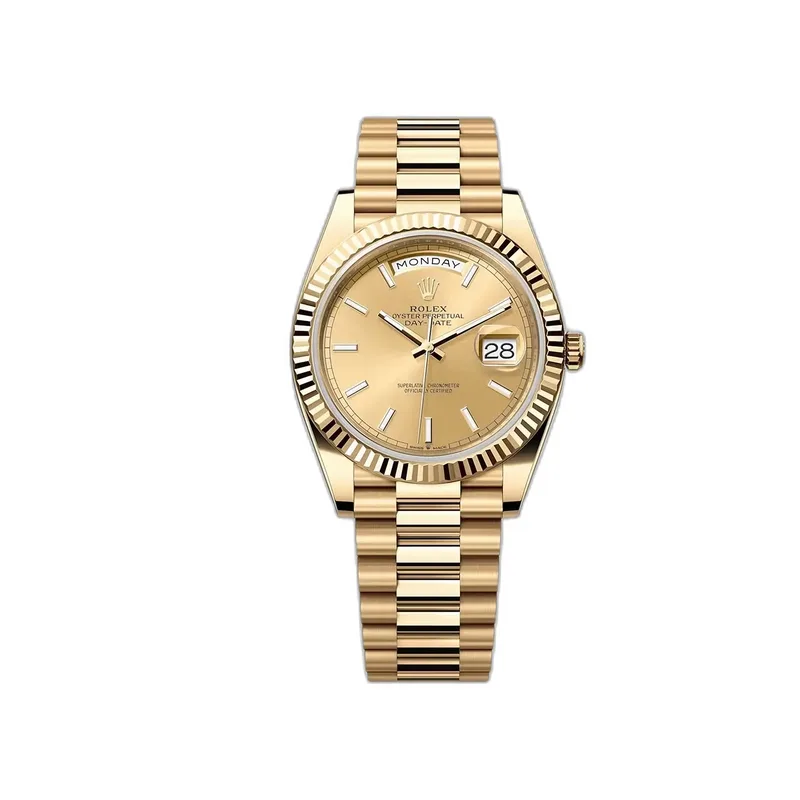
The Day-Date is the Rolex that shows the day of the week spelled out in full in a window at 12 o’clock, alongside the date at 3. It was introduced in 1956 and is made only in 18 ct gold or platinum, today in two sizes, 36 and 40 mm. The “President” name comes from the bracelet: Rolex uses it for the semi-circular-link bracelet it created for this watch, and over the years the name passed to the watch itself.
What is the Day-Date?
1956: the day of the week spelled out, next to the date
Rolex introduced the Day-Date in 1956. It was the first wristwatch to show not only the date but also the day of the week written out in full, without abbreviations. The mechanism had been described in a Swiss patent of 1955, which Monochrome credits to the Rolex engineer Marc Huguenin.
The first two references were the 6510, with a smooth bezel, and the 6511, with a fluted bezel. They measured 36 mm, had an Oyster case and were made for roughly a year. In 1957 they were replaced by the 6611, with calibre 1055, which fixed a problem with the date advance. The 1803, from the 1960s and 1970s, was the last with an acrylic crystal; in the late 1970s the 18038 introduced the sapphire crystal and calibre 3055, running at 28,800 vibrations per hour.
The dial layout has not changed since: a curved, arched window at 12 o’clock for the day and a window at 3 o’clock under a Cyclops lens for the date.
Only in 18 ct gold or platinum
The first references were made in yellow, white and rose 18 ct gold, and since then the Day-Date has only ever been made in gold and platinum. There has never been a steel or steel-and-gold version in the Rolex catalogue. It is the clearest difference from the Datejust, which is offered in steel, Rolesor and gold.
The only caveat is historical: a handful of steel 6611s made outside normal production are known. Monochrome mentions five and Wikipedia six, made as prizes for Geneva watchmaking students; either way, they are exceptional pieces that were never sold as a catalogue model.
Why is the Day-Date called the President?
President is a Rolex name, but for the bracelet: the one with semi-circular three-piece links that arrived with the Day-Date. According to Wikipedia, the brand was already using “President bracelet” in 1957; Fratello finds the name in advertisements from 1966 and admits it is unclear whether it referred to the bracelet or the watch. Over time, popular usage extended it to the whole watch.
Monochrome and Wikipedia link the nickname to Lyndon B. Johnson, who wore a gold Day-Date in the mid-1960s, and to the advertising of the period, although neither pins down an exact origin. In practice, “the Rolex President” today means the Day-Date, almost always on a President bracelet.
If you are curious about other names that are not Rolex’s own, such as Pepsi, Batman or Wimbledon, see our article on Rolex nicknames.
Day-Date 36 vs 40 (and the 41 mm Day-Date II)
The Day-Date had a single size, 36 mm, for more than fifty years. Then came two changes:
| Size | References | Calibre | Years |
|---|---|---|---|
| 36 mm (previous generation) | 1182xx | 3155 | From 2000 until the arrival of the 1282xx |
| 36 mm (current) | 1282xx | 3255 | Since 2019 |
| Day-Date II, 41 mm | 2182xx | 3156 | 2008–2015 |
| Day-Date 40, 40 mm | 2282xx | 3255 | Since 2015 |
The Day-Date II arrived in 2008 at 41 mm, with reference 218238 in yellow gold. It lasted until 2015, when the Day-Date 40 took over, a millimetre smaller and with the new calibre 3255. Fratello dates the arrival of the same calibre in the Day-Date 36 to 2019.
36 or 40? It is a matter of wrist, not of label. The Day-Date is a gold or platinum watch on a bracelet of the same metal, so it weighs considerably more than a steel watch of the same size, and on a slim wrist a 40 on a President bracelet makes itself felt. The 36 is the model’s original size. The 40 offers a larger dial, on which the day and date are easier to read. As ever, trying both on is the most reliable test.
Materials: yellow gold, white gold, Everose gold and platinum
The final digit of the reference tells you the metal:
| Final digit | Material | Examples |
|---|---|---|
| 5 | 18 ct Everose gold | 228235, 128235 |
| 6 | 950 platinum | 228236 |
| 8 | 18 ct yellow gold | 228238, 128238 |
| 9 | 18 ct white gold | 228239 |
Everose is Rolex’s name for its 18 ct rose gold alloy. White gold and platinum look very similar at a glance; on the Day-Date, a common clue is the ice blue dial, which Rolex reserves for its platinum watches.
In 2026 Rolex introduced a new gold alloy it calls Jubilee Gold. According to Revolution, the brand describes it as a blend of yellow, grey and pink tones, with the presence of yellow gold but a softer edge. It debuted on a Day-Date 40 with a green aventurine dial, in natural stone, and baguette diamond hour markers, which Monochrome reports is outside the regular catalogue.
Bezel: fluted, smooth or gem-set (RBR, TBR)
Fluted. The Day-Date’s most common bezel, always in the same precious metal as the case. In platinum it arrived in 2022: until then, the platinum Day-Date came only with a smooth or gem-set bezel.
Smooth. The very first reference, the 6510, already had one. None of the watches we currently have uses a smooth bezel.
Gem-set. With diamonds, and this is where the letters in the reference come in. We have found no official explanation of the abbreviations, but their use in Rolex’s images is consistent:
- RBR goes with bezels set with round brilliant-cut diamonds, as on the Everose gold 228345RBR or the yellow gold 128348RBR.
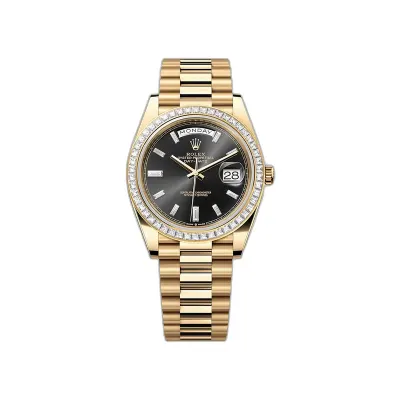
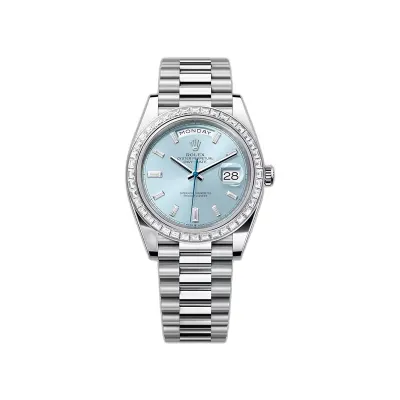
- TBR goes with bezels set with rectangular baguette-cut diamonds, as on the platinum 228396TBR or the yellow gold 228398TBR.
The penultimate digit helps too: on the watches we have checked, 3 corresponds to the fluted bezel (228238), 4 to the RBR gem-set bezel (228345RBR) and 9 to the TBR gem-set bezel (228396TBR).
The President bracelet
The President has semi-circular three-piece links. It was created for the Day-Date in 1956 and is made in the same metal as the case: yellow, white or Everose gold, or platinum.
It has changed over the generations. In 2000 the 118xxx family introduced a President with solid links; Fratello explains that the extra digit added to the reference, which went from five figures to six, reflected the new bracelet. Rolex now also fits it to some gold Datejust versions, but it is on the Day-Date that model and bracelet blur together to the point of sharing a name.
It has not always come on a metal bracelet: Fratello recalls that in 2013 Rolex presented 36 mm Day-Dates on leather straps, such as the 118138.
Dials
Ice blue, the platinum dial
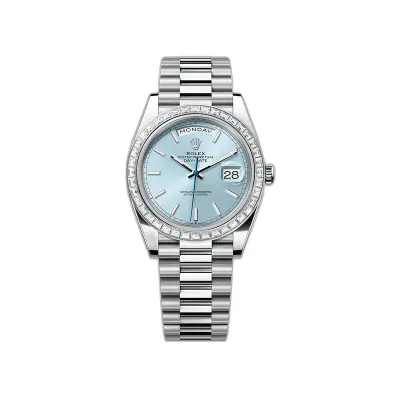
Ice blue is a very pale blue, almost white with a cool sheen, that Rolex uses only on its platinum watches, as Phillips notes in its auction catalogues. On the Day-Date 40 it appears, for example, on the 228236 with a platinum fluted bezel and the 228396TBR with a baguette diamond bezel. The same dial is found on the platinum Daytona, as we explain in our Rolex Daytona guide. If you are interested in a Day-Date with this dial, check that the reference ends in 6, the digit for platinum.
Stone dials: meteorite and eisenkiesel
Stone dials are a thin slice of a natural material, so no two are the same.
- Meteorite. A slice of iron meteorite, pale grey, with the crystalline pattern typical of the material. In our catalogue it appears on the 228239-0055, in white gold, with baguette diamond hour markers.
- Eisenkiesel. German for “iron pebble”: a variety of quartz with iron inclusions. Rolex introduced it in 2021, only on Everose gold Day-Dates, and on the dial it looks very dark brown with reddish veining. It is fitted to the 228235-0045, also with baguette diamond hour markers.
Diamond hour markers and Roman numerals
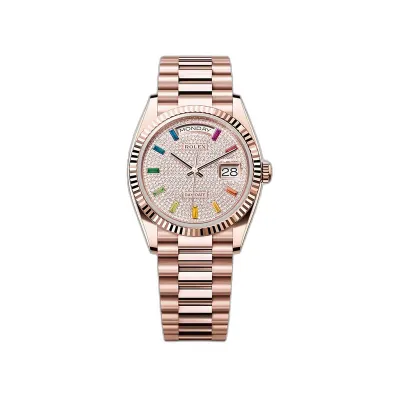
Day-Date dials combine three kinds of hour marker: gold batons, Roman numerals and diamonds. Our catalogue has examples of all three. The 228235-0002 has a brown dial with Roman numerals; the 228345RBR-0011, a green dial with Roman numerals and a diamond bezel; and the 36 mm 128235-0039, a diamond-paved dial with baguette markers in coloured stones.
The day of the week in different languages
The day disc can be in 26 languages, according to Fratello and Wikipedia, Spanish among them. It was not always so: according to Fratello, there were once 24 and later 25. Each watch has its disc in one particular language, so if you want to read “MONDAY” rather than “LUNES” at 12 o’clock, it is worth confirming on the watch before buying. We can send you photos of any piece you are interested in.
The movement: calibre 3255
Calibre 3255 arrived in 2015 with the Day-Date 40 and moved into the Day-Date 36 in 2019. It is automatic, with the Chronergy escapement and a Parachrom hairspring, and its power reserve is about 70 hours, 50% more than its predecessor’s. It is certified as a Superlative Chronometer, with the test carried out on the cased watch.
To see what it brings, it helps to look at where it comes from:
| Calibre | Introduced | What was new |
|---|---|---|
| 3055 | Late 1970s (18038) | 28,800 vibrations per hour and a quickset date; the 18038 also introduced the sapphire crystal |
| 3155 | 1988 (18238) | Quickset for the day as well as the date |
| 3156 | 2008 (Day-Date II) | Calibre of the 41 mm model |
| 3255 | 2015 (Day-Date 40) | Chronergy escapement and about 70 hours of power reserve |
The double quickset of the 3155 remains practical: day and date are set from the crown without turning the hands round for days on end.
How to tell which generation a Day-Date belongs to
On a pre-owned Day-Date, knowing the generation tells you which calibre it uses and what is worth checking. The reference is the quickest clue, but some details are visible at a glance:
- Number of digits in the reference. Four digits (6510, 6511, 6611, 1803) belong to the early decades; five (18038, 18238) to the period from 1977–1978 to 2000; six (118238, 218238, 228238, 128238) to watches made since 2000.
- The crystal. The 1803 was the last with a domed acrylic crystal. From the 18038 onwards the crystal is flat sapphire.
- The dial. Monochrome and Fratello agree that the 1803 was the last with a “pie-pan” dial, its edge bevelled like the rim of a pie dish.
- The quickset. On the 18038 only the date can be set quickly; from the 18238 of 1988, the day can too.
- The bracelet. The 118xxx family, from 2000, introduced a President with solid links and, according to Monochrome, the engraved inner ring around the dial.
- The size. A 41 mm Day-Date is a Day-Date II, made between 2008 and 2015; a 40 mm one dates from 2015 onwards.
With the full reference, including the suffix after the hyphen, it is easy to confirm the original dial and bracelet configuration. If a particular watch interests you, we can send you photos of the reference, the dial and the bracelet.
References in our catalogue
These are the Day-Date references currently in our Rolex Day-Date collection:
| Reference | Size | Material | Bezel | Dials in the catalogue |
|---|---|---|---|---|
| 128235 | 36 mm | Everose gold | Fluted | Brown (-0037), diamond pavé (-0039), green (-0089) |
| 128238 | 36 mm | Yellow gold | Fluted | Green (-0069) |
| 128348RBR | 36 mm | Yellow gold | Brilliant-cut diamonds | Green (-0078) |
| 228235 | 40 mm | Everose gold | Fluted | Brown (-0002, -0003), green (-0025), eisenkiesel (-0045) |
| 228236 | 40 mm | Platinum | Fluted | Ice blue (-0018) |
| 228238 | 40 mm | Yellow gold | Fluted | Champagne (-0003), black (-0004, -0067) |
| 228239 | 40 mm | White gold | Fluted | Silver (-0003), green (-0033), meteorite (-0055) |
| 228345RBR | 40 mm | Everose gold | Brilliant-cut diamonds | Green with Roman numerals (-0011) |
| 228396TBR | 40 mm | Platinum | Baguette-cut diamonds | Ice blue (-0002, -0039) |
| 228398TBR | 40 mm | Yellow gold | Baguette-cut diamonds | Black (-0001) |
All are priced on request and available to order, and you can ask us for photos of any of them. If you are looking for a combination of size, metal and dial that is not in the table, you can request a specific model.
How to read a Day-Date reference
Take the 228238-0003, the watch in the picture:
- 2282 indicates a current-generation Day-Date 40. A current Day-Date 36 starts with 1282.
- The penultimate digit, 3, is associated with the fluted bezel.
- The final digit, 8, indicates yellow gold.
- -0003 identifies the configuration: here, a champagne dial on a President bracelet.
The letters at the end, RBR or TBR, flag a gem-set bezel. The full system, with examples from other models and brands, is in our guide on how to read a watch reference number.
Day-Date vs Datejust
They look very alike, as both are classic Rolex models with an Oyster case, a date at 3 o’clock and a Cyclops lens. The differences:
| Day-Date | Datejust | |
|---|---|---|
| Functions | Time, date and the day of the week spelled out | Time and date |
| Introduced | 1956 | 1945 |
| Current sizes | 36 and 40 mm | 28, 31, 36 and 41 mm |
| Materials | 18 ct gold or platinum only | Steel, Rolesor and gold |
| Usual bracelet | President | Oyster or Jubilee |
| Calibre in the larger sizes | 3255 | 3235 |
The Day-Date adds the day, but what really separates it from the Datejust is the metal: it does not exist in steel or Rolesor, and that changes the weight, the look and the kind of watch it is. Anyone after a classic Rolex with a date in steel, or in steel and gold, is looking for a Datejust. Our Rolex Datejust guide explains it, and the watches are in our Rolex Datejust collection. The brand’s other models are among our Rolex watches.
Frequently asked questions
Is the President the watch or the bracelet?
For Rolex, the bracelet. President is the brand’s name for the semi-circular three-piece-link bracelet it created for the Day-Date in 1956. Over the years popular usage extended the name to the watch, and today “Rolex President” is understood to mean the Day-Date. Rolex also fits the President bracelet to some gold versions of the Datejust, which are not Day-Dates.
Is there a steel Day-Date?
Not in the Rolex catalogue. Since 1956 the Day-Date has only been made in 18 ct gold, whether yellow, white or Everose, and in platinum. A few early steel examples of reference 6611 are known, made outside normal production, but they were never a model on sale. If you want a classic Rolex with a date in steel, the model to look at is the Datejust.
Day-Date 36 vs 40: which should I choose?
Both use calibre 3255 and come in the same metals. The 36 is the original 1956 size and the more discreet on the wrist. The 40, introduced in 2015, has a larger dial on which the day and date are easier to read. As a gold watch on a gold bracelet, weight matters: on slimmer wrists the 36 is usually the more comfortable choice.
How many languages can the day be shown in?
Twenty-six, including English, Spanish and French, according to Fratello and Wikipedia. The number has grown over the generations: there were once 24 and later 25. Each watch carries its day disc in one particular language, so the language of a given piece is checked on the piece itself. If one interests you, ask us for photos of the dial.
What is the ice blue dial?
A very pale blue, almost white with a cool sheen, that Rolex reserves for its platinum watches. On the Day-Date 40 it appears on platinum references such as the 228236, with a fluted bezel, or the 228396TBR, with a baguette diamond bezel. It also features on the platinum Daytona. If you are offered a Day-Date with this dial, check that the reference ends in 6, the digit for platinum.
What do RBR and TBR mean?
We have found no official explanation of the abbreviations, but their use is consistent. RBR appears on references whose bezel is set with round brilliant-cut diamonds, such as the 228345RBR. TBR appears on references whose bezel is set with rectangular baguette-cut diamonds, such as the platinum 228396TBR or the yellow gold 228398TBR. Without letters, a Day-Date bezel is usually fluted.
Sources
- Monochrome, The History of the Rolex Day-Date, The Presidential Watch (opens in a new window)
- Fratello, Rolex Day-Date: Historical Overview Of Rolex's Flagship (opens in a new window)
- Wikipedia, Rolex Day-Date (opens in a new window)
- Revolution, Rolex at Watches and Wonders 2026 (opens in a new window)
- Monochrome, Hands-On: The New Rolex Day-Date 40 Jubilee Gold (2026) (opens in a new window)
- Revolution, Eisenkiesel: Rolex's Latest Rolling Stone (2021) (opens in a new window)
- Fratello, Hands-On With The Rolex Day-Date In Platinum (228236 and 128236) (opens in a new window)
- Phillips, Rolex Day-Date 40 ref. 228206 (lot 22, The Geneva Watch Auction: FIVE) (opens in a new window)
- Watches by SJX, Introducing the Rolex Day-Date 40 (2015) (opens in a new window)
- Phillips, Rolex Day-Date ref. 18038 (lot 891, The Hong Kong Watch Auction: XIV) (opens in a new window)