Rolex Datejust 36 vs 41: Sizes, Bezels and Bracelets
A guide to the Rolex Datejust: sizes from 28 to 41 mm, smooth or fluted bezel, Oyster or Jubilee bracelet, Rolesor materials and the Wimbledon dial.
The Datejust is the Rolex with a date window at 3 o’clock under a Cyclops lens, introduced in 1945. It is made today in four sizes: 28 mm (the Lady-Datejust), 31, 36 and 41 mm. On the 36 versus 41 question, the short answer is that both use the same calibre 3235, have the same water resistance and come in the same materials and bracelets, so the choice comes down almost entirely to your wrist. The 41 is 4.3 mm longer from lug tip to lug tip.
What is the Datejust?
1945: the date window and the Jubilee bracelet
Rolex introduced the Datejust in 1945, the year the company turned forty. The first reference, the 4467, measured 36 mm, was made in 18 ct gold and brought together the brand’s two inventions, the waterproof Oyster case and Perpetual self-winding, with something new: a window at 3 o’clock in which the date changed by itself. It was among the first automatic wristwatches with a date window.
It also launched the five-link Jubilee bracelet, named after the anniversary. Fratello notes that Rolex registered the name “Ritedate” on 1 October 1945 and also considered “Jubilee” and “Victory” before settling on Datejust. According to the same source, the name did not appear on the dial until 1953.
At first it was made only in precious metals; steel versions followed a few years later. In the mid-1950s the date change became instantaneous at midnight, and in 1977 calibre 3035 added a quickset date via the crown.
The Cyclops lens and the fluted bezel
The Cyclops lens is the small magnifier on the crystal at 3 o’clock that enlarges the date. It reached the Datejust in 1953, on references 6304 and 6305, and later spread to the other Oyster models with a date. Today it is a separate piece of sapphire bonded to the sapphire crystal, with an anti-reflective coating.
The fluted bezel predates the Datejust: it comes from the 1926 Oyster case, which was sealed by screwing down the bezel, caseback and crown, like the lid of a jar. Today its role is aesthetic. Sources disagree on when the modern fluted bezel reached the Datejust: Monochrome describes a coin-edge fluted bezel on the 4467 already, while Fratello credits the modern fluting to the 6305.
Sizes: 28, 31, 36 and 41 mm
Datejust 36 vs 41: what is the difference?
| Datejust 36 | Datejust 41 | |
|---|---|---|
| Diameter | 36 mm | 41 mm |
| Thickness | 11.8 mm | 11.6 mm |
| Lug to lug | 43.1 mm | 47.4 mm |
| Lug width | 20 mm | 21 mm |
| Reference family | 1262xx | 1263xx |
| Calibre | 3235 | 3235 |
| Bezels, with examples | Smooth (126200), fluted (126234, 126233, 126231) or diamond-set (126281RBR, 126284RBR) | Smooth (126300) or fluted (126334, 126333) |
| Bracelets | Oyster or Jubilee | Oyster or Jubilee |
| Water resistance | 100 m | 100 m |
The thickness (excluding the Cyclops lens) and lug measurements are those Monochrome publishes for the 2026 versions. The thickness difference is negligible; what you notice on the wrist is length. A 41 measures 47.4 mm from lug tip to lug tip, and on a narrow wrist those tips can overhang the sides.
The 41 arrived in 2016, following on from the 41 mm Datejust II introduced in 2009. The current 36, the 1262xx family, dates from 2018: that year every Datejust 36 moved to calibre 3235, and the case and lugs were slimmed slightly.
Datejust 31 and Lady-Datejust 28
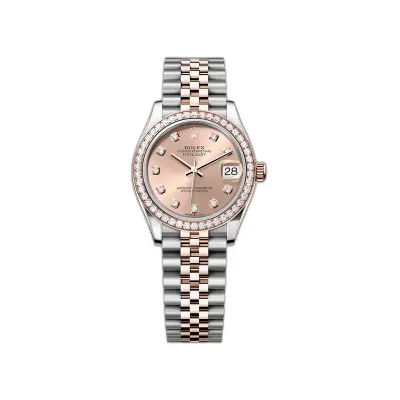
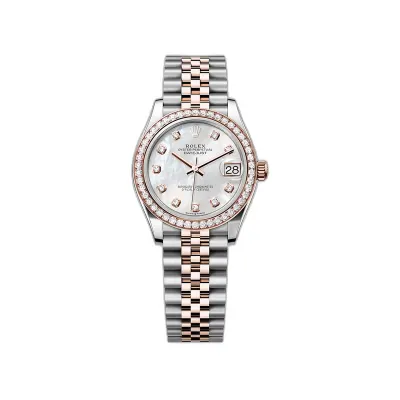
The Datejust 31 is the middle size, with references in the 278xxx family. Rolex has offered a mid-size Datejust since the 1960s. In our catalogue there are steel and gold versions with fluted bezels, versions with diamond bezels and solid gold versions with diamonds on the bezel and dial.
The Lady-Datejust is the smallest size. It was born in 1957 at 26 mm and grew to 28 mm in 2015. Its references belong to the 279xxx family. On our site it has its own collection, Rolex Lady-Datejust, separate from the Datejust.
The 31 and 28 mm sizes do not use calibre 3235 but the smaller calibre 2236.
How to choose a size
Datejust sizes are chosen in millimetres, not by labels. Rolex does not divide them by gender, and there are large wrists that wear a 36 well and slim wrists that suit a 41. What to look at:
- Lug-to-lug length. Lay a ruler across the flat top of your wrist. If it measures less than 47 mm, the 41 will probably overhang; the 36 stays at 43.1 mm.
- Wrist circumference. This tells you how many links will need adding or removing, rather than which diameter to choose.
- Style. The 31 and 28, especially with a diamond bezel, come close to jewellery. The 36 is the model’s original size. The 41 has a larger, more legible dial.
If you can, try on both of the sizes you are deciding between. If not, compare with a watch you already own whose diameter you know.
Fluted or smooth bezel?
The Datejust has three types of bezel, and each changes the look of the watch considerably.
- Smooth. Domed and polished, in the same metal as the case. It is the bezel of steel references ending in 0, such as the 126200 and 126300.
- Fluted. On current Datejusts it is 18 ct gold. On a steel Datejust, the fluted bezel is white gold, and that makes the watch white Rolesor.
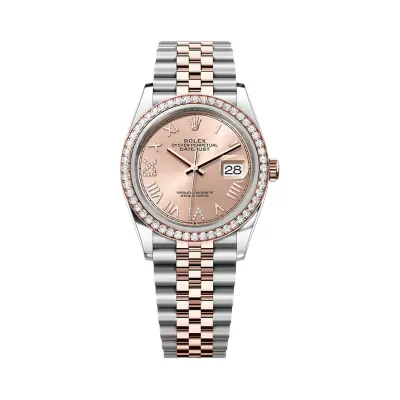
- Gem-set. With diamonds. In the reference this is shown by the letters RBR, as in the 126284RBR or the 278381RBR.
In the 36 and 41 mm sizes, the penultimate digit of the reference is associated with the bezel: 0 for smooth (126300), 3 for fluted (126334) and 8 for gem-set (126284RBR). On the Datejust 31 the digit differs, so the rule is best not stretched.
Jubilee vs Oyster bracelet
Comparing the two
| Oyster | Jubilee | |
|---|---|---|
| Links | Three per row, broad and flat | Five per row, smaller |
| Use | Almost every Oyster model | Created in 1945 for the Datejust |
| Look | Sportier and more understated | Brighter and more supple |
| In yellow or Everose Rolesor | Gold centre links | Gold centre links |
The Jubilee belongs to the Datejust; with the 2009 Datejust II it was left out of the larger size, and it returned there with the Datejust 41. The choice is one of taste: the Jubilee catches more light and drapes more freely, while the Oyster has a sportier feel.
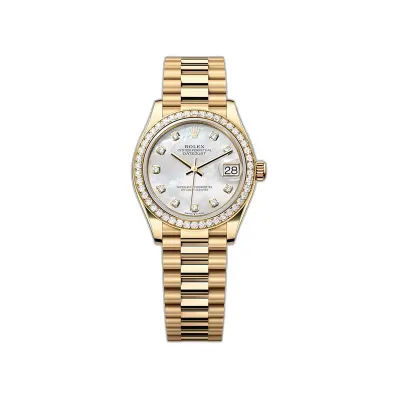
The third bracelet is the President, with semi-circular three-piece links, which Rolex created in 1956 for the Day-Date. On the Datejust it appears on some solid gold versions, such as the Datejust 31 278288RBR in our catalogue.
Clasp and adjustment
On current-generation Datejust 36 models, Monochrome describes the same clasp for the Oyster and the Jubilee: a folding Oysterclasp with the Easylink system, a link that folds out to lengthen the bracelet by about 5 mm without tools. For fine adjustment, each configuration has its own page on the Rolex website, and the number of links on a particular watch is checked on the watch itself.
Materials: Oystersteel and Rolesor
Oystersteel is Rolex’s name for its steel, from the 904L family. Everose is its 18 ct rose gold alloy. And Rolesor is the name for combining Oystersteel and 18 ct gold in the same watch. There are also solid gold Datejusts, in yellow, white or Everose gold.
What is Rolesor? Yellow, Everose and white, part by part
| Bezel | Crown | Centre links | Case and outer links | |
|---|---|---|---|---|
| Yellow Rolesor | Yellow gold | Yellow gold | Yellow gold | Oystersteel |
| Everose Rolesor | Everose gold | Everose gold | Everose gold | Oystersteel |
| White Rolesor | White gold | Oystersteel | Oystersteel | Oystersteel |
White Rolesor is the most discreet: from a distance it looks like a steel watch, and the only gold is in the fluted bezel. Monochrome puts it plainly in its review of the 126234: the bezel is the only part of the watch that contains 18 ct white gold. On yellow and Everose Rolesor, by contrast, the gold shows on the crown and down the centre of the bracelet.
The reference tells you with its final digit: 0 for steel, 1 for Everose Rolesor, 3 for yellow Rolesor and 4 for white Rolesor. Solid gold watches end in 5 (Everose), 8 (yellow) or 9 (white).
Dials
The Datejust has one of the widest ranges of dials at Rolex, and in 2026 the brand overhauled it again.
What is the Wimbledon dial?
“Wimbledon” is a nickname. It refers to a slate grey dial with green-outlined Roman numerals, which Rolex introduced in 2009 on a steel and yellow gold Datejust and which its catalogue simply calls a slate dial. The nickname comes from the brand’s association with the Wimbledon Championships, dating back to 1978, and from the green of the numerals, which recalls the grass.
Today it is fitted to, among others, the Datejust 41 126300 and 126334 and the Datejust 36 126200. In the 2026 update it was the exception: Rolex redesigned the Roman numerals on almost every dial, but not on the Wimbledon. We cover the brand’s other nicknames, from Pepsi to Hulk, in our article on Rolex nicknames.
Patterns, mother-of-pearl, Roman numerals and diamonds
- Roman numerals. In 2026 Rolex redesigned them on the 36 and 41 mm sizes, in steel and all three Rolesor combinations: they are now applied, sans-serif, flatter and thicker, and a IX numeral replaces the baton marker at 9 o’clock. According to Monochrome, that adds up to more than a hundred new references. The Datejust 31 was not part of the change.
- Gradients. The same year brought a green gradient dial, lacquered green with black lacquer towards the edge, across eight references in 36 and 41 mm.
- Mother-of-pearl. In our catalogue it appears on 28, 31 and 36 mm watches, often with diamond hour markers. As a natural material, each dial has its own sheen.
- Diamonds. They can be set in the hour markers, in particular numerals or in the bezel. On the yellow gold Datejust 31 278288RBR, for example, they are in the markers and the bezel.
The movement: calibres 3235 and 2236
Calibre 3235. Used in the 36 and 41 mm sizes. It reached the Datejust with the 41 in 2016 and the 36 in 2018, replacing calibre 3135, the Datejust’s movement since 1988, and renewing more than 90% of its parts. It has about 70 hours of power reserve, the Chronergy escapement, a paramagnetic Parachrom hairspring and Superlative Chronometer certification, with a precision of −2/+2 seconds a day once cased.
Calibre 2236. Used in the 31 and 28 mm sizes. The 28 mm Lady-Datejust has used it since its introduction in 2015.
The date changes instantaneously at midnight, as it has on every Datejust since the mid-1950s, and can be set quickly via the crown without running through 24 hours, a feature the model has had since 1977. The 2009 Datejust II used a different calibre, the 3136.
Generations and references
Table: reference family, size and calibre
| Reference family | Size | Calibre | Years, according to the specialist press |
|---|---|---|---|
| 4467 | 36 mm | Rolex automatic | 1945–1949 |
| 6304 and 6305 | 36 mm | Rolex automatic | 1953–1957 |
| 1601 | 36 mm | 1560/1570 family | Around 1960–1981 |
| 16030 and family | 36 mm | 3035 | 1977–1988 |
| 16234 and family | 36 mm | 3135 | 1988–2004 |
| 116300 and 116334 (Datejust II) | 41 mm | 3136 | 2009–2016 |
| 1263xx (Datejust 41) | 41 mm | 3235 | Since 2016 |
| 1262xx (Datejust 36) | 36 mm | 3235 | Since 2018 |
| 278xxx (Datejust 31) | 31 mm | 2236 | Current generation |
| 279xxx (Lady-Datejust 28) | 28 mm | 2236 | Since 2015 |
Between the 16234 family and the 1262xx came a six-digit 36 mm generation, the 1162xx, also with calibre 3135.
How to read a Datejust reference
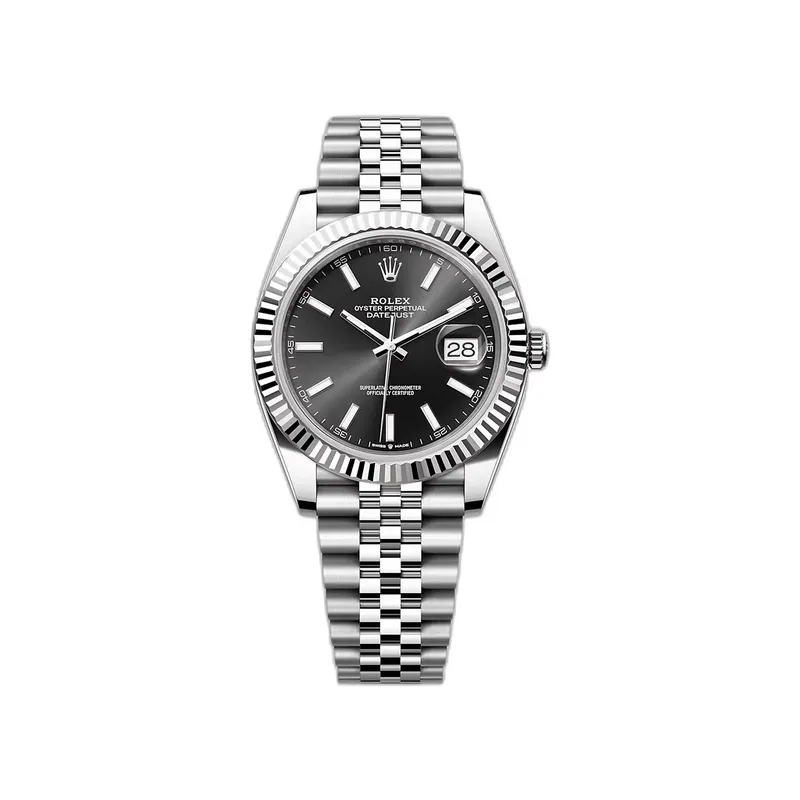
Take the 126334-0018, the watch in the picture:
- 1263 says it is a current-generation Datejust 41. A 36 would start with 1262, a 31 with 278 and a Lady-Datejust with 279.
- The penultimate digit, 3, is associated with the fluted bezel.
- The final digit, 4, indicates white Rolesor: steel with a white gold bezel.
- -0018 identifies the configuration: in this case, a black dial on a Jubilee bracelet.
If the reference includes RBR, the bezel is set with diamonds. The full system, with examples from other brands, is in our guide on how to read a watch reference number.
Five-digit references such as the 16233
Five-digit references belong to earlier generations. The 16233 is a 36 mm Datejust in steel and yellow gold with a fluted bezel: 1623 for the model and generation, and a final 3 for yellow Rolesor, the same pattern as today. It belongs to the family Monochrome dates to 1988–2004, with calibre 3135 and a sapphire crystal, so it uses the 3135 rather than the current 3235. When buying a watch of that age, the things to check are the condition of the case, bracelet and movement, and whether the paperwork survives.
Datejust vs Oyster Perpetual vs Day-Date
All three share the Oyster case and the Perpetual rotor. What changes is what the dial shows and which metals they come in.
| Oyster Perpetual | Datejust | Day-Date | |
|---|---|---|---|
| Functions | Time | Time and date | Time, date and the day of the week spelled out |
| Current sizes | 28 to 41 mm | 28 to 41 mm | 36 and 40 mm |
| Calibre in the larger sizes | 3230 | 3235 | 3255 |
| Materials | Steel and, since 2026, yellow Rolesor and gold in some sizes | Steel, Rolesor and gold | 18 ct gold or platinum only |
| Usual bracelet | Oyster | Oyster or Jubilee | President |
The Oyster Perpetual is the Datejust without a date: smooth bezel, Oyster bracelet and colourful dials. Our Rolex Oyster Perpetual guide explains it. The Day-Date adds the day of the week spelled out at 12 o’clock and is made only in precious metals; see our Rolex Day-Date guide and our Rolex Day-Date collection.
Our Rolex Datejust collection includes 31, 36 and 41 mm watches, price on request and available to order. You can ask us for photos of any of them. And if the combination of size, bezel and dial you want is not there, you can request a specific model.
Frequently asked questions
Datejust 36 vs 41: which should I choose?
They share calibre 3235, 100-metre water resistance, the Oyster and Jubilee bracelets and almost the same thickness. What changes is size: the 36 measures 43.1 mm from lug tip to lug tip and the 41, 47.4 mm. If the top of your wrist is narrower than that, the watch will overhang. The 36 is the model’s original size; the 41 offers a larger dial. Trying both on is the best guide.
What is Rolesor?
It is Rolex’s name for combining its Oystersteel with 18 ct gold in the same watch. On yellow and Everose Rolesor, the gold is in the bezel, the crown and the centre links of the bracelet. On white Rolesor, the only gold is the white gold fluted bezel, so the watch looks like steel. The final digit of the reference tells you which it is: 1, 3 or 4.
Is the fluted bezel gold?
On current Datejusts, yes. On a steel model with a fluted bezel, the bezel is 18 ct white gold, the only gold part of the watch, which is why it is classed as white Rolesor rather than steel. On yellow and Everose Rolesor, the fluting is in the same gold as the crown, and on solid gold models it matches the case. On vintage watches it is worth confirming the material for the specific reference before buying.
What is the Wimbledon dial?
It is the nickname of a slate grey dial with green-outlined Roman numerals. Rolex introduced it in 2009 on a steel and yellow gold Datejust and calls it simply a slate dial. The name comes from Rolex’s association with the tennis championships, which began in 1978, and from the green of the numerals. Today it is fitted to 36 and 41 mm Datejusts such as the 126300 and 126334.
What is the difference between the Datejust II and the Datejust 41?
Both measure 41 mm. The Datejust II, from 2009, used calibre 3136 and came on an Oyster bracelet. The Datejust 41 replaced it in 2016 with calibre 3235, which has about 70 hours of power reserve, and brought the Jubilee bracelet back to that size. The references differ too: the Datejust II starts with 116 and the Datejust 41 with 1263.
Which calibre does the current Datejust use?
The Datejust 36 and 41 use calibre 3235, an automatic movement with about 70 hours of power reserve, the Chronergy escapement and Superlative Chronometer certification for a precision of −2/+2 seconds a day. The Datejust 31 and the 28 mm Lady-Datejust use the smaller calibre 2236. References from before 2016 (41 mm) and 2018 (36 mm) use earlier-generation calibres such as the 3135 or 3136.
Sources
- Monochrome, The History of the Rolex Datejust (opens in a new window)
- Fratello, Five Rolex Datejust Facts You (Probably) Did Not Know (opens in a new window)
- Monochrome, Rolex Datejust 36 Steel Rolesor Ref. 126234: Review (opens in a new window)
- Monochrome, The 2018 Rolex Oyster Perpetual Datejust 36 ref. 126231 (opens in a new window)
- Monochrome, All the New Dials for the Rolex Datejust in 2026 (opens in a new window)
- Revolution, Rolex Oyster: On The Case (opens in a new window)
- Wikipedia, Rolex Datejust (opens in a new window)
- Monochrome, The Rolex Cyclops Lens (opens in a new window)
- Revolution, A Crown Fit for a Queen (Datejust 31, calibre 2236) (opens in a new window)