Rolex Oyster Perpetual Guide: Sizes, Colours and Dials
A guide to the Rolex Oyster Perpetual: sizes from 28 to 41 mm, colourful dials, what “Oyster” and “Perpetual” mean and how it differs from the Datejust.
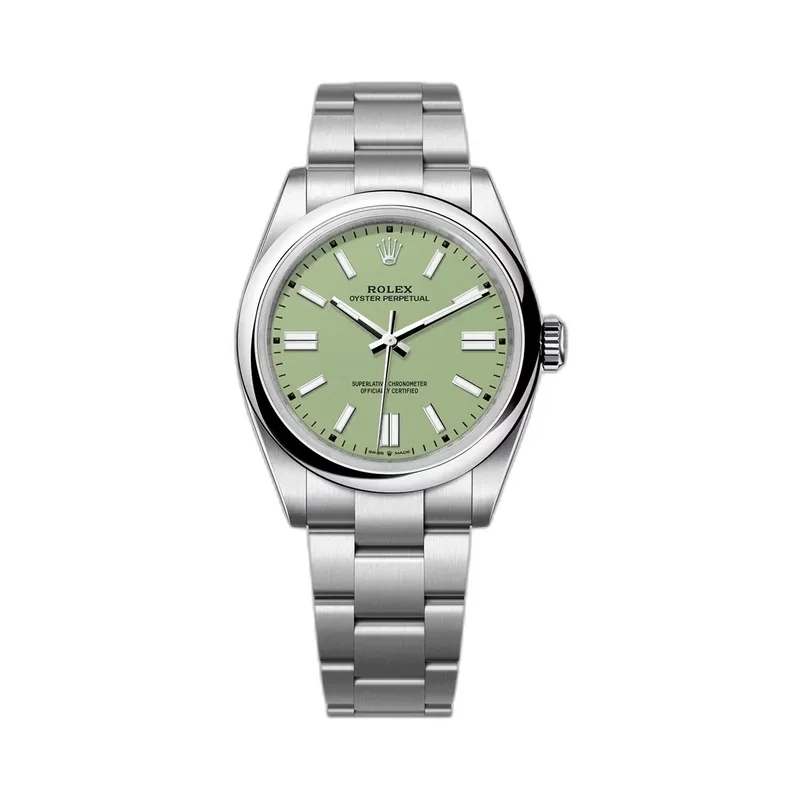
The Oyster Perpetual is the simplest watch Rolex makes: hours, minutes and seconds, with no date and no other function. It currently comes in five sizes, 28, 31, 34, 36 and 41 mm, with calibre 2232 in the three smaller ones and calibre 3230 in the two larger ones. What changes most from one version to the next is the dial, and Rolex reworked the colour range in 2020, 2025 and 2026.
What is the Oyster Perpetual?
The name brings together two Rolex inventions from almost a century ago: a waterproof case and a self-winding system. Each solved a problem of its own; together they shaped almost everything the brand has made since.
“Oyster”: the waterproof case
In 1926 Hans Wilsdorf presented a case he called the Oyster, because it was meant to seal shut like one. The bezel, caseback and crown screwed down onto the middle case, leaving water and dust no way in. To make the point, Wilsdorf had the shops selling his watches display them in fish tanks in their windows.
The best-known test came in 1927. The British swimmer Mercedes Gleitze carried a small gold Oyster around her neck on her attempt to swim the English Channel, and the watch kept time. Rolex told the story in an advertisement on the front page of the Daily Mail.
The case has evolved a great deal since. In 1953 the Twinlock crown arrived, guaranteeing the crown’s water resistance to 100 metres. That is still the rating of the Oyster Perpetual today, with a screw-down Twinlock crown and a solid, finely fluted steel caseback that can only be opened with a dedicated tool.
“Perpetual”: the self-winding rotor
The Oyster case had one weakness: to wind the watch you had to unscrew the crown, and every time you did, the movement was exposed to moisture. The answer was a watch that wound itself. By 1931 Rolex had registered patents for a mechanism with a free rotor, a half-moon weight that swings with the movement of the wrist and tensions the mainspring. It called it Perpetual.
With a rotor, the crown could stay screwed down for days on end. Current calibres follow the same principle, with a rotor that winds in both directions.
Why the name appears on almost every Rolex
A waterproof case and automatic winding became the foundation of the brand. That is why “Oyster Perpetual” is printed on the dial of almost every Rolex, from the Datejust to the Submariner, ahead of the model name. The watch called simply Oyster Perpetual is what you get when nothing else is added: no date, no rotating bezel, no chronograph, no second time zone.
Rolex Oyster Perpetual sizes: 28, 31, 34, 36 and 41 mm
The current collection has five diameters. The table shows the steel reference, which is the base of each size, and the calibre inside.
| Size | Steel reference | Calibre | Power reserve |
|---|---|---|---|
| 28 mm | 276200 | 2232 | About 55 hours |
| 31 mm | 277200 | 2232 | About 55 hours |
| 34 mm | 124200 | 2232 | About 55 hours |
| 36 mm | 126000 | 3230 | About 70 hours |
| 41 mm | 134300 (124300 until 2025) | 3230 | About 70 hours |
Since 2026 there have also been steel and yellow gold (yellow Rolesor) versions in 36 and 41 mm, references 126003 and 134303, and solid gold versions in 28 and 34 mm; in 34 mm they are the 124205 in Everose gold and the 124208 in yellow gold. The section on generations explains where they come from.
The dimensions of the two larger sizes are well documented by the specialist press: the 36 is 11.6 mm thick with a 20 mm lug width, and the 41 is 11.6 mm thick with a 21 mm lug width. Both are water-resistant to 100 metres and have a sapphire crystal.
How to choose a size
Sizes are chosen in millimetres, not by labels. A 31 or 34 on a large wrist reads as a discreet watch, and a 41 on a slim wrist covers almost its full width. What matters is proportion.
Three facts help:
- The thickness is almost identical. The 36 and the 41 are the same height, 11.6 mm. The difference lies in width and in how much of the wrist they cover, not in how they sit under a cuff.
- The bracelet is the same design. Every size comes on the three-link Oyster bracelet; on the 36 and 41, with an Oysterclasp and the Easylink extension, which lengthens the bracelet by about 5 mm without tools. It earns its keep on hot days, when the wrist swells slightly.
- The power reserve differs. The 36 and 41 mm sizes run for about 70 hours once taken off; the 28, 31 and 34 mm sizes, about 55. Take one off on Friday evening and leave it until Monday morning, and the former will probably still be running while the latter will need setting.
The most reliable method is to try on the two sizes you are torn between. If you cannot, measure your wrist and compare it with a watch you already own whose diameter you know.
What about the Oyster Perpetual 39?
It existed between 2015 and 2020 as reference 114300. It used calibre 3132, with 48 hours of power reserve, and shared its case, bracelet, bezel and movement with the 39 mm Explorer of the time, reference 214270. It launched with three dials: dark rhodium, red grape and blue. In 2020 the Oyster Perpetual 41 replaced it, so today a 39 can only be found pre-owned.
Colourful dials
Rolex rarely changes the Oyster Perpetual’s case, but it changes its dials often. Much of what separates one reference from another is colour, and with each update part of the range has come and gone.
The 2020 lacquer colours
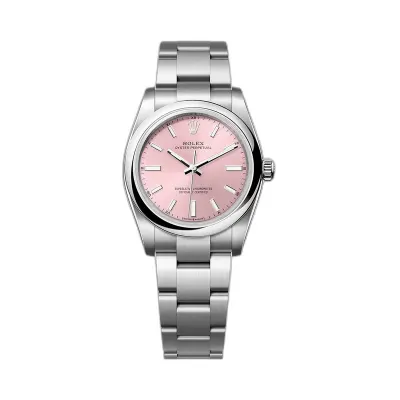
In 2020 the Oyster Perpetual 41 arrived with black, silver and blue dials and four solid lacquered colours: yellow, turquoise blue, coral red and green. The 36 received the same colours plus a pink that Rolex calls candy pink; the 31, the full range, sunray and lacquered; the 34 and 28 kept sunray dials at the time. Monochrome links the range to the Stella dials, the coloured lacquer dials found on some vintage Rolex models.
The 2020 lacquer dials were glossy. That is a useful way to identify a watch, because in 2025 Rolex switched to a matte lacquer.
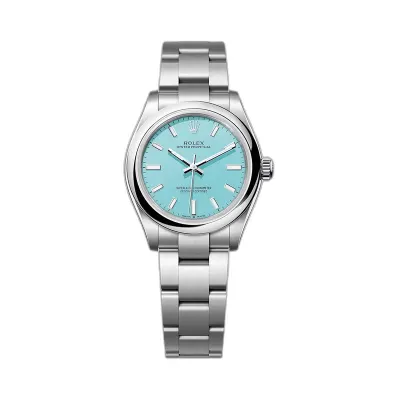
The turquoise dial nicknamed “Tiffany”
“Tiffany” is a nickname, not a Rolex name. Rolex calls this dial turquoise blue. The nickname spread because of the colour’s resemblance to that of the New York jeweller, but there is no link between the two houses on this watch: the dial carries no signature other than Rolex’s, and Fratello points out that the shade is not even the same.
Turquoise blue is no longer offered on the Oyster Perpetual 41, but it remains in other sizes, such as the 36.
Patterned dials
In 2023 Rolex presented the Celebration dial, with colourful bubbles on a turquoise background. It was fitted to the 31, 36 and 41 and was discontinued in 2025.
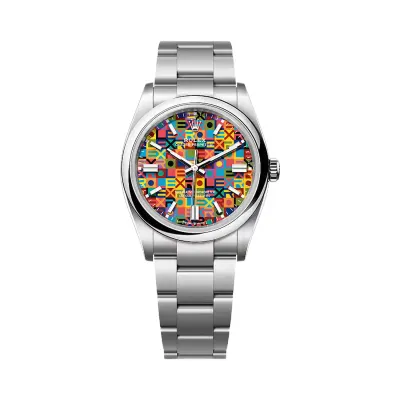
In 2026 a multicoloured dial with a Jubilee motif arrived, the Rolex name repeated across the surface, a pattern the brand has used since the late 1970s. It has ten colours, each printed separately, and is fitted to the 31 (277200-0019), the 36 (126000-0016) and the 41 (134300-0019).
The latest colours
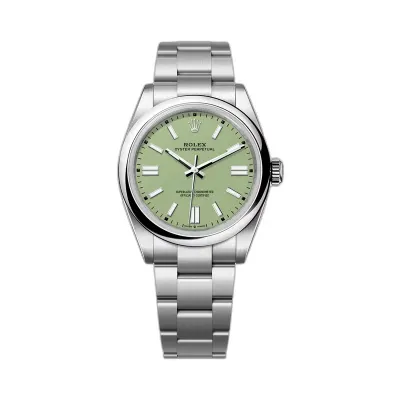
In 2025 three matte lacquer colours arrived: beige, pistachio and lavender. The 41 took pistachio and beige, as lavender is not offered in that size, while the 36 has all three. The same year, the black, dark blue and dark green dials of the 41 also moved to matte lacquer, while the silver dial with gold hands and hour markers stayed as it was.
In 2026 the first dials with natural stone hour markers appeared, on the gold Oyster Perpetual 28 and 34: the Everose 34 with a blue dial, for instance, has dumortierite markers at 3, 6 and 9. And the yellow Rolesor centenary edition has a slate dial with green accents.
Generations: the 2020 overhaul and the latest Oyster Perpetual 41
The recent history of the model comes down to four moments:
| Year | What changed |
|---|---|
| 2015 | The Oyster Perpetual 39 (114300) arrives, with calibre 3132 |
| 2020 | The 41 (124300) replaces the 39; the 36 (126000) and the 41 introduce calibre 3230 and the lacquer colours; the 28, 31 and 34 use calibre 2232 |
| 2025 | The 41 changes to reference 134300; matte lacquers arrive, along with beige, pistachio and lavender |
| 2026 | Centenary of the Oyster case: yellow Rolesor and gold versions, and the Jubilee motif dial |
From 124300 to 134300. Rolex changed the 41’s reference in 2025 with barely any announcement. At first glance the two look the same, but the 134300 has a larger Twinlock crown that is easier to use, slightly slimmer lugs with sharper tips, a marginally narrower bezel and a thinner Oysterclasp. Diameter and lug width are unchanged at 41 and 21 mm, and the published thickness is 11.6 mm. The calibre is still the 3230.
The 2026 centenary. To mark a hundred years of the Oyster case, Rolex presented the Oyster Perpetual in yellow Rolesor, with a yellow gold bezel and crown, in 41 mm (134303) and 36 mm (126003). The slate dial replaces the “Swiss Made” inscription at 6 o’clock with “100 years”, and the crown carries a “100” in relief.
Gold in the smaller sizes. The solid gold Oyster Perpetual 34, in Everose (124205) and yellow gold (124208), has a case and bracelet finished mainly in satin brushing; Monochrome notes that Rolex had stopped making the Oyster Perpetual 34 in gold in 2001. The 28 also comes in gold, with heliotrope hour markers on a green dial, according to Revolution.
The movement and chronometer certification
Calibre 3230. Used in the 36 and 41 mm sizes since 2020. Automatic, no date, 31 jewels, a frequency of 28,800 vibrations per hour and about 70 hours of power reserve. It has the Chronergy escapement patented by Rolex, a Parachrom hairspring and Paraflex shock absorbers.
Calibre 2232. Used in the 28, 31 and 34 mm sizes, also since 2020. It has a bidirectional Perpetual rotor, the same 28,800 vibrations per hour, a Syloxi silicon hairspring and about 55 hours of power reserve.
Certification. Every Oyster Perpetual carries the green Superlative Chronometer seal. Rolex tests the watch once cased and requires a precision of −2/+2 seconds a day. Before that, the uncased movement has passed chronometer certification by COSC, the Swiss testing body. In 2026 Rolex made the certification stricter with three new criteria, resistance to magnetism, reliability and sustainability, applied during design and manufacturing. The earlier criteria, namely precision, water resistance, self-winding and power reserve, are still checked on the finished watch.
If you want to understand what sets an automatic calibre apart from a hand-wound or quartz one, our guide to automatic, manual and quartz watches explains it.
References in our catalogue
These are the Oyster Perpetual references currently in our Rolex Oyster Perpetual collection. All are in steel.
| Reference | Size | Dial |
|---|---|---|
| 277200-0005 | 31 mm | Yellow |
| 277200-0006 | 31 mm | Green |
| 277200-0007 | 31 mm | Turquoise blue |
| 277200-0008 | 31 mm | Coral red |
| 277200-0009 | 31 mm | Pink (candy pink) |
| 277200-0014 | 31 mm | Lavender |
| 124200-0002 | 34 mm | Black |
| 124200-0004 | 34 mm | Pink |
| 126000-0016 | 36 mm | Multicoloured with Jubilee motif |
| 134300-0006 | 41 mm | Pistachio |
All are priced on request and available to order. You can ask us for photos of any of them. If you are looking for a size or colour that is not on the list, you can request a specific model. And if you want to know what the digits of each reference and the suffix after the hyphen tell you, see our guide on how to read a watch reference number.
Oyster Perpetual vs Datejust (and the Explorer)
All three share the Oyster case and automatic winding, and in some sizes almost the same calibre. The differences lie in what each one adds.
| Oyster Perpetual | Datejust | |
|---|---|---|
| Functions | Hours, minutes and seconds | Hours, minutes, seconds and date under a Cyclops lens |
| Current sizes | 28, 31, 34, 36 and 41 mm | 28, 31, 36 and 41 mm |
| Calibre in 36 and 41 mm | 3230 | 3235 |
| Bezel | Smooth | Smooth, fluted or gem-set |
| Bracelet | Oyster | Oyster, Jubilee and, on some gold versions, President |
| Materials | Steel; since 2026 also yellow Rolesor and gold in some sizes | Steel, Rolesor and gold |
Datejust. It is the Oyster Perpetual with a date. Calibre 3235 is the date-equipped counterpart of the 3230, and the case adds the Cyclops lens over the window at 3 o’clock. There is more choice too: a gold fluted bezel, the five-link Jubilee bracelet and a far wider range of steel and gold combinations. If you are torn between the two, the question is simple: if you want the date on the dial, it is a Datejust. Our Rolex Datejust guide covers it in depth, and you can browse the watches in our Rolex Datejust collection.
Explorer. Another three-hand Rolex without a date, with a black dial and 3, 6 and 9 numerals. In 2015 the Oyster Perpetual 39 shared its case and calibre with the Explorer of the day; the dial was the difference. Any Explorer watches we have are among our Rolex watches.
Frequently asked questions
What does “Oyster Perpetual” mean?
It names two Rolex inventions. “Oyster” is the waterproof case of 1926, with a screw-down bezel, caseback and crown that keep out water and dust. “Perpetual” is the self-winding rotor Rolex patented in 1931, a weight that turns with the movement of the wrist and winds the watch. That is why the name appears on the dial of almost every Rolex, while the model called simply Oyster Perpetual adds no further function.
Why doesn’t the Oyster Perpetual have a date?
Because it is the essential version of the collection: it shows hours, minutes and seconds and nothing else. Rolex keeps the date for other models with the same case, above all the Datejust, which adds a window at 3 o’clock under a Cyclops lens. In all five current sizes the Oyster Perpetual is time-only, and that uncluttered dial is precisely what sets it apart.
Is there a women’s Oyster Perpetual?
Rolex does not divide the Oyster Perpetual by gender: it offers five diameters, 28, 31, 34, 36 and 41 mm, and each person picks the one that suits them. The 28, 31 and 34 mm sizes, with calibre 2232, are the smallest, and the 31 mm offers the widest choice of colours. The 36 works on a very wide range of wrists. The best approach is to try two sizes and keep the one with the right proportions.
What is the “Tiffany” dial?
It is the nickname given to the turquoise blue Oyster Perpetual dial that Rolex introduced in 2020. It is not a Rolex name and there is no collaboration with the jeweller of that name: the dial bears only the Rolex signature, and the shade does not even match the jeweller’s. It is no longer offered on the 41 mm but remains in other sizes, such as the 36.
Oyster Perpetual 36 vs 41: which should I choose?
They share the same 11.6 mm thickness, the same calibre 3230 with about 70 hours of power reserve, the same 100-metre water resistance and the same Oyster bracelet. What changes is the diameter and the lug width, 20 mm on the 36 and 21 mm on the 41. On slim or medium wrists the 36 usually keeps better proportions; on broad wrists, the 41. Trying both on is the most reliable test.
What is the difference between an Oyster Perpetual and a Datejust?
The date. The Datejust adds a window at 3 o’clock with a Cyclops lens and uses calibre 3235 instead of the 3230. It also offers fluted or gem-set bezels, the Jubilee bracelet and many steel and gold combinations, whereas the Oyster Perpetual has a smooth bezel and an Oyster bracelet. If you want a time-only watch with a clean dial, it is an Oyster Perpetual.
Can you swim with an Oyster Perpetual?
Rolex rates it water-resistant to 100 metres, with a screw-down Twinlock crown and a solid caseback, so swimming is fine. The one condition is that the crown is fully screwed down before the watch goes in the water. For scuba diving Rolex makes dedicated models such as the Submariner, with a rotating bezel and greater water resistance.
Sources
- Monochrome, First Look: The New Rolex Oyster Perpetual 41 ref. 134300 (2025) (opens in a new window)
- Monochrome, Introducing the 2020 Rolex Oyster Perpetual 41 Reference 124300 (opens in a new window)
- Monochrome, Hands-On: The Rolex Oyster Perpetual 36 with Multicoloured Jubilee Dial (2026) (opens in a new window)
- Monochrome, The Quiet Luxury of the Rolex Oyster Perpetual 34 in Solid Gold (2026) (opens in a new window)
- Monochrome, Hands-on Review: The 2015 Rolex Oyster Perpetual 39mm (opens in a new window)
- Fratello, Hands-On With The 100th-Anniversary Rolex Oyster Perpetual Watches (opens in a new window)
- Fratello, The Rolex “Tiffany” Oyster Perpetual Doesn’t Exist (opens in a new window)
- Revolution, Rolex at Watches and Wonders 2026 (opens in a new window)
- Revolution, Rolex Oyster: On The Case (opens in a new window)
- webChronos, What types of Rolex Oyster Perpetual models are there? (opens in a new window)
- webChronos, Introducing all of Rolex's new watches for 2026 (Superlative Chronometer criteria) (opens in a new window)
- Watches by SJX, Rolex Introduces the New Oyster Perpetual (in Bright Colours Too) (2020) (opens in a new window)