Rolex Daytona Guide: References, Materials and Dials
A guide to the Rolex Cosmograph Daytona: 116500 vs 126500 generations, calibres 4130 and 4131, materials, dials and nicknames such as Panda and John Mayer.
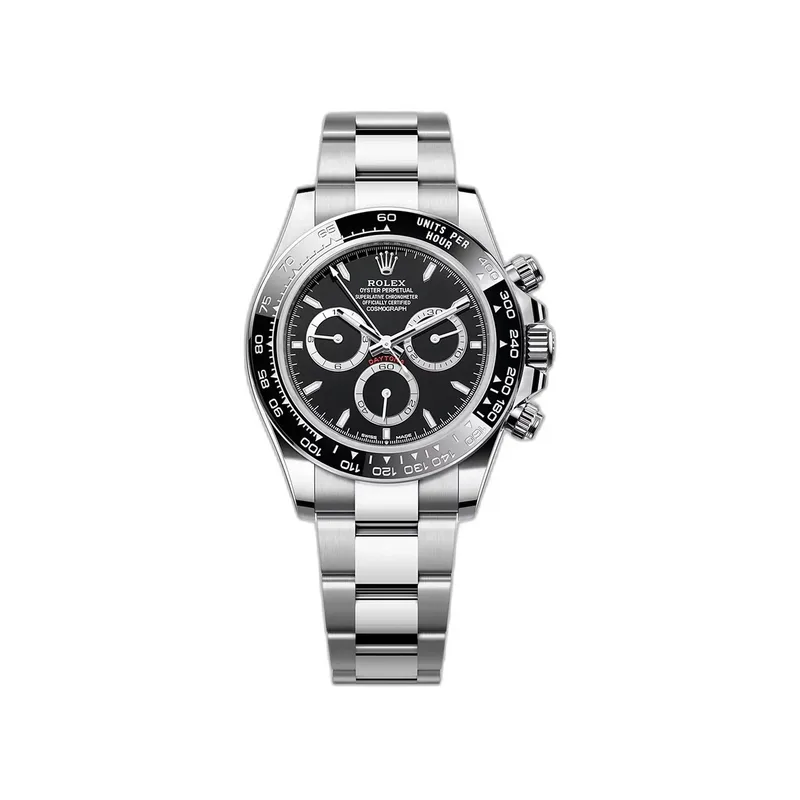
The Cosmograph Daytona is Rolex’s chronograph: a 40 mm case, three counters and a tachymetric scale on the bezel. Two generations account for most of the watches you will come across today, the 1165xx references with calibre 4130 and the 1265xx references with calibre 4131, introduced in 2023. Within each generation, the reference tells you the material, the type of bezel and the dial, and that is what this guide explains.
What is the Cosmograph Daytona?
Rolex introduced the Cosmograph in 1963 with reference 6239. The Daytona name followed shortly afterwards and refers to Daytona, in Florida, a town tied to speed racing and home to the Daytona International Speedway. The model has gone through several stages since then. Between 1988 and 2000, reference 16520 used calibre 4030, derived from the Zenith El Primero. In 2000 came calibre 4130, made in-house, and with it the six-digit references that are still the most common.
A chronograph with a tachymetric scale
A chronograph measures intervals of time without stopping the watch. The Daytona does this with a central seconds hand and two counters, one for 30 minutes and one for 12 hours. The third counter is the watch’s small seconds.
The tachymetric scale has been on the bezel since the first reference, the 6239. It is used to read an average speed: you time how long it takes to cover a known distance, a kilometre for example, and the hand points to the speed on the scale. On current models it reads up to 400 units per hour, whether kilometres or miles. The chronograph, the tachymeter scale and related functions such as the flyback are explained in our watch complications glossary.
How to read a Daytona reference number
Rolex does not explain on its product pages how its reference numbers are built, but on the Daytona the pattern is easy to see by comparing them. Take 126500LN-0002:
- 1265 identifies the current-generation Daytona. The previous one begins with 1165.
- The last digit gives the material: 0 for steel, 3 for steel and yellow gold, 5 for Everose gold, 6 for platinum, 8 for yellow gold and 9 for white gold.
- LN is read as lunette noire, French for black bezel. It appears on references with a black Cerachrom bezel.
- -0002 identifies the dial. On the 126500LN, -0001 is the white dial and -0002 the black dial.
Gold versions with a ceramic bezel and Oysterflex bracelet also change the fifth digit: 126515LN, 126518LN and 126519LN. To see how the system works on other models and brands, read our guide on how to read watch reference numbers.
The two generations you will see most
1165xx references (calibre 4130)
The family begins in 2000 with the 116520 and calibre 4130, a self-winding chronograph with a column wheel, a vertical clutch and a 72-hour power reserve. These are the references from this generation that turn up most often today:
- 116500LN. Steel with a black Cerachrom bezel. Introduced in 2016 and produced until 2023. It came with two dials: white with black rings around the counters, and black with silver rings.
- 116508. Yellow gold, with case, bezel and bracelet in the same metal.
- 116509. White gold.
- 116506. Platinum. Rolex introduced it in 2013 for the model’s 50th anniversary.
- 116515LN, 116518LN and 116519LN. Everose, yellow and white gold with a black Cerachrom bezel and Oysterflex bracelet. Rolex presented all three on this bracelet in 2017.
The ceramic bezel did not start with steel. Rolex first fitted it to the Daytona in 2011, on an Everose gold version, and took five years to bring it to the steel reference.
1265xx references (calibre 4131, from 2023)
In 2023, as the model turned sixty, Rolex renewed the whole collection. References now begin with 1265 and the movement is calibre 4131, an evolution of the 4130. It keeps the column wheel, the vertical clutch and a power reserve of about 72 hours, and uses the Chronergy escapement and Paraflex shock absorbers. We explain what a calibre is and how the rotor of an automatic works in our guide to automatic, manual and quartz watches.
The range has grown since. New dials arrived in 2025, among them a green one in yellow gold and three in meteorite. In 2026 Rolex presented the 126502 in steel and platinum, a combination the brand calls Rolesium. It has an anthracite ceramic bezel framed in platinum, a white enamel dial and a sapphire case back. It is not part of the regular catalogue: according to the specialist press, it is available by special order.
116500LN vs 126500LN: what changed in 2023
At first glance the two generations look very similar. The differences are in the details:
- Case. Still 40 mm, but the lugs were redrawn and the thickness came down to 11.9 mm, about 0.5 mm less.
- Bezel. On the steel 126500LN and the platinum 126506, the ceramic is now framed by a thin band of the same metal as the case; the gold Cerachrom versions on Oysterflex do not have it. On the 116500LN the ring was ceramic all the way to the edge.
- Dial. The hour markers are smaller and the counter rings thinner.
- Case back. The platinum version, 126506, was the first Daytona with a sapphire case back, which shows the movement. The other references presented alongside it kept a solid back.
- Water resistance. Unchanged: 100 metres.
Daytona materials: steel, Rolesor, gold and platinum
The current Daytona is made in steel (Rolex calls it Oystersteel), in steel and yellow gold (Rolesor), in 18 ct yellow, white or Everose gold, and in platinum, as well as the 126502 in Rolesium. Everose is Rolex’s name for its pink gold alloy. The last digit of the reference tells you which version it is, as the table below shows.
Metal or ceramic bezel
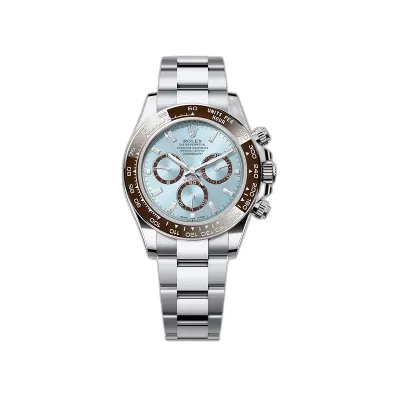
There are two types of bezel. The metal one has the tachymetric scale engraved and is made of the same gold as the case: you will find it on the 126503, 126505, 126508 and 126509. The Cerachrom one, Rolex’s ceramic, has a moulded scale. It is black on the steel 126500LN and on the three gold versions with Oysterflex, and chestnut brown on the platinum 126506.
A practical rule: if the reference ends in LN, the bezel is black ceramic. The platinum 126506 and the 126502 are the exceptions: both have ceramic in another colour and no letters in the reference.
Oyster bracelet or Oysterflex
The Oyster bracelet, with three-piece solid links, comes on the steel versions, the steel and gold versions and the gold versions with a metal bezel. The Oysterflex looks like a rubber strap, but inside it has flexible metal blades covered in black elastomer. In the current range it goes with gold cases and a black Cerachrom bezel: 126515LN, 126518LN and 126519LN.
Dials and nicknames: Panda, John Mayer, meteorite and ice blue
Daytona nicknames come from collectors. They are not Rolex names and do not appear on the brand’s product pages, but they are used so widely that they are worth knowing.
Panda. The name for a white dial with black counters. Today it is mostly applied to the steel Daytona with a white dial, such as the 116500LN, although on that watch the black is in the rings around the counters. The 126500LN-0001 keeps the same scheme: white dial and black rings.
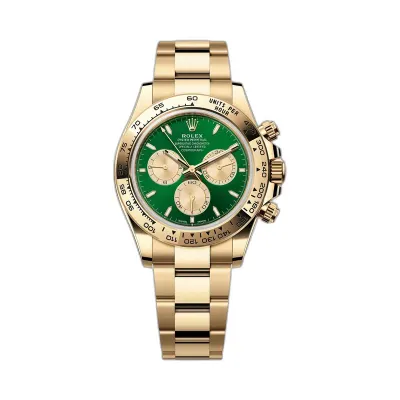
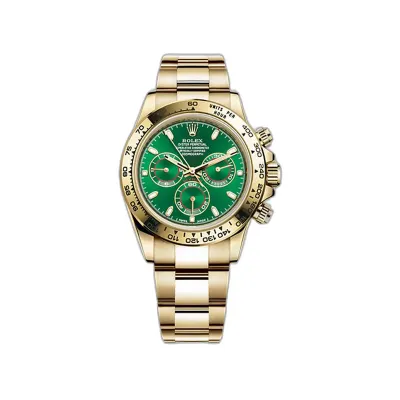
John Mayer. The yellow gold 116508 with a green dial, reference 116508-0013, introduced in 2016. The nickname refers to the musician and collector of that name. In 2025 Rolex released a green dial for the current generation, the 126508-0008, with golden counters.
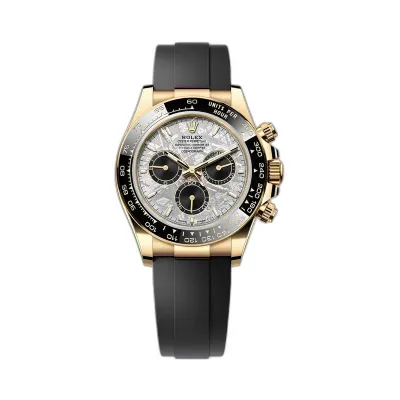
Meteorite. This is not a new dial for the Daytona. In 2025 Rolex presented three, all in gold with a black Cerachrom bezel and Oysterflex: the 126515LN-0008 in Everose gold, the 126518LN-0016 in yellow gold and the 126519LN-0007 in white gold. Rolex describes all three as a meteorite and black dial.
Ice blue. The dial colour of the platinum version, the 126506, paired with the chestnut brown bezel. The 126506-0002 adds baguette-cut diamond hour markers.
Paul Newman. A historical nickname. It refers to certain dials on early manually wound Daytonas, known as exotic dials, with square markers in the counters. The actor wore one.
The rest of the brand has a vocabulary of its own, which we cover in our article on Rolex nicknames.
Rolex Daytona reference table
The table lists the references whose details we have checked. The dial column is not a complete list: these are confirmed examples, with their suffix.
| Reference | Material | Bezel | Dials checked |
|---|---|---|---|
| 126500LN | Steel | Black Cerachrom | -0001 white; -0002 black |
| 126502 | Steel and platinum (Rolesium), outside the regular catalogue | Anthracite Cerachrom with a platinum ring | White enamel |
| 126503 | Steel and yellow gold | Yellow gold | -0002 black and golden with diamonds |
| 126505 | Everose gold | Everose gold | -0002 black and Sundust with diamonds |
| 126506 | Platinum | Chestnut brown Cerachrom | -0001 ice blue; -0002 ice blue with diamonds |
| 126508 | Yellow gold | Yellow gold | -0008 green and golden |
| 126509 | White gold | White gold | -0005 blue |
| 126515LN | Everose gold, Oysterflex | Black Cerachrom | -0008 meteorite and black |
| 126518LN | Yellow gold, Oysterflex | Black Cerachrom | -0016 meteorite and black |
| 126519LN | White gold, Oysterflex | Black Cerachrom | -0007 meteorite and black |
| 116500LN | Steel | Black Cerachrom | White or black |
| 116508 | Yellow gold | Yellow gold | -0013 green |
Our Rolex Daytona collection gives the reference and condition of each piece on its watch page; every watch is available to order, with price on request. You can ask us for photos of any of them. If you are deciding between an unworn watch and a worn one, our guide on what to check in a new or pre-owned watch will help. And if the reference you are looking for is not among our Rolex watches, you can request a specific model.
Frequently asked questions
What is the difference between the 116500LN and the 126500LN?
Both are steel, measure 40 mm and have a black Cerachrom bezel. The 126500LN, from 2023, uses calibre 4131 instead of the 4130 and has a slightly thinner case, a steel band around the ceramic of the bezel, smaller hour markers and thinner counter rings. The power reserve is around 72 hours on both.
What does “LN” mean?
It is read as lunette noire, French for black bezel. Rolex does not explain these letters on its product pages, but the reading matches what you see: Daytona references ending in LN have a black Cerachrom bezel.
What size is a Rolex Daytona?
40 mm according to the Rolex catalogue, in both the 1165xx and the 1265xx generation. The references presented in 2023 are 11.9 mm thick, according to the specialist press.
Sources
- Rolex, Cosmograph Daytona: all models and individual reference pages (opens in a new window)
- Rolex, new Cosmograph Daytona in Rolesium (2026) (opens in a new window)
- Rolex, history 1953-1967 (opens in a new window)
- Monochrome, The History of the Rolex Daytona (opens in a new window)
- Monochrome, Everything There's To Know About the New Steel Rolex Daytona 126500LN (opens in a new window)
- Monochrome, From Steel To Platinum, There's A Rolex Daytona For Everyone (opens in a new window)
- Monochrome, Rolex Daytona 116500LN in steel with Cerachrom black bezel (opens in a new window)
- Monochrome, The Rolex Daytona Gold / Ceramic / Oysterflex 2017 (opens in a new window)
- Monochrome, Rolex Silently Launched 7 new Daytona Models (opens in a new window)
- Monochrome, Rolex Daytona Rolesium 126502 with white enamel dial (opens in a new window)
- Time+Tide, Rolex Cosmograph Daytona Rolesium 126502 (opens in a new window)
- Revolution, The Rolex Daytona Reference 116508 in gold with a green dial (opens in a new window)
- Phillips, Three Generations of the Rolex Daytona (opens in a new window)
- Sotheby's, The Rolex Daytona: A Complete Collector's Guide (opens in a new window)
- Sotheby's, From Pandas to Pepsi: A Guide to Rolex Nicknames (opens in a new window)