IWC Portugieser
We currently have one IWC Portugieser watch. It is available to order, with the price on request.
1 watch
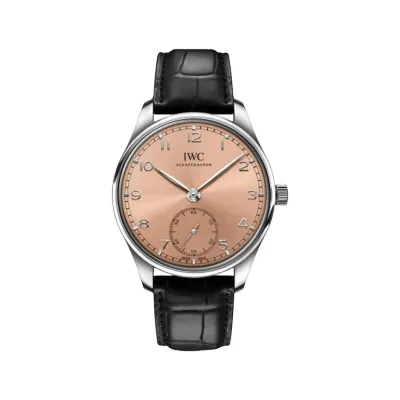
IWC
IWC Portugieser 40 mm
Stainless steel · pink dial
Ref. IW358313 · New
Price on request
Available to order
No watches match these filters
Try removing a filter, or ask us for the piece you are looking for.
From a Portuguese order to a collection
The Portugieser began with an order. In the late 1930s, two Portuguese importers asked IWC for large wristwatches with the precision of a marine chronometer. The brand answered with reference 325: a 41.5 mm case, huge for the period, housing calibre 74, a hand-wound pocket-watch movement. The first deliveries, in 1939, went not to Portugal but to Odessa; the Portuguese ones followed in 1942.
That watch set the traits IWC has kept ever since: an uncluttered dial, a railway-track minute scale, applied Arabic numerals, leaf-shaped hands, a slim bezel and small seconds, usually at 6 o’clock.
The key references
The modern collection began in 1993 with the 42 mm Portugieser Jubilee, made for IWC’s 125th anniversary. The Portugieser Chronograph 3714, at 40.9 mm, followed in 1998, and in 2000 came the 42.3 mm Portugieser Automatic 5000, with the in-house calibre 5000, a seven-day power reserve and Pellaton winding. A perpetual calendar joined in 2003, with moon phases for both hemispheres.
In 2020 came the Automatic 40, with calibre 82200 and a 60-hour reserve, and the 41 mm Chronograph 3716, now with an in-house calibre. In 2023 the Automatic 40 gained a salmon dial. In 2024 IWC revised the whole collection: the former “7 Days” was renamed the Automatic 42, water resistance on the 40 and 42 rose from 30 to 50 m, and new dial colours arrived, among them Horizon Blue, Obsidian, Silver Moon and Dune, a champagne tone. There was also a Perpetual Calendar 44 and a hand-wound tourbillon with a day/night indicator in Armor Gold.
What to look for when choosing
Size sets the character: 40 mm for the Automatic 40, 41 mm for the chronograph and 42 mm for the Automatic 42, the one with the seven-day reserve. Then comes the generation, which you can read from the reference and the listing. Each listing shows the reference, the condition, the specifications and whether a certificate is included, and you can ask us for photos of the watch itself.
If you want a sportier IWC, see the IWC Pilot, or go back to all our IWC watches. The Portugieser’s complications, from the chronograph to the perpetual calendar, are explained in our watch complications glossary.
Questions about IWC Portugieser
Why is it called the Portugieser?
Because it began with an order from two Portuguese importers in the late 1930s. They asked IWC for large wristwatches with the precision of a marine chronometer, and the brand answered with reference 325, which used a pocket-watch calibre. Portugieser is German for Portuguese, and German is the language of Schaffhausen.
What is the difference between the Portugieser Automatic 40 and Automatic 42?
The Automatic 40 measures 40.4 mm and uses calibre 82200, with Pellaton winding and a 60-hour power reserve. The Automatic 42, known until 2024 as the “7 Days”, measures 42.4 mm and uses calibre 52011, with 168 hours of reserve, in other words seven days. In 2024 its case lost a millimetre in thickness and, like the 40, its water resistance rose to 50 m.
What size is the Portugieser Chronograph?
Reference 3714, from 1998, measured 40.9 mm and was one of the mainstays of the catalogue until 2020. That year brought the Chronograph 3716, with the in-house calibre 69355, a 46-hour power reserve and a case 41 mm in diameter and 13.1 mm thick, dimensions it kept in the 2024 update.