IWC watches
Our IWC selection currently includes 3 watches (Pilot and Portugieser). Every piece is available to order, with prices on request. If you are looking for another IWC model, request it and we will tell you whether we can source it.
3 watches
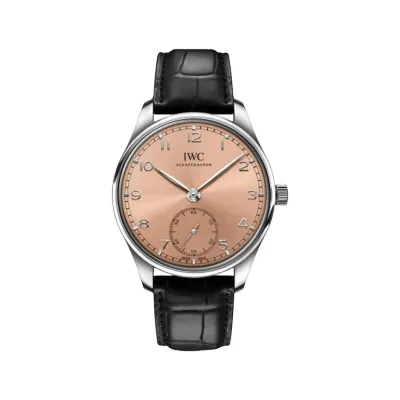
IWC
IWC Portugieser 40 mm
Stainless steel · pink dial
Ref. IW358313 · New
Price on request
Available to order
No watches match these filters
Try removing a filter, or ask us for the piece you are looking for.
IWC Schaffhausen at a glance
IWC was founded in 1868 in Schaffhausen, on the Rhine, by the American watchmaker Florentine Ariosto Jones. Its best-known families include the Pilot’s Watches, Portugieser, Ingenieur, Aquatimer and Portofino. We tell the story of its founding in our guide to luxury watch brands.
Pilot’s Watches, Portugieser and Ingenieur
The Pilot’s Watches began in 1936 with the Special Pilot’s Watch and its antimagnetic movement. The Big Pilot’s Watch followed in 1940, with calibre 52 T.S.C. and a 55 mm case, and in 1948 the Mark 11, built for the Royal Air Force with a soft-iron inner case against the magnetic fields of radar. The Big Pilot’s Watch returned in 2002 as reference IW5002, measuring 46.2 mm. Ceramics have a long history at the house too: IWC’s first ceramic-cased watch dates from 1986, the first pilot’s watch in a black zirconium oxide case from 1994, and the first Top Gun, a ceramic double chronograph, from 2007.
The Portugieser grew out of an order from two Portuguese wholesalers in the late 1930s: a large wristwatch with a pocket-watch calibre, the 74. The Jubilee edition, reference 5441, arrived in 1993 at 42 mm. The Portugieser Chronograph, reference 3714, followed in 1998 at 40.9 mm, and in 2000 the Portugieser Automatic, with calibre 5000 and Pellaton winding, at 42.3 mm. The Automatic 40, at 40.4 mm, joined in 2020. Its hallmarks are applied Arabic numerals, leaf-shaped hands and a railway minute track.
The Ingenieur made its debut in 1955 as IWC’s first antimagnetic wristwatch for civilian use. In 1976 Gérald Genta turned it into the Ingenieur SL, with an integrated case and bracelet, and in 2023 IWC revived that line with the Ingenieur Automatic 40, which measures 40 mm, keeps the soft-iron inner case and uses calibre 32111, with a 120-hour power reserve and water resistance to 100 metres.
The list is completed by the Aquatimer, introduced in 1967 with an internal rotating bezel, and the Portofino. The Da Vinci, for its part, introduced a perpetual calendar in 1985.
What to look for
Size varies a great deal between IWC families, from the 40.4 mm of a Portugieser Automatic 40 to the 46.2 mm of a Big Pilot. Look at the case material as well: steel, titanium, which IWC first used in a wristwatch in 1980, or ceramic. And look at the complications, which we explain in our watch complications glossary.
On this page you will find the IWC watches we offer. Each listing shows the reference, the condition, the specifications and whether a certificate is included, and the image is the model’s reference picture, so you can ask us for photos of the actual piece. If the model you want is not listed, you can request a model.
Questions about IWC
Why is it called the Portugieser?
Because it grew out of an order from two Portuguese wholesalers, Rodrigues and Teixeira, who asked IWC for a large wristwatch as precise as a marine chronometer. IWC answered with its calibre 74 pocket-watch movement, and the model was given reference 325. The first watches were delivered in February 1939 to a wholesaler in Odessa; the first documented deliveries to Portugal date from 1942.
What is a Big Pilot?
It is IWC’s large pilot’s watch. It goes back to the Big Pilot’s Watch of 1940, with calibre 52 T.S.C. and a 55 mm case, developed for military observation. IWC describes it as the largest wristwatch it has made. In 2002 IWC presented the modern Big Pilot’s Watch, reference IW5002, measuring 46.2 mm.
Why do some IWC watches have a soft-iron inner case?
To shield the movement from magnetic fields. IWC used one in the Mark 11 of 1948, built for the Royal Air Force to work near radar equipment, and in the first Ingenieur of 1955, its first antimagnetic wristwatch for civilian use. The Ingenieur Automatic 40 introduced in 2023 keeps that inner case.
IWC guides
All articles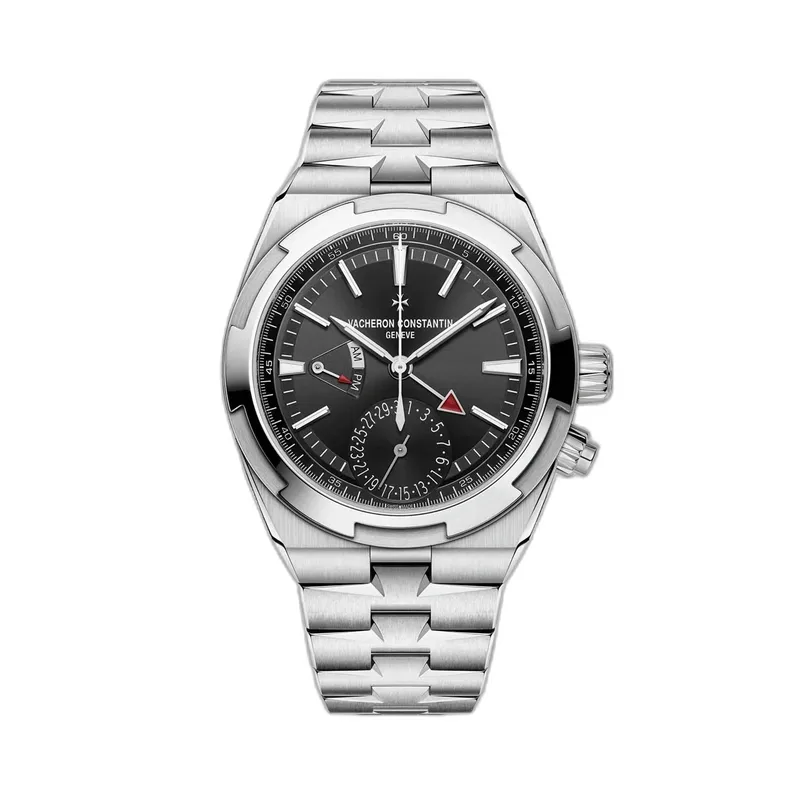
Luxury Watch Brands: A Guide to the Great Houses
Rolex, Patek Philippe, Audemars Piguet, Vacheron Constantin, A. Lange & Söhne, Richard Mille and more: origins, key collections and what sets each apart.