Jaeger-LeCoultre Reverso
We currently have one Jaeger-LeCoultre Reverso watch. It is available to order, with the price on request.
1 watch
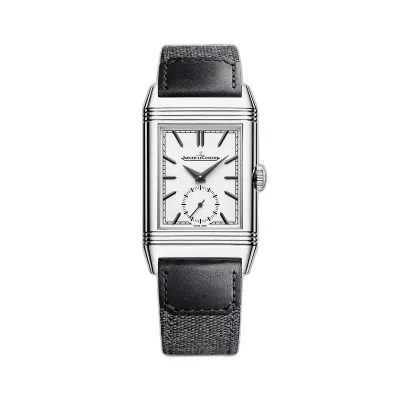
Jaeger-LeCoultre
Jaeger-LeCoultre Reverso 27 mm
Stainless steel · white dial
Ref. Q713842J · New
Price on request
Available to order
No watches match these filters
Try removing a filter, or ask us for the piece you are looking for.
A watch that turns over
The Reverso was the answer to a very specific problem. In 1930 the Swiss businessman César de Trey was challenged in India by British army officers who played polo: could he make a watch that would survive the knocks of the game? De Trey worked with Jacques-David LeCoultre and the French designer René-Alfred Chauvot, who on 4 March 1931 filed a patent for a case that runs along its cradle and flips right over. That way the dial is protected against the wrist. The name, registered in November 1931, comes from Latin and means “I turn”.
The rectangular case broke with the round watches of the day and draws on Art Deco, with proportions the brand links to the golden ratio. The first deliveries were made in the winter of 1931, in Staybrite steel, and over time the metal back became a canvas for engraving, enamel and miniature painting.
Monoface, Duoface and the Reverso families
In 1994 Jaeger-LeCoultre found another use for the hidden side with the Duoface: two dials, one on each side, driven by a single calibre, which in the first version showed two time zones. Small seconds, moon phases, a date, a chronograph and a tourbillon later appeared on the second dial. That is why listings say “Monoface”, with one dial, or “Duoface”, with two.
In 2016, the model’s 85th anniversary, the brand organised the collection into three families: Reverso Classic, in three sizes; Reverso One, designed for women and based on the elongated cases of the 1930s; and Reverso Tribute, closer to the originals and richer in complications. One example of a Tribute is the 2023 Monoface Small Seconds: 45.6 × 27.4 mm, 8.5 mm thick, with the hand-wound calibre 822, a 42-hour power reserve and 30 m water resistance.
What to look for when choosing
On a rectangular watch both measurements count, width and length, so compare them on the listing. Look at the movement too: many Reverso models, such as the Tribute Small Seconds, are hand-wound and need winding regularly. And check the carrier and case back in the photos, since they are the parts that work every time you flip the case. Each listing shows the reference, the condition, the specifications and whether a certificate is included, and you can ask us for photos of the watch itself.
To get to know the house, see all our Jaeger-LeCoultre watches or our luxury watch brands guide. If you are weighing up hand-wound against automatic, our guide to automatic, manual and quartz watches explains the difference.
Questions about Jaeger-LeCoultre Reverso
Why does the Reverso have a case that turns over?
Because it was made for polo. In 1930 British army officers playing polo in India asked César de Trey for a watch that could survive the game. The answer, for which René-Alfred Chauvot filed a patent in 1931, was a case that slides in its carrier and flips over completely, so the dial is protected against the wrist.
What is the difference between a Reverso Monoface and a Duoface?
The Monoface has a single dial: when you turn the case over you see the metal back, which can be engraved. The Duoface, introduced in 1994, has two dials, one on each side, driven by the same calibre. The first showed two time zones; later versions added small seconds, moon phases, a date, a chronograph or a tourbillon on the second dial.
What is the difference between the Reverso Tribute, Classic and One?
They are the three families into which Jaeger-LeCoultre organised the Reverso in 2016. The Tribute stays closest to the original models and carries most of the complications. The Classic was offered in three sizes, proportioned according to the golden ratio. The One was designed for women and revisits the elongated cases of the 1930s.