3 watches
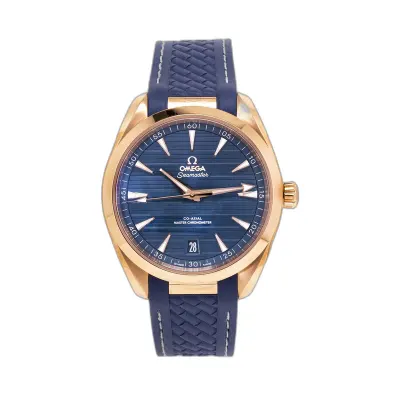
Omega
Omega Seamaster 41 mm
Sedna gold · blue dial
Ref. 220.52.41.21.03.001 · New
Price on request
Available to order
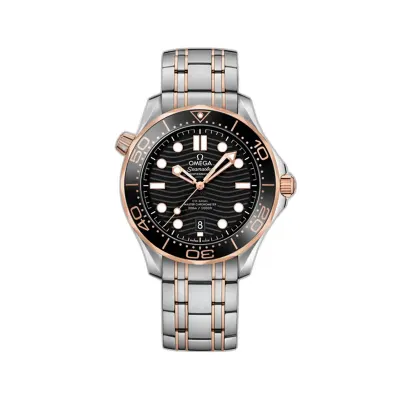
Omega
Omega Seamaster 42 mm
Ceramic, Sedna gold and stainless steel · black dial
Ref. 210.20.42.20.01.001 · New
Price on request
Available to order
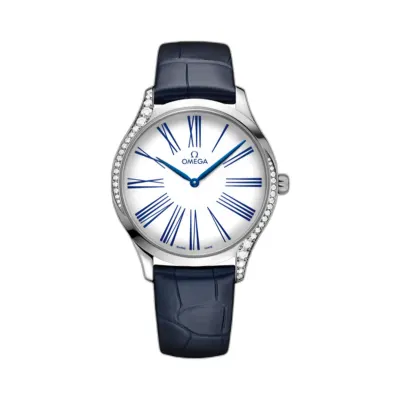
Omega
Omega De Ville 39 mm
Stainless steel · white dial
Ref. 428.18.39.60.04.001 · New
Price on request
Available to order
No watches match these filters
Try removing a filter, or ask us for the piece you are looking for.
Omega at a glance
Omega began in 1848, when the 23-year-old Louis Brandt opened a small workshop in La Chaux-de-Fonds, and it took its name from a 19-ligne calibre the Brandt brothers released in 1894. We tell its story in our guide to luxury watch brands; here we look at the collections and the technology that links them.
Speedmaster, Seamaster, Constellation and De Ville
The Speedmaster was launched in 1957 as part of a trilogy of professional watches, alongside the Seamaster 300 and the Railmaster. In 1965 NASA qualified it for all its manned missions, and in 1969 every Apollo 11 astronaut carried a Speedmaster Professional. That is why it is called the Moonwatch.
The Seamaster was born in 1948 to mark the brand’s centenary and has grown into a family with several branches. It only took diving seriously with the 300 of 1957; the Ploprof arrived in 1970, the Diver 300M in 1993, the Aqua Terra in 2002 and the Planet Ocean in 2005. The Diver 300M was updated in 2018 with a 42 mm steel case, a ceramic bezel, a dial with a laser-engraved wave pattern, a helium escape valve at 10 o’clock and water resistance to 300 metres. A blue Diver 300M was also James Bond’s watch in GoldenEye, in 1995.
The first Constellation, a chronometer, arrived in 1952, and Omega dates the launch of the De Ville collection to 1967.
The technology: Co-Axial and Master Chronometer
Two advances explain much of modern Omega. The first is the Co-Axial escapement, invented by George Daniels and launched by Omega in 1999, which reduces friction and the need for lubrication. The second is Master Chronometer certification, which Omega introduced in 2015 with the Globemaster: the watch passes the tests of the Swiss Federal Institute of Metrology (METAS), including resistance to magnetic fields of 15,000 gauss. The 2018 Seamaster Diver 300M, for example, uses the Master Chronometer calibre 8800.
What to look for
Pin down the exact Seamaster branch, because a Diver 300M, an Aqua Terra and a Planet Ocean are different watches, and check whether the calibre is Co-Axial or Master Chronometer. If a chronograph such as the Speedmaster appeals, we explain how it works in our watch complications glossary.
On this page you will find the Omega watches we offer. Each listing shows the reference, the condition, the specifications and whether a certificate is included, and the image is the model’s reference picture, so you can ask us for photos of the actual piece. If the model you want is not listed, you can request a model.
Questions about Omega
Why is the Speedmaster called the Moonwatch?
Because it was the watch of the Apollo 11 astronauts. NASA had qualified it in 1965 as the only watch for all its manned missions and spacewalks, and on 21 July 1969 every astronaut’s kit included a Speedmaster Professional. It has been known as the Moonwatch ever since.
What is an Omega Master Chronometer?
It is a watch that has passed the tests of the Swiss Federal Institute of Metrology (METAS), which go further than COSC testing. They cover eight criteria, including accuracy in six positions, tests that simulate daily wear and correct running in a magnetic field of 15,000 gauss. The first was the Globemaster of 2015.
What does the Co-Axial escapement do?
It is an escapement invented by the watchmaker George Daniels and launched by Omega on 12 April 1999. Its contact surfaces are smaller than those of a traditional escapement, so it creates less friction and needs less lubrication. According to Omega, no practical new escapement had appeared in around 250 years.
Omega guides
All articles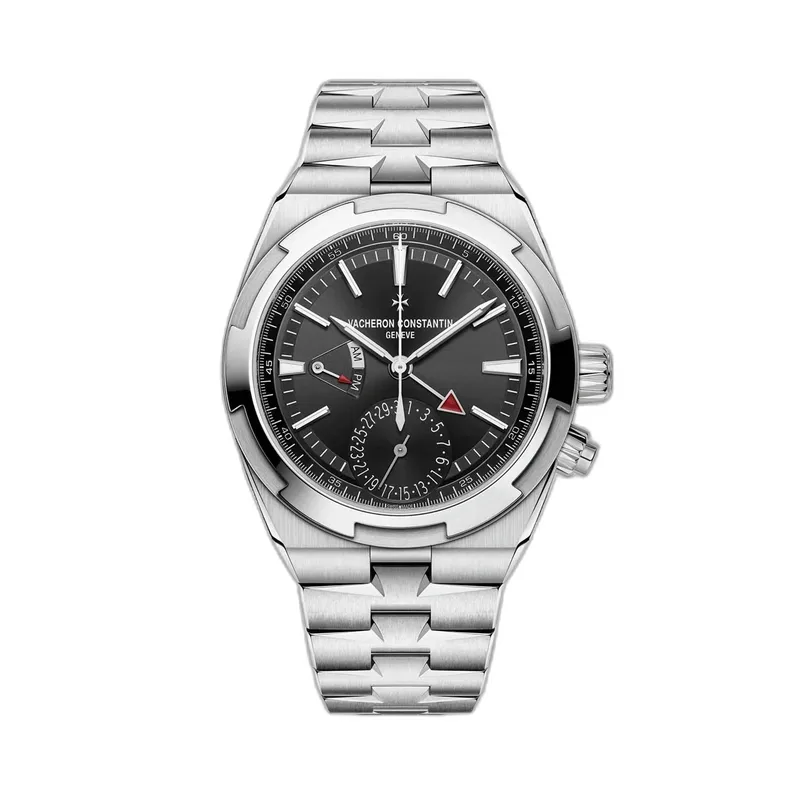
Luxury Watch Brands: A Guide to the Great Houses
Rolex, Patek Philippe, Audemars Piguet, Vacheron Constantin, A. Lange & Söhne, Richard Mille and more: origins, key collections and what sets each apart.