Panerai watches
Our Panerai selection currently consists of one watch: Radiomir. It is available to order, with the price on request. If you are looking for another Panerai model, request it and we will tell you whether we can source it.
1 watch
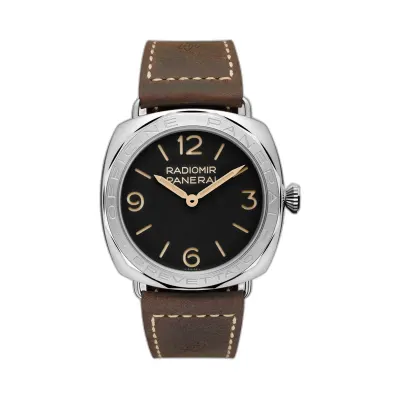
Panerai
Panerai Radiomir 47 mm
Stainless steel · black dial
Ref. PAM00685 · New
Price on request
Available to order
No watches match these filters
Try removing a filter, or ask us for the piece you are looking for.
Panerai at a glance
Panerai was born in Florence in 1860, when Giovanni Panerai opened his watchmaker’s shop on the Ponte alle Grazie. From the 1910s it supplied precision instruments to the Italian Navy, and its watches were not sold to the public until 1993. Today it makes its watches in Neuchâtel, Switzerland. We tell the story in our guide to luxury watch brands.
Radiomir, Luminor and Submersible
Panerai organises its catalogue into three collections: Luminor, Radiomir and Submersible. The first two take their names from luminous substances developed by the house.
The Radiomir recalls the first watches Panerai made for the Italian Navy’s divers, delivered from 1938 onwards. One of them is reference 3646: a 47 mm case made by Rolex, a hand-wound Rolex movement built on a Cortébert base and a “sandwich” dial, with an upper disc cut out for the numerals and markers laid over a second disc coated with luminous material. The cushion case and soldered wire lugs also date from that period. The name comes from the radium-based substance the house patented in 1916.
The Luminor belongs to the next chapter. Luminor is the tritium-based substance that replaced radium: Panerai registered the name in 1949 but, according to Phillips, did not use it on the watches until the mid-1960s. Its unmistakable feature is the bridge that protects the crown, a lever that locks it against the case, which the house patented in Italy in 1955 and in the United States in 1956. The Luminor Due followed in 2016 as a slimmer, more elegant version.
The Submersible completes the trio. Panerai made it a collection in its own right in 2019; before that, the name appeared on models such as the Luminor Submersible 1950.
In the modern era, Panerai presented its first in-house movement, calibre P.2002, in 2005, and in 2014 it opened a new manufacture in Neuchâtel.
What to look for
Panerai references begin with PAM followed by a number, and that is the surest way to identify a model, because size, material and movement vary a great deal within each collection. If you would like to know how we handle each piece, we explain it in how to buy.
On this page you will find the Panerai watches we offer. Each listing shows the reference, the condition, the specifications and whether a certificate is included, and the image is the model’s reference picture, so you can ask us for photos of the actual piece. If the model you want is not listed, you can request a model.
Questions about Panerai
What is the difference between Radiomir and Luminor?
Both names come from the house’s luminous substances. Radiomir, based on radium, was patented in 1916 and gives its name to the watches with a cushion case and wire lugs. Luminor, based on tritium, replaced it: the name was registered in 1949 and reached the watches in the mid-1960s. The Luminor is recognised by its crown-protecting bridge.
What is the Luminor’s crown-protecting bridge for?
It is a lever device that locks the crown against the case to keep it watertight. Panerai patented it in Italy in 1955 and in the United States in 1956, and according to Phillips the first watch to carry it was the GPF 2/56, made for the Egyptian Navy. Over the years it has become the Luminor’s most recognisable feature.
When did Panerai start selling watches to the public?
In 1993. Until then the Florentine house had worked as a supplier of precision instruments and watches to the Italian Navy, from the 1910s onwards. In 1997 it was bought by the Vendôme group, now Richemont, and in 2005 it presented its first in-house movement, calibre P.2002.
Panerai guides
All articles
Luxury Watch Brands: A Guide to the Great Houses
Rolex, Patek Philippe, Audemars Piguet, Vacheron Constantin, A. Lange & Söhne, Richard Mille and more: origins, key collections and what sets each apart.