Panerai Radiomir
We currently have one Panerai Radiomir watch. It is available to order, with the price on request.
1 watch
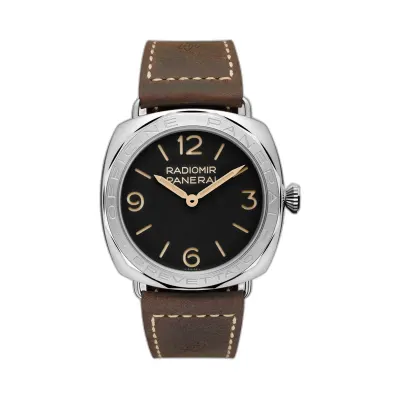
Panerai
Panerai Radiomir 47 mm
Stainless steel · black dial
Ref. PAM00685 · New
Price on request
Available to order
No watches match these filters
Try removing a filter, or ask us for the piece you are looking for.
From radium paste to a diver’s wrist
Radiomir was first the name of a radium-based luminous substance that Panerai developed in 1916. The watch came some twenty years later, and its earliest dates are disputed. The most widely told account, which follows the brand’s own version, has Panerai making ten prototypes in 1936 for the frogmen of the Italian Regia Marina; other sources place a first reference, the 2533, in 1935. These first watches had a 47 mm cushion case with welded wire lugs, and Rolex made the case and supplied the calibre. The early series introduced the sandwich dial, and around 1940 the lugs began to be machined from the same block of steel as the case.
In 1949 Panerai replaced radium with a tritium-based substance, Luminor, which went on to name another collection. In 1993 the brand made three special editions based on its historical models, and in 1997 it presented a platinum Radiomir, the PAM 21, limited to 60 pieces and fitted with a vintage Rolex 618 calibre.
Cushion case, sandwich dial and conical crown
You can spot a Radiomir by three things: the cushion-shaped case, the sandwich dial and the conical crown. The sandwich dial stacks two discs: the lower one carries the luminous material, while the dark upper one has the numerals cut out. And unlike the Luminor, the Radiomir has no bridge protecting the crown.
Look at the lugs too: the wire lugs of the original model, or the solid lugs of the 1940 case.
Sizes: 47, 45 and 40 mm
The original measured 47 mm, which was also the size of the earlier California-dial Radiomir models. In 2023 Panerai presented several 45 mm Radiomir models, such as the hand-wound Otto Giorni, with eight days of power reserve from the P.5000 calibre, and the first 45 mm “California”, the PAM01349. The same year brought the Radiomir Quaranta, at 40 mm, with the self-winding P.900 calibre and three days of power reserve.
What to check when choosing
Look at the PAM reference, the size and the type of movement: several Radiomir models, such as the Otto Giorni, are hand-wound. We explain the differences in our guide to automatic, manual and quartz watches. Check the water resistance as well, as it varies from model to model. Each watch page gives the reference, the condition, the specifications and whether a certificate is included, and you can ask us for photos of the piece itself. We tell the brand’s story in our guide to luxury watch brands. Browse all our Panerai watches and, if the Radiomir you want is not here, request a model.
Questions about Panerai Radiomir
What is the difference between the Panerai Radiomir and the Luminor?
Both names come from Panerai’s luminous substances: Radiomir, radium-based, from 1916, and Luminor, tritium-based, which replaced it in 1949. As watches, the Radiomir keeps the cushion case with wire lugs, or the 1940 case with solid lugs, while the Luminor of 1950 added the bridge that protects the crown.
What is a “California” dial on a Panerai?
It is a dial that combines Roman and Arabic numerals with baton markers and an inverted triangle at 12. Panerai bases it on its reference 3646 and has used it on the Radiomir, traditionally at 47 mm. In 2023 it brought it to a 45 mm case for the first time with the hand-wound PAM01349.
What is a sandwich dial?
It is a dial made of two stacked discs. The lower one carries the luminous material and the upper, dark one has the numerals and markers cut out, so the light shows through the openings. Panerai adopted it on its early watches for the Italian Navy, for better legibility underwater, and it remains one of the Radiomir’s defining features.