Rolex Explorer
We currently have one Rolex Explorer watch. It is available to order, with the price on request.
1 watch
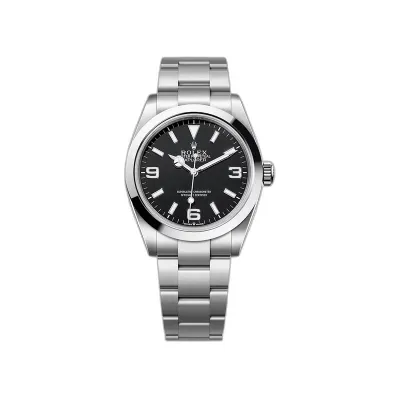
Rolex
Rolex Explorer 40 mm
Stainless steel · black dial
Ref. 224270-0001 · New
Price on request
Available to order
No watches match these filters
Try removing a filter, or ask us for the piece you are looking for.
A three-hand Rolex since 1953
Rolex introduced the Explorer in 1953, the year Edmund Hillary and Tenzing Norgay reached the summit of Everest on an expedition Rolex had equipped with Oyster watches. Reference 6350 was the first to carry the word Explorer on the dial. The recipe has barely changed since: a steel Oyster case, a black dial with 3, 6 and 9 numerals, a Mercedes hour hand and nothing else. There is no date and no rotating bezel.
Well-known references came along the way, such as the 1016 (1960 to 1989) and the 14270, which introduced the sapphire crystal.
36, 39 or 40 mm: telling the references apart
Size is what has changed most. In 2010 the 214270 grew to 39 mm, and it stayed that way until 2021. That year Rolex returned to the original 36 mm with the 124270, alongside a Rolesor version in steel and gold, the 124273. In 2023 came the 224270, at 40 mm and 11.6 mm thick.
The 36 and 40 mm models share the automatic calibre 3230, with around 70 hours of power reserve, the black 3-6-9 dial and 100 metres of water resistance. If you are torn between them, look at the lug width: 19 mm on the 36 and 21 mm on the 40. Our Rolex Oyster Perpetual guide compares it with Rolex’s other simple three-hand watches.
Explorer II: the orange 24-hour hand
The Explorer II arrived in 1971 as reference 1655, designed for cavers and speleologists who needed to tell day from night without seeing the sun. Hence the 24-hour hand, orange on the first model, and the fixed bezel graduated in 24 hours.
The 226570 of 2021 measures 42 mm and uses calibre 3285, with 70 hours of power reserve and a second time zone. It was launched with a black or a white dial, the latter known as the “Polar”. If what you really want is a watch built for travelling across time zones, compare it with the Rolex GMT-Master II.
What to check before you choose
Check the full reference: in photographs the 214270, 124270 and 224270 look very alike, and the difference lies in the size. Each watch page gives the reference, the condition, the specifications and whether a certificate is included, and you can ask us for photos of the piece itself. Every watch is price on request. Browse all our Rolex watches or, if the Explorer you want is not listed, request a model.
Questions about Rolex Explorer
What is the difference between the Explorer and the Explorer II?
The Explorer is a time-only, three-hand watch with a black 3-6-9 dial, made in 36 or 40 mm with calibre 3230. The Explorer II, first released in 1971, is 42 mm, has a date, an orange 24-hour hand and a fixed bezel marked in 24 hours, and uses calibre 3285. Both are water resistant to 100 metres.
Explorer 36 or Explorer 40?
Inside, they are the same watch: calibre 3230, around 70 hours of power reserve, a black dial with 3, 6 and 9 numerals and 100 metres of water resistance. The size is what changes. The 124270 of 2021 brought back the 36 mm of 1953 and has 19 mm between the lugs; the 224270 of 2023 is 40 mm, with 21 mm lugs.
Why is the white Explorer II called the “Polar”?
It is an enthusiasts’ nickname for the white-dial version, which is the -0001 suffix of reference 226570; the black dial is -0002. Both have the orange 24-hour hand. On the white dial, the metal of the hands and hour markers is coated black so they stand out clearly against the pale background.