TAG Heuer watches
Our TAG Heuer selection currently includes 6 watches (Aquaracer, Autavia, Carrera and Formula 1). Every piece is available to order, with prices on request. If you are looking for another TAG Heuer model, request it and we will tell you whether we can source it.
6 watches
TAG Heuer
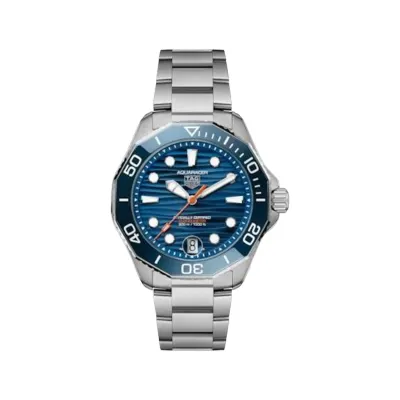
TAG Heuer Aquaracer 42 mm
Ceramic and stainless steel · blue dial
Ref. WBP5111.BA0013 · New
Price on request
Available to order
TAG Heuer
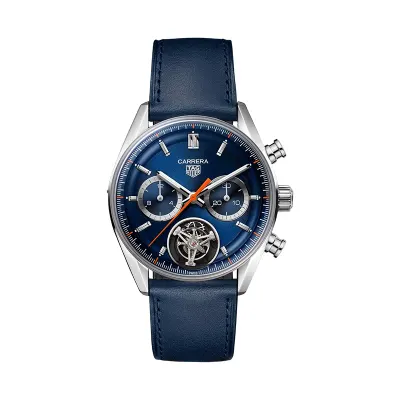
TAG Heuer Carrera 42 mm
Stainless steel · blue dial
Ref. CBS5010.FC6543 · New
Price on request
Available to order
TAG Heuer
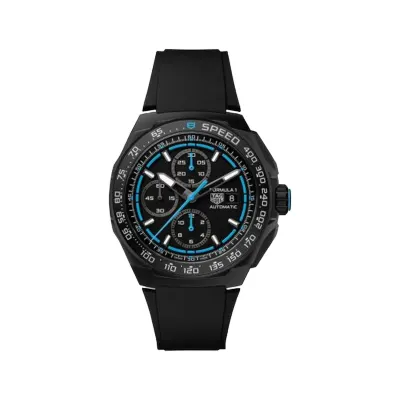
TAG Heuer Formula 1 44 mm
Titanium and aluminium · black dial
Ref. CBZ2084.FT8097 · New
Price on request
Available to order
TAG Heuer
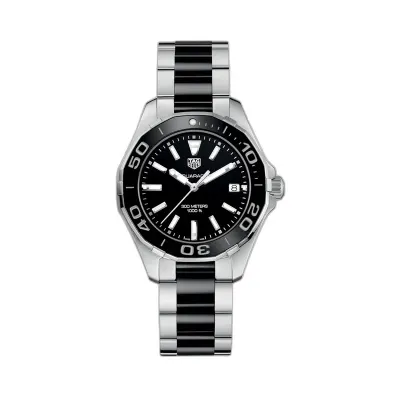
TAG Heuer Aquaracer 35 mm
Ceramic and stainless steel · black dial
Ref. WAY131A.BA0913 · New
Price on request
Available to order
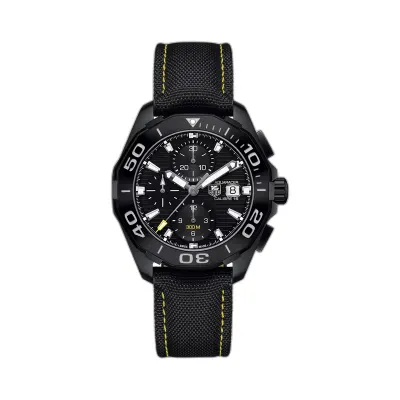
TAG Heuer
TAG Heuer Aquaracer 43 mm
Titanium and ceramic · black dial
Ref. CAY218A.FC6361 · New
Price on request
Available to order
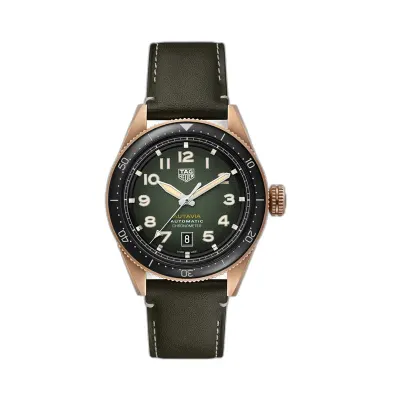
TAG Heuer
TAG Heuer Autavia 42 mm
Bronze and stainless steel · green dial
Ref. WBE5190.FC8268 · New
Price on request
Available to order
No watches match these filters
Try removing a filter, or ask us for the piece you are looking for.
From Saint-Imier to the chronograph
Edouard Heuer opened his workshop in Saint-Imier in 1860, aged 20, and the firm’s early milestones are tied to the chronograph. In 1869 a patent allowed it to make its first crown-wound pocket chronographs, with no separate key. In 1887 came the oscillating pinion, which changed the way chronographs were built. In 1911 Heuer created the Time of Trip, the first dashboard timer for cars and aircraft, and in 1916 it presented its first stopwatch able to measure hundredths of a second. Heuer stopwatches were used at the 1920 Antwerp Olympics.
Autavia, Carrera and Monaco
That link with speed gave its models their names. The TAG Heuer Autavia appeared in 1933 as an instrument for pilots and rally drivers, and in 1962 it became a wrist chronograph. The TAG Heuer Carrera, from 1963, takes its name from Mexico’s Carrera Panamericana. And in 1969 the Monaco arrived with the Calibre 11, one of the first automatic chronograph movements, developed by Heuer with Breitling, Hamilton-Büren and Dépraz, now Dubois-Dépraz. It was presented on 3 March that year, simultaneously in Geneva and New York, and placed the crown at 9 o’clock, opposite the pushers. In 1971 Steve McQueen wore a Monaco in the film Le Mans.
From Heuer to TAG Heuer
In 1985 the Techniques d’Avant-Garde (TAG) group bought Heuer, and in 1986 the company was renamed TAG Heuer, the same year it launched the TAG Heuer Formula 1 collection. The brand is part of LVMH. In 2015 it introduced the TAG Heuer Connected, which it describes as the first Swiss luxury smartwatch.
Alongside the Carrera, Monaco, Autavia and Formula 1, the brand has a dive watch line, the TAG Heuer Aquaracer. Its roots lie in the Heuer 844 of 1978, and the Aquaracer name first appeared in 2004. To place TAG Heuer among the other houses, see our guide to luxury watch brands.
What to look at in a TAG Heuer
With a TAG Heuer, look first at the movement, because a single collection can include quartz, solar and automatic models, and then at the era: pieces from before the 1986 name change carry the Heuer signature. Each listing shows the reference, the condition, the specifications and whether a certificate is included. The image is the reference picture for the model, so you can ask us for photos of the watch itself. And if the model you want is not listed, you can ask us for it.
Questions about TAG Heuer
What does TAG stand for in TAG Heuer?
Techniques d’Avant-Garde, the group that bought Heuer in 1985. A year later, in 1986, the company was renamed TAG Heuer and launched the Formula 1 collection. Until then, from 1860 onwards, the watches carried only the founder’s surname, Edouard Heuer, which is why earlier pieces are known simply as Heuer.
What is the Calibre 11?
It is one of the first automatic chronograph movements. Heuer, Breitling, Hamilton-Büren and Dépraz, now Dubois-Dépraz, developed it together, and it was presented on 3 March 1969, simultaneously in Geneva and New York. It combined a micro-rotor base with a chronograph module and placed the crown at 9 o’clock. Heuer fitted it to the Monaco, the Carrera and the Autavia.
Where does the Carrera name come from?
From the Carrera Panamericana, a motor race held in Mexico. Heuer introduced the Carrera chronograph in 1963, when Jack Heuer, the founder’s great-grandson, was already at the company, having joined in 1958. Like the Autavia and the Monaco, it is one of the brand’s watches tied to motor racing.
TAG Heuer guides
All articles
Luxury Watch Brands: A Guide to the Great Houses
Rolex, Patek Philippe, Audemars Piguet, Vacheron Constantin, A. Lange & Söhne, Richard Mille and more: origins, key collections and what sets each apart.