TAG Heuer Autavia
We currently have one TAG Heuer Autavia watch. It is available to order, with the price on request.
1 watch
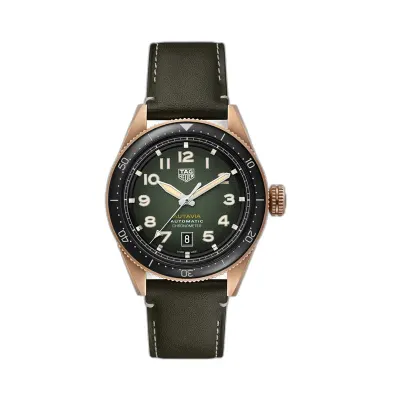
TAG Heuer
TAG Heuer Autavia 42 mm
Bronze and stainless steel · green dial
Ref. WBE5190.FC8268 · New
Price on request
Available to order
No watches match these filters
Try removing a filter, or ask us for the piece you are looking for.
From dashboard instrument to wristwatch
The name Autavia combines two words, automobile and aviation. Heuer used it from 1933 for dashboard timers made for aircraft and rally cars. In 1962 Jack Heuer brought it to the wrist: the Autavia was the first wrist chronograph with a rotating bezel. Drivers such as Jochen Rindt, Jo Siffert and Mario Andretti wore it, which is why some references are known by a driver’s name, such as the 2446 “Rindt”.
The 2017 re-edition and the 2019 collection
In 2017 TAG Heuer revived the Autavia with a re-edition of the 1966 reference 2446 “Rindt”, whose design came out of the Autavia Cup, a process in which enthusiasts had their say. The case went from 39 to 42 mm and the movement was the Heuer 02 chronograph with an 80-hour power reserve; the black 12-hour bezel and the black dial with white counters were kept.
Baselworld 2019 brought a different collection: three-hand watches with the date at 6 o’clock and the air of an aviation instrument, with a 42 mm case, an oversized crown and a propeller engraved on the case back. They came in steel and in bronze, the bronze versions with a titanium case back so the patina would not stain the skin. The bidirectional rotating bezel had a ceramic insert, except on one reference with a steel bezel, and the smoked dials, lighter towards the centre, ranged from grey to blue, black, brown and green. Inside was the automatic Calibre 5, a COSC-certified chronometer, with Isograph, a carbon-composite hairspring made by TAG Heuer. All were water resistant to 100 m. In 2020 the brand went back to a conventional hairspring, and “Automatic” replaced “Isograph” on the dial.
In 2022, for the 60th anniversary, two 42 mm Autavia Chronometer Flyback models joined the range, with a chronometer-certified Heuer 02.
How to tell an Autavia apart
First decide whether you are after a chronograph or a three-hand watch: the 1960s Autavias, the 2017 re-edition and the 2022 Flyback models are chronographs; the 2019 models are not. On those, the dial tells you whether the Isograph hairspring is inside. Then consider the material, because bronze develops a patina with wear and each watch takes it on in its own way. Each listing shows the reference, the condition, the specifications and whether a certificate is included, and you can ask us for photos of the watch itself to see the state of the bronze.
To explore the brand further, see the TAG Heuer Carrera, the TAG Heuer Formula 1 or all our TAG Heuer watches. The history of the house is in our luxury watch brands guide.
Questions about TAG Heuer Autavia
Is the TAG Heuer Autavia a chronograph?
It depends on the era. The wrist Autavias that Heuer made from 1962 were chronographs, as were the 2017 re-edition with the Heuer 02 calibre and the 2022 Chronometer Flyback models. The collection launched in 2019 took a different route: three-hand watches with a date, 42 mm across, powered by the automatic Calibre 5 with chronometer certification.
What does Autavia mean?
It is a blend of two words, automobile and aviation. Heuer used the name from the 1930s for dashboard timing instruments made for rally cars and aircraft, and in 1962 it moved it to a wrist chronograph with a rotating bezel. That is why the Autavia mixes the traits of a racing watch and a pilot’s watch.
Why do the bronze Autavias have a titanium case back?
Bronze develops a patina with wear and time, and against the skin it can leave greenish marks. On the bronze versions of the 2019 collection, TAG Heuer made the case back in titanium to prevent this, so the patina forms on the case without the bronze touching the wrist.